Bulletin No. 110

Posted by: Editors  :  Category: News & Articles

THE HELLENIC LINK, Inc.logo

EllinikosSyndesmosBlack

Member Update- BULLETIN

Editorial Committee: Ahilleas Adamantiades, Alex Economides, Dean C. Lomis, Katherine Efthymiatou-Stabile, Contributing Editor: Evangelos Calamitsis, Assoicate Editor: John Angelidis; Acting Editor: Costas Efthymiou

No. 110, September-October 2013

A Special Meeting of the Athens Hellenic Link Section

In order to inform the entire membership of the Hellenic Link, we bring in this issue the proceedings of a Special Meeting held recently in Athens, Greece by the local HL- members who convened to welcome and hear the visiting president of the Hellenic Link. In deference to our Athenian colleagues, we present this report in the Greek language in which the Meeting was conducted.


ΕΚΤΑΚΤΗ ΣΥΝΑΝΤΗΣΗ ΤΟΥ ΕΛΛΗΝΙΚΟΥ ΣΥΝΔΕΣΜΟΥ ΑΘΗΝΩΝ


Την 30ην Σεπτεμβρίου 2013, με την ευκαιρία διέλευσης του  προέδρου του Ελληνικού Συνδέσμου Κώστα Ευθυμίου από την Αθήνα, πραγματοποιήθηκε συνάντηση μελών και φίλων του Συνδέσμου που φιλοξενήθηκε στην Τάξη Θετικών Επιστημών της Ακαδημίας Αθηνών (Γραφείον Ακαδημαϊκού  Γεωργίου Κοντοπούλου). Παρόντες εκτός του προεδρεύοντος κ. Κοντοπούλου ήταν και οι Ακαδημαϊκοί κ.κ. Λουκάς Χριστοφόρου και Αντώνης Κουνάδης (πρόεδρος του πολιτισμικού οργανισμού “Ελληνική Γλωσσική Κληρονομιά”), καθώς και ο Ομότιμος Καθηγητής Φιλοσοφικής Σχολής Πανεπ.. Αθηνών κ.Γεώργιος Μποζώνης. Σκοπός της συνάντησης ήταν η παρουσίαση εκ μέρους του προέδρου του Ε.Σ. της παρούσης φάσης των δραστηριοτήτων του Συνδέσμου, συζήτηση επ’ αυτών, και ελεύθερη έκφραση εισηγήσεων για την περαιτέρω ανάπτυξή των.

Αρχίζοντας, ο K. Ευθυμίου ευχαρίστησε τον κ. Κοντόπουλον για την φιλόφρονα φιλοξενία του και την συνεχιζόμενη στήριξη της συνεργασίας μεταξύ των μελών του Συνδέσμου που βρίσκονται στις δύο πλευρές του Ατλαντικού. Ακολούθως, ανεφέρθη στα στάδια εξέλιξης των κάτωθι συλλογικών δραστηριοτήτων του Συνδέσμου:

  • Το θέμα των Κανόνων (Standards) Διδασκαλίας της Νεο-Ελληνικής Γλώσσας στα σχολεία της επικράτειας των ΗΠΑ βαίνει κατ ευχήν προς ολοκλήρωσή του. Η με πρωτοβουλία του ΕΣ σχηματισθείσα εξ εκπαιδευτικών δωδεκαμελής Ομάδα Εργασίας προς  τον σκοπόν της διατύπωσής των Κανόνων, μετά σύντονη εργασία δύο και πλέον ετών, υπέβαλε  προσχέδιον εις τον Αμερικανικό εκπαιδευτικό φορέα American Council for the Teaching of Foreign Languages (ACTFL) τον Νοέμβριον του 2012. Συντονίστρια της Ομάδας Εργασίας είναι η Vasiliki Tsigas-Fotinis, D.Ed., μέλος του Συμβουλίου Παιδείας του ΕΣ. Μετά τον Νοέμβριον 2012, το σχέδιον βρίσκεται κάτω από την εκδοτικήν επεξεργασίαν του φορέα, και, από του θέρους 2013, σε διαβούλευση προς βελτίωσιν και συμπλήρωσίν του: ο Διευθυντής Παιδείας του ACTFL μαζί με την Ομάδα Εργασίας έκαναν έκκληση σε ινστιτούτα, πανεπιστημιακές σχολές, και σε ειδικούς γλωσσολόγους που καταγίνονται με την διδασκαλίαν της Νεο-Ελληνικής Γλώσσας να συνεισφέρουν από τις γνώσεις τους προς τον σκοπόν αυτόν. Εθεσαν, μάλιστα, χρονικά όρια δια την βελτίωσιν συγκεκριμένων τμημάτων του Σχεδίου. Σύμφωνα με τα όρια αυτά, αναμένεται η συνολική συμπλήρωση των Standards μέχρι July1, 2014. Εάν τα όρια τηρηθούν, τα Greek Standards θα κυκλοφορήσουν επίσημα κατά το Ετήσιο Συνέδριο του ACTFL, τον Νοέμβριον 2014. Είναι πιθανόν να εκδοθούν πρώτα σε ψηφιακή (digital) μορφή (CD), προτού ενσωματωθούν στον μεγάλο τόμο που περιέχει τα Standards διδασκαλίας όλων των εγκεκριμένων  ξένων γλωσσών που διδάσκονται στα Αμερικανικά σχολεία και σχολές.

Σε παρέμβασή του, ο Ακαδημαϊκός κ. Κουνάδης παρετήρησε ότι η εισαγωγή της διδασκαλίας της Νεο-Ελληνικής γλώσσας στην Αμερικανική εκπαίδευση προϋποθέτει και την έκδοση και χρήση σχολικών βιβλίων βασισμένων στα εισαγόμενα δια πρώτην φοράν Greek Standards. Ο πρόεδρος του ΕΣ συμφώνησε και επεξήγησε ότι η εισαγωγή των Greek Standards είναι βασική υποδομή και το πρώτο βήμα μόνον για την ανάπτυξη Ελληνικών Σπουδών σε δημόσιο και ιδιωτικό πλαίσιο. Θα πρέπει να ακολουθηθεί από άλλες βασικές βελτιώσεις, όπως η ανάπτυξη συνεργασίας μεταξύ των Ελληνιστών εκπαιδευτικών και της Αμερικανικής κοινότητος, διά να δημιουργηθούν ευάριθμοι τάξεις μαθητών, που είναι απαραίτητος οικονομικός όρος λειτουργίας κάθε εκπαιδευτικού προγράμματος και πρόσληψης διδασκόντων. Εξ άλλου, θα πρέπει να δημιουργηθεί πρόγραμμα εκπαίδευσης δοκίμων διδασκάλων (certified teachers) διά τα Ελληνικά curricula σε ένα, τουλάχιστον, Αμερικανικό κολέγιο ή πανεπιστήμιο. Προς το παρόν, δεν υπάρχει ούτε ένα με τέτοιο πρόγραμμα στην Αμερικανική Συμπολιτεία. Ο κ. Κουνάδης, ως ειδικός και μη πολιτικον μέλος της Διακομματικής Επιτροπής της Βουλής των Ελλήνων, επιφορτισμένης με την νομοθετικήν επίλυσιν προβλημάτων που απασχολούν τον Ομογενειακό Ελληνισμό — μεταξύ αυτών η Παιδεία και Ελληνομάθεια, προσκάλεσε τον ΕΣ να ετοιμάσει και υποβάλει δι’ αυτού εις την Επιτροπήν πρότασιν νομοθετικής ρύθμισης που θα μπορούσε να συμβάλει σημαντικά στην αξιοποίηση της έγκρισης Ελληνικών Σπουδών διά τα Αμερικανικά σχολεία και σχολές. Ο πρόεδρος του ΕΣ ανέλαβε να παρουσιάσει την εισήγησιν του κ. Κουνάδη στο ΔΣ και το Συμβούλιον Παιδείας του ΕΣ.

  • Στη συνέχεια, ο πρόεδρος του ΕΣ συνέστησε στην ομήγυρη την  Φιλόλογον καν Μαρίαν Κεκροπούλου και τον Μαθηματικόν κον Θεόδωρον Πετρέσκου, καθηγητάς του Προτύπου Πειραματικού Σχολείου Πανεπιστημίου Αθηνών. Οι δύο εκπαιδευτικοί πήραν προ καιρού την πρωτοβουλίαν να ζητήσουν την μεσολάβηση του ΕΣ για την επίτευξη επαφής και ερευνητικής συνεργασίας μεταξύ ομάδων μαθητών του Σχολείου των και αντιστοίχων ομάδων μαθητών Αμερικανικού λυκείου. Δύο λύκεια στην Νέα Υόρκη, το Forest Hill High School και το W.C.Bryant High School, εξεδήλωσαν ενδιαφέρον συμμετοχής εις το προτεινόμενο από το ΠΣΠΑ project και ήδη άρχισαν να αλληλογραφούν. Η επικοινωνία διεξάγεται ηλεκτρονικά, με ηλεκτρονικό ταχυδρομείο και τηλεδιάσκεψη.


Με προτροπήν του Προέδρου Ευθυμίου, οι καθηγητές του ΠΣΠΑ ανέλυσαν το σκεπτικόν του είδους συνεργασίας που επιζητούν να πραγματοποιήσουν. Η κοινή έρευνα που προτείνουν αφορά πολιτισμικά θέματα: “Μαθηματικά και Πολιτισμός” και ιστορική έρευνα επάνω σε θέμα Βυζαντινού Πολιτισμού. Απήντησαν σε πολλές ερωτήσεις που τους απηύθυναν οι συμμετέχοντες στην συνάντηση. Στη  συζήτηση διεπιστώθη ότι μεταξύ των μελών του ΕΣ στην Αθήνα υπάρχει ενδιαφέρον να διευκολύνουν ανάλογες μορφωτικές ανταλλαγές και άλλων προτύπων Αθηναϊκών λυκείων. Η κα Ευαγγελία Γεωργουλέα επρότεινε συμμετοχήν του Αρσακείου και του Λυκείου της “Ελληνικής Παιδείας.” Στο σημείο αυτό, ο πρόεδρος του ΕΣ συνέστησε στους ενδιαφερομένους να διατηρήσουν ενημερωτική επαφή με τους παρόντες καθηγητές του ΠΣΠΑ και μετά κατάλληλη προετοιμασία να ζητήσουν από το Συμβούλιον Παιδείας του ΕΣ στην Νέα Υόρκη να προβεί σε ενέργειες προς ανεύρεσιν ταιριαστών Αμερικανικών σχολείων διά συνεργασίαν.


  • Διά το project συγγραφής βοηθήματος θεματικής (modular) διδαχής του Βυζαντινού Πολιτισμού σε σχολεία μέσης παιδείας των ΗΠΑ, ο καθηγ. Ευθυμίου εξήγησε ότι στηρίζεται κυρίως στην συνεργασία Βυζαντινολόγων και Εκπαιδευτικών του ΕΣ (USA) και ομάδας ερευνητών του Εθνικού Ιδρύματος Ερευνών (EIE ) της Ελλάδος. Οι εν Ελλάδι συνεργάτες κατευθύνονται από τον Διευθυντήν του Ινστιτούτου Ιστορικών Ερευνών του ΕΙΕ, καθηγ. της Φιλοσοφικής Σχολής του Εθνικού και Καποδιστριακού Πανεπιστημίου Αθηνών κ.Ταξιάρχην Κόλιαν, και συντονίζονται από τον ερευνητήν του ΕΙΕ κ.Γεράσιμον Μέριανον ο οποίος παρίσταται στην σημερινή μας συνάντηση. Στο σημείο αυτό έλαβεν τον λόγον ο κ. Μέριανος και ανεφέρθη στην προέλευση και οργάνωση του project, έδωσε τους τίτλους των κεφαλαίων, ονόματα των αντιστοίχων συγγραφέων, και απήντησε σε ερωτήσεις. Πρόσφατα, ελήφθη απόφαση να επισπευθεί η υποβολή των χειρογράφων ώστε να προχωρήσει η παιδαγωγική προσαρμογή των. Τέλος ανεφέρθη η συνεχιζόμενη συλλογική προσπάθεια επίτευξης χορηγίας, απαραίτητης για την υλοποίηση της σχεδιαζομένης έκδοσης. Εις το πλαίσιο της ζωτικής σημασίας προσπάθειας αυτής, ο Ακαδημαϊκός κ. Λουκάς Χριστοφόρου συνέστησε υποβολήν αίτησης χορηγίας σε συγκεκριμένα κοινωφελή ιδρύματα.. Ο κ. Κοντόπουλος ετόνισε την ανάγκη να πραγματοποιηθεί το εκπαιδευτικό αυτό εγχείρημα. Το όλον project επιμελείται ο Dr. Constantine Hatzidimitriou, Βυζαντινολόγος, διοικητικό στέλεχος του Department of Education, NY City, μέλος του Συμβουλίου Παιδείας του ΕΣ.


  • Ο Πρόεδρος του ΕΣ πληροφόρησε ακόμη τους παρόντες για την προσπάθεια αναβάθμισης του πληροφοριακού δελτίου (HL Bulletin) που αναλήφθηκε από το Συμβούλιο Παιδείας, ιδιαίτερα από τον Associate Editor Dr.John Angelidis, προ τριών μηνών. Για την επίτευξη του δύσκολου αλλά ζωτικού αυτού στόχου αποφασίσθηκε η διεπιστημονική διεύρυνση της Συντακτικής Επιτροπής (Editorial Committee) του δελτίου. Σκοπός είναι να αναδειχθεί το HL Bulletin έγκυρο πληροφοριακό μέσο που θα παρουσιάζει ποικίλα θέματα, ενδιαφέροντα τον Ελληνισμό, και θα διαφωτίζει τους αναγνώστες στον μεγαλύτερο δυνατόν βαθμό ωφελιμότητας και αποδοχής. Τα κάτωθι  μέλη και συνεργάτες του ΕΣ Αθηνών ανταποκρίθηκαν στην πρόσκληση συμμετοχής στην Συντακτική Επιτροπή: ο κ.Χρήστος Ευθυμιόπουλος, αστροφυσικός, ερευνητής της Ακαδημίας Αθηνών, ο κ. Γεράσιμος Μέριανος, Βυζαντινολόγος του ΕΙΕ, ο κ.Αλέξανδρος Οικονομίδης, Ηλεκτρολόγος Μηχανικός, και ο κ. Παναγιώτης Σίσκος, Χημικός, Ομότιμος Καθηγητής Πανεπιστημίου Αθηνών. Ολοι μας εκφράζουμε  ευγνωμοσύνη στους νέους συνεργάτες για την πολύτιμη εθελοντική προσφορά τους.


  • Έγινε τέλος υπόμνηση ότι στο τρέχον ακαδημαϊκό έτος συμπληρώνεται η τριετής θητεία του παρόντος ΔΣ του Συνδέσμου, και ότι την προσεχή ανοιξη 2014 θα γινει εκλογή νέου ΔΣ. Σχετικά, ζητήθηκε η συνεργασία των μελών του ΕΣ Αθηνών Ελλάδος στην διεργασία αυτή ώστε να εξασφαλισθεί μελλοντικά η σταθερή πρόοδος του Συνδέσμου στην εφαρμογή του Καταστατικού του. Ο Πρόεδρος ανέλαβε να μεταφέρει προς επίλυση στο ΔΣ ορισμένες δυσκολίες που αντιμετωπίζουν τα εν Αθήναις μέλη του ΕΣ, που του ανεφέρθησαν.

Report received 10/11/2013


In Defense of Our Ethnic Minority in T urkey :

Dear friends and colleagues:

Because of your interest, I am forwarding to you the two papers I presented at the recent OSCE Conference on the Human dimension in Warsaw, Poland. They are now posted on the OSCE web page and are public knowledge. My fellow Archon Fanis Economides was not able to join me in this mission, owing to illness in the family, but the papers are a joint effort with information received from multiple sources. You may forward them as you see fit. Your comments would be welcomed.

Best regards,

Achilleas


The Status and Issues of the Greek-Orthodox Minority in Turkey

The Organization for Security and Cooperation in Europe (OSCE)

2013 Human Dimension Implementation Meeting – Warsaw, Poland

Working session 2: Tolerance and non-discrimination:   24 September 2013

Presented on Behalf of the Order of St. Andrew

by

Dr. Achilles G. Adamantiades, Archon Protector of Letters

A.               Introduction

1.            This presentation focuses on the need for protection of the rights of the Greek-Orthodox minority of Turkey and, by extension, of all religious minorities in Turkey.  We are aware of the important fact that a process of reform has been initiated and is proceeding. A most important process has been initiated to write a new Constitution for the Turkish state which is making significant progress. We are also aware of the fledgling democratic-reform package that is being finalized and of the process to write a new Constitution for the Turkish state. However, it is worrisome to observe that democratic reforms have been put on hold or regressed during the last two years.

B.               Violations of the Human Rights of Minorities

2.            Over the past several years, serious violations of the human rights of minorities have been reported although the constitution of the Turkish state explicitly prohibits discrimination on religious grounds. The Order of St. Andrew (the Order) strongly associates itself with the 2013 Report of the United States Commission on International Religious Freedom (USCIRF).  This report offers a thorough and objective account of the status of religious freedom in Turkey and provides a detailed list of the many violations of the rights of minorities. However, the Order does not feel that enough progress was made in the past year to warrant the removal of Turkey from the list of Countries of Particular Concern (CPC)[1] as was the case in the previous year.[2]

3.            More specifically, while giving credit to actions by the current Government of Turkey, including the process of constitutional and other reforms, we are painfully conscious that a practice of property confiscation, under various pretexts, was evident in the past 100 years, especially against the Ecumenical Patriarchate and its associated Greek-Orthodox foundations. This practice stripped from the foundations the resources necessary for them to adequately fulfill their role in the world. The following summarize these violations.

(a) Legal personality has been denied the Ecumenical Patriarchate, together with other churches and faiths, including the Roman Catholic Church, the Armenian Church, and the Jewish faith, making them unable to own and manage property in spite of many protests against and denouncements of this practice by the Venice Commission,[3] representatives of the European Union, and the U.S. State Department.[4]

(b)    For almost 100 years, the government has imposed a variety of onerous restrictions on all religious minorities affecting their ability to own, maintain, and transfer communal and individual property; in addition, heavy interference with their internal governance and even outright prohibition in the training of clergy was applied. As a result, their numbers have diminished, threatening their sustainability.

(c)    Members of religious minorities continue to face threats and societal discrimination and occasional violence,[5] on the basis of their religious and/or ethnic minority status.

The Fate of the Greek-Orthodox minority of Turkey

4.               Interference with the management of minority Foundations. The USCIRF Report for 2012 highlights in detail the plight of minorities.[6] The main instrument of the Government’s interference has been through a rigid and tight control by the General Directorate of Foundations (GDF or VGM by the Turkish language initials or Vakiflar)[7] over the day-to-day management of Greek-Orthodox foundations. The principal way GDF has restricted their self-management has been the practice of “seized foundations” (mazbut vakıf) whereby the GDF takes over the management of foundations deemed to “no longer be of charitable or practical use.” A principal way of this unacceptable interference has been the policy that disabled foundations from holding regular board elections. For example, candidates running for board elections are required to reside in the district where the foundation is located, which effectively precludes elections for many foundations that are located in areas with very few Greek-Orthodox residents. This interference is a direct violation of article 40 of the Lausanne Treaty.

5.           As a result of these policies, GDF has seized, since the 1970s, 17 Greek Orthodox foundations, taking over their management and confiscating hundreds of properties belonging to them. Further interference was manifested when state policies disabled foundations from holding regular board elections; the ad hoc, arbitrary, and unpredictable nature of the imposed election system has been criticized by the Greek-Orthodox minority as a serious impediment to their autonomy.

6.            Altogether, a policy of unremitting harassment over the past sixty (60) years has driven down the Greek-Orthodox population of Turkey from over 100,000 in the 1950’s to about 2,500 at present. The recorded demographic and economic decline, as well as the dramatic reduction in property owned by minorities over the years, offer unequivocal proof of the deep and persistent strategy of oppression and persecution of the Greek-Orthodox and other ethnic/religious minorities by the Turkish Government.  Nevertheless, in this paper, we will now focus on positive developments.

C.               Positive Developments

7.            During the past year, the Government of Turkey has continued its path toward reform and strong, albeit incomplete, measures to strengthen democracy and the rule of law.  The main accomplishments, from our perspective, have been: (i) decisive measures to establish civilian authority over the military; (ii) paying attention to the issues of ethnic and religious minorities; (iii) a decisive  move against the clandestine, ultranationalist groups (e.g., Ergenekon), which has threatened religious leaders, including the Ecumenical Patriarch; and (iv) announcements to return confiscated properties or provide fair compensation.

8.            The Order of St. Andrew is in the position to note specific positive moves and gestures by the government in recent years although these have generally been ad hoc moves rather than permanent legal reforms (with some exceptions, i.e., the 2008 Law on Foundations). We cite below a few of these positive developments:

(a)    The Return of the Prinkipos (Büyükada) Orphanage building, following much litigation and judgments by the European Court of Human Rights (ECHR) to which Turkey is a contracting party. The ECHR judgment was implemented by the issuance of an order by the Court of Büyükada which produced, in late November 2010, a deed for the property in the name of Rum Patrikhanesi.[8]

(b)    Restoration of property rights. In March 2011, Turkey implemented the ECHR judgment of March 2009 on the property rights of the Greek-Orthodox minority foundation of the island of Bozcaada (“Kimisis Theodokou Greek Orthodox Church” of Tenedos) by transferring the property titles to its name.

(c)     Permission for religious ceremonies. During 2013, as in the three previous years (20012, 2011 and 2010), the Government allowed the conduct of annual religious worship services at the Sümela Monastery near Trabzon, on the Black Sea, as well as in other religiously significant sites.  The order of St. Andrew believes that international practice and human rights conventions dictate that religious shrines of all faiths should be returned to their rightful owners and services should be conducted as frequently as desired without interference; rather, the state should provide protection against interference.

(d)    The Decree of 27-August-2011[9] on property return or compensation. This decree is a major development on which we shall devote the balance of this paper.

(e)    The Council of Foundations  — part of Turkey’s Directorate General for Foundations (VGM) — returned 190 hectares of forest to the Greek Orthodox Halki (Heybeliada) Seminary.[10] This forested land will be given to the seminary’s owner, the Aya Triada Monastery Foundation. This is the biggest property return to a minority group in the history of Turkey.

D.           The Decree on Property Return or Compensation

9.            As background on this issue we state that massive property confiscations have been among the top grievances of minority Greek-Orthodox foundations as well as of other religious minorities. These confiscations concerned mainly churches, monasteries and cemeteries.

10. On 28-August-2011, Prime Minister Erdoğan announced a Decree, issued the previous day, 27-August-2011, adding a new transitional article (No. 11) to the 2008 Foundations Law in force. The new article   enables minority foundations to apply for return of their properties that had been expropriated by the state. The new article also allows application for their return, or for fair compensation in the case that properties were sold to a third party. The Decree also provided for the formation of new religious community foundations in order to correct oversights in the 1936 law.  The Decree came to remedy minority foundations property questions that had not been addressed by the 2008 Law of Foundations. Parties interested in the return of confiscated properties were invited to submit the relevant documentation to the Directorate General of Foundations (DGF, or VGM, by the Turkish initials) within 12 months.

11.          The provisions of the Decree are: (i) the restitution of properties as they were surveyed and registered in 1936 and subsequently confiscated from the religious foundations by the various administrations of the Republic of Turkey; (ii) the return of cemeteries belonging to non-Muslim foundations which had been improperly placed under the control and management of various towns and municipalities; (iii) the restitution of undefined deeded property (such as monasteries, parishes, and schools), which were never recognized as legal entities by the Turkish Republic; and (iv) the Minister of Finance of the Republic of Turkey will establish, with the owners, a just compensation in the event that these properties have been sold or disposed of in various ways by the Turkish state.

12.          It is not the intent of the Order of St. Andrew to file, in this paper, a detailed legal analysis of the Decree and its application. Such analysis is actually being done in the field by the VGM Assembly[11] which includes a member elected by the non-Muslim minorities.  Here, we wish to point out serious deficiencies that should be taken into account and properly corrected:

(a)    A deadline for the submission of restitution applications was set as one year from the Decree’s announcement. There seem to be a need for a formal extension to the original deadline.

(b)    The Decree applies to foundations only and not to religious organizations and/or institutions. This deficiency harkens back to the issue of legal personality which is lacking for these latter bodies.

(c)     The administration of the process, including the approval of applications and the valuation of properties (in case compensation is called for) is left up to VGM, the body that was the main arm of the government performing the confiscations in the first place. This is clearly a case of “conflict of interest” that should have been avoided through the appointment of an independent Commission dedicated to this important task. Furthermore, our information indicates that much of the documentation needed for the applications is in the possession of VGM and it would be up to their goodwill and spirit of cooperation to cede them to the applicants; there is no guarantee they will keep doing so.

(d)    The appeal process is flawed.  Applicants are provided with the right to appeal an unfavorable decision but the final arbiter is again the same body against which the appeal is filed. The Finance Ministry, having a strong motivation to reduce government liability, is the only body permitted to decide on the amount of compensation to be paid! This arrangement does not comply with the principle of fairness.

(e)    The Decree is narrow in scope as it does not apply to a number of property categories, as it should,  namely it does not cover:

(i)           property of the five Greek-Orthodox foundations of Gökçeada (Imvros). According to the official document of the VGM of December 2011[12], there are no copies of the 1936 declaration of these five foundations;

(ii)         property that had not been declared by the non-Muslim minorities in the inventory of 1936 (the so-called 1936 Declaration), because they had been labeled as “acquired illegally;”

(iii)        property of “seized” (“mazbut”) non-Muslim community foundations,[13] meaning those  whose administration was seized by the VGM, for various excuses, for example, because they were, allegedly, not able either to hold board elections for a certain time or to fulfill any longer their charitable purpose;

(iv)        property that may have been listed in the 1936 Declaration of a non-Muslim community foundation, but later transferred to legal entities, which are different than the State Treasury, the Directorate General for Foundations, a Municipality or City Special Administration, but still under the supervision of a public body or other foundations. Thus,  applications concerning these transferred properties may not be approved as valid;

(v)         property that was “nationalized,” which was often done in an unjust manner, amounting to “wrongful seizure;”

(vi)        properties taken away from religious institutions or communities that do not have community foundations (e.g., property that once belonged to the Roman Catholic or Anglican churches);

(vii)       certain cemeteries which, even though registered in the 1936 Declaration in the name of non-Muslim community foundations, such cemeteries were not seen as “property” and were not explicitly listed in the Declaration; and

(viii)     properties of  Muslim religious communities. This last omission has been criticized as an unjustified omission not only by these Muslim foundations themselves but also by Christian leaders.

The cases above, not covered by the Decree, are likely to be brought before the European Court of Human Rights (ECHR) and it is likely that they will win their cases.

13.            Experience to date indicates that application of the Law of 2008 on Foundations and the Decree of 27-August-2012 has been erratic and of limited effect. For example, after the 2008 amendments to the Law on Foundations went into effect, the General Directorate of Foundations (GDF or Vakiflar) received around 998 applications for the return of confiscated properties of the Greek-Orthodox minority. Between the passage of the 2008 amended law and August 2011, a total of only 68 properties were returned to Greek-Orthodox.  Since August 2011, 30 additional properties have been returned to Greek-Orthodox minority foundations, and the Vakiflar is still considering some 600 applications.  The total of 98 properties returned since 2008 represent only a small portion of the minority properties expropriated by successive Turkish governments over many years. Moreover, despite the 2008 amendments and the August 2011 decree, the Turkish government retains the legal right to expropriate land from religious communities although, in fact, it has not confiscated any since 2007.[14] A distorted interpretation of the Law of 2008, considering mere declarations of property as founding statutes of foundations, enabled VGM to confiscate all properties that non-Muslim foundations had acquired after 1936 – so, the application has been quite unsatisfactory.

E.           Request for remedies

14.      Based on the above observations, the following requests are made by the Order in consonance with such requests made by the various bodies of Greek-Orthodox minority foundations.

(a)    A new Regulation is needed concerning elections in minority foundations — the democratic process in the elections of minority foundations should not be cancelled.

(b)    VMG shall proceed to provide all necessary administrative steps for the first free elections in the Balüklı Hospital.

(c)    All the Greek-Orthodox foundations shall be granted city-wide electoral districts.

(d)    The foundations law should be amended in a way to permit the common management of two or more Greek-Orthodox foundations.

(e)    An impartial and fair judicial mechanism should be established to review the VGM’s assessment of applications for the return of properties and to annul arbitrary rejections and demands that require applicants to submit further documentation.

(f)    Close monitoring of key bureaucratic institutions such as the VGM and the land registry offices should be exercised by government to ensure that they effectively protect the foundations rights.

(g)    A follow-up circular should be issued by the P.M. office specifically calling on the VGM and land registry offices to eliminate foundation requirements for documents that do not exist or cannot be obtained.

(h)    Especially for Imvros and Tenedos (Gökçeada and Bozcaada), the government should take disciplinary sanctions against VGM bureaucrats and land registrars abusing their offices by acting beyond their powers.

F.               Conclusions and Recommendations

15.          The process of reform in Turkey is proceeding apace and is producing welcome results. The Decree of 27-August-2011 was a bold and welcome move to correct past injustice and reverse a climate of long-standing intolerance and unremitting discrimination that has prevailed in Turkey for too long; this climate, between the government and religions that have community foundations, has been greatly improved. However, close examination of the initiative shows that it was seriously flawed and incomplete in its inception and poorly implemented in practice.  A basic flaw of these provisions mentioned above is that they are not codified in law. We feel that a more effective, legally robust and practically effective system needs to be put in place if the authorities intend to see their good intensions convert fully into reality.

16.          We respectfully submit that OSCE should immediately impress upon the Government of Turkey the need to fully comply with the principles of OSCE, of which Turkey is a member, and specifically, to:

(a)    Fully adhere to the principles on the rights of expression, assembly and association, dissent, and religious faith and practice of all citizens without discrimination.

(b)    Allow full legal status for Turkey’s religious institutions (minorities), including religious leadership organs, by making all the necessary legal changes and imbed the changes into the new constitution.

(c)    Establish and defend a climate of respect, tolerance, and legitimate assistance toward the free functioning of ethnic and religious minorities and their various institutions.

(d)    Convert the Decree on the Return of Properties into a Law of the Land, and appoint a truly independent body for its oversight and implementation.  The law must correct the deficiencies that have been pointed out in the Decree, including extending property losses before 1936. The Law should also mandate full cooperation of the bureaucracy, T

(e)    Extend the deadline as needed and provide for the full implementation of the Government Decree of 27-August-2011, on the return of confiscated properties with full cooperation by VGM and its Assembly.

(f)    Appoint a Public Advocate with the necessary staff and power to assist applicants and help them work with the government (modeled after a similar institution of the European Union).

17.          The progress made in establishing reform is acknowledged. For past injustices to be amended and for solidifying respect for the rights of religious and ethnic minorities, the constitution being currently debated should incorporate their rights unequivocally in its text in a comprehensive, explicit and precise manner. We are confident, and indeed hopeful, that the constitutional reform now in progress will lead to democratic gains for the common citizen and to full respect for the rights of all faiths and people of all ethnic origins in Turkey.

Editor’s Note The second paper,“The Status and Issues of the Ecumenical Patriarchate of Constantinople”, authored by Mr. Fanis Economides and presented at the same international forum by

Dr. Achilleas Adamantiades, as explained by him in the introductory letter, will be reprinted in the HL-website due to space limitations in the Bulletin.

Cultural News & Opportunities

Έκθεση “Heaven & Earth” στην Ουάσινγκτον / Exhibition “Heaven & Earth,” Washington, D.C.


Το Μουσείο Μπενάκη, σε συνεργασία με το ελληνικό Υπουργείο Πολιτισμού και Αθλητισμού, διοργανώνει μεγάλη έκθεση με τίτλο Heaven and Earth: Art of Byzantium from Greek Collections, η οποία θα παρουσιαστεί στη National Gallery of Art, Ουάσιγκτον, από τις 6 Οκτωβρίου 2013 έως τις 2 Μαρτίου 2014.


Το άνοιγμα της έκθεσης πλαισιώσaν εορταστικές εκδηλώσεις. Την Κυριακή, 6 Οκτωβρίου 2013 και ώρα 10:00, ο Σεβασμιότατος Αρχιεπίσκοπος Αμερικής κκ. Δημήτριος ετέλεσε Θεία Λειτουργία στον ναό της Αγίας Σοφίας της Ουάσινγκτον, και την ίδια ημέρα και ώρα 14:00, στο μεγάλο αμφιθέατρο της National Gallery of Art πραγματοποιήθηκαν εναρκτήριες διαλέξεις της έκθεσης. Εμίλησαν η Δρ. Μαρία Βλαζάκη-Ανδρεαδάκη, Γενική Διευθύντρια Αρχαιοτήτων και Πολιτιστικής Κληρονομιάς, και ο καθηγητής Άγγελος Δεληβορριάς, Διευθυντής του Μουσείου Μπενάκη.


Την έκθεση συνοδεύουν δύο ξεχωριστές εκδόσεις:

1) Αναστασία Δρανδάκη, Δήμητρα Παπανικόλα-Μπακιρτζή και Αναστασία Τούρτα (επιμ.), Heaven & Earth. Art of Byzantium from Greek Collections, Υπουργείο Πολιτισμού και Αθλητισμού – Μουσείο Μπενάκη, Αθήνα 2013.


2) Ευγενία Αλμπάνη και Ευγενία Χαλκιά (επιμ.), Heaven & Earth. Cities and Countryside in the Byzantine Greece, Υπουργείο Πολιτισμού και Αθλητισμού – Μουσείο Μπενάκη, Αθήνα 2013.

Πηγή: http://www.byzantinestudies.gr/content/c17-ektheseis


By Gerasimos Merianos


On-Line Course in Modern Greek Offered Free

In cooperation with the Institute for Language and Speech Processing (ILSP)/

“Athena” Research  Center, the Hellenic Link, Inc. is offering as a service to the community a series of Greek language lessons on its Web site: http://www.helleniclink.org ( on a 24/7 schedule)

On the home page of the site, upper left corner, click on “Learning Greek,

to be introduced to a series of fifteen lessons of the philoglossia+ courseware.

Please inform anyone who would be interested in learning Greek of this service.

THE HELLENIC LINK,  Inc.

A NON PROFIT CULTURAL AND SCIENTIFIC ASSOCIATION

OF HELLENES AND PHILHELLENES

INCORPORATED IN DELAWARE

Suite No. 278, 38-11 Ditmars Blvd, Astoria, New York 11105

Web Site: http://www.helleniclink.org Email: info@helleniclink.org

Contact Telephone: (718) 217- 0430


[1] U.S. Commission on International Religious Freedom (USCIRF). 2013 Annual Report, March 2013 (Covering 1-March-2012 to 28February-2013).

[2] Order of St Andrew Newsletter, Dr. Elizabeth H. Prodromou, “The Politics of Human Rights: Orthodox Christianity Gets the Short End,” 8-May-13.


[3] Formal opinion of the 82nd Plenary Session, Venice, 12-13 March 2010. The document was issued in Strasbourg, 15 March 2010, Opinion no. 535/2009, CDL-AD (2010) 005 Or. Engl.

[4] International Religious Freedom Report for 2012, U.S. Department of State, Mid May 2013.

[5] In June 2010, Bishop Luigi Padovese, the Vicar Apostolic of Anatolia, was murdered in the city of Iskenderun while en route to join the Pope in Cyprus. Currently, the trial of the alleged assassin is on-going.

[6] USCIRF 2013 Report, Op. Cit.

[7] The term originates from “the Law on Foundations” (Vakıflar Kanunu) of 1935.  The foundations fell under the jurisdiction of the General Directorate of Foundations (Vakıflar Genel Müdürlüğü, or VGM), often referred to as Vakiflar.

[8] This is the official name for the Patriarchate used by the Government of Turkey, referring to its origins in the Roman Empire.

[9] The Decree is dated 27-August-2011 but the announcement by P.M. Erdoğan was made on 28-August-2011.

[10] Today’s Zaman, 10-January-2013.

[11] The Assembly is the highest VGM decision-making organ, with fifteen members, one of whom is chosen by the non-Muslim community foundations (since the beginning of 2009, Mr. Lakis Vingas, from the Greek-Orthodox Community, was elected to the Assembly and re-elected at the end of 2011 for a 3-year term, by the majority of the 165 non-Muslim community foundations).


[12] Document no. B.02.1.VGM.1.05.02.130.01- 99/3967/16.12.2011.

[13] A March 2009 report by the Istanbul-based TESEV Foundation, “Bir Yabancilastirma Hikayesi”, found that the number of properties seized from Greek-Orthodox community foundations alone was over 900.

[14] Y. Ktistakis, “The Remedy and Reparations towards the Greek Community of Istanbul: A fundamental Human Rights Issue,” unpublished paper.
Bulletin No. 109

Posted by: Editors  :  Category: News & Articles

THE HELLENIC LINK, Inc.logo

EllinikosSyndesmosBlack

Member Update- BULLETIN

Editorial Committee: Ahilleas Adamantiades, Alex Economides, Dean C. Lomis, Katherine Efthymiatou-Stabile, Contributing Editor: Evangelos Calamitsis, Assoicate Editor: John Angelidis; Acting Editor: Costas Efthymiou

No. 109,  July-August  2013

News from and about our Association


We are pleased to inform our readers that the colleague-new member on the Advisory Council, John Angelidis, Professor and Chairperson, Department of Management, The Peter J. Tobin College of Business, St. John’s University, has graciously accepted the appointment as Associate Editor of the Hellenic Link Bulletin. In this capacity, he will lead an effort to consolidate incremental upgrade of the quality, extent coverage of interdisciplinary topics, and improve its effective presentation. The intended goal is the circulation of an authentic informational e-medium, which hopefully will present for the highest possible enlightenment diverse topics of interest to Hellenism. Focal themes of articles to be sought and considered for publication will include Hellenic education and culture, the economy, the environment, energy issues and problems, political science studies, and ethnic concerns.

A first change about to be introduced will have the present and future members of the Editorial Committee

oversee editorially the publication of articles by Hellenic Link members or friends ellenic KLinkexperts in their fields  and also to contribute articles of their own on topics akin to their professional interests and endeavors. Editorial assignments will be further articulated by intra-committee discussions and framed as consistent policy.

All members of the Advisory Council, including those who currently are not serving as “editors,” will be called to support the Bulletin’s planned upgrading, and contribute to its publication regardless of their

residence location.


—   In the collaborative project on Byzantine Civilization, considerable articulation in planning has been attained by experts who are active participants in the field. The central feature of the project is to address educationally our society’s existing now-low knowledge and appreciation level on the role played by Byzantium in the historical development of Western Civilization. The project’s premises are scientific as well as educational; its specific goals have been defined and their attainment will be pursued by

publication of focused scientific research, coupled with an outreach educational effort. Through this combination, it is hoped that enlightenment of Byzantium’s public perception will gradually increase, as the 1,000-year historical experience and achievements of the Byzantine Empire will be elucidated, proving its value as a guiding model for tackling and solving major contemporary problems in our and other global

societies.

As with other cultural objectives pursued in previous projects, the Hellenic Link depends for the actual implementation of this Byzantine endeavor also on the voluntary collaboration of its members and that of cooperating philhellene colleagues. The conduct and management of cultural projects is overseen by the Advisory Council on Hellenic Education, which includes leading academics and professional educators. In this particular Byzantine project, they shall seek focused writings, based on scientific data, by members of the American academic/educational communities, scholars of the Greek Institute of Historical Research

( Εθνικόν Ιδρυμα Ερευνών), and members of the Association of Byzantine Studies of the U.S.A. and Canada. More details on this project, directed by Dr. Constantine Hatzidimitriou, will be forthcoming and presented in the Bulletin as future steps already planned are put into effect.


— The Hellenic Link was recently invited to assist in a special educational-exchange project in which direct collaboration on cultural and scientific subjects would bring together students of a Greek and a United States high school. The request was made by the Model Pilot Experimental School affiliated with the University of Athens (Πρότυπον Πειραματικόν Σχολείον Πανεπιστημίου Αθηνών). The HL Advisory Council gladly responded making the relevant inquiries at several U.S. high schools, and passed along information on the type of collaboration sought. Contacts with the direction and faculties of schools produced expression of interest in the proposed collaboration by two senior high schools in New York, and facilitated direct exchange of content-information and views among and between respective educators.

We believe that such an exchange-project can build bridges of friendship and understanding among participants who can benefit mutually by the cooperative research effort of both teachers and students.

The students who would carry on this project plan to communicate directly on the progress and results of their research by teleconferences. We do hope that the experience and learning to be gained in the joint endeavor will be substantive and fulfilling for all concerned; if successfully completed, we also hope and wish that it would find imitators among additional Greek and U.S. schools.


Update on the “Standards for Teaching Modern Greek” Project

In a form letter sent recently to leading Educators affiliated with organizations or institutions responsible for the teaching of the Modern Greek (MG) Language, addressed jointly by Dr. Paul Sandrock, Director of Education at the American Council on the Teaching of Foreign Languages (ACTFL) and the Task Force (TF) engaged in the project, the recipients of the letter are invited to participate in a transparent and inclusive process of reviewing the semi-final draft of “Standards for Learning Modern Greek Language in the United States,” drawn up in July 2013. The goal is “to produce the best and most useful standards for

the teaching of Modern Greek.” Attached to the letter are the Draft of Standards and a “Template” needed for revisions. The same letter also disclosed the timeline for completion of the work, which includes language-specific standards, as well as learning scenarios:

1.     By November 2013: first draft of revised language-specific scenarios;

2.     By March 2014: draft of revised language-specific standards;

3.     By July 1, 2014: finalized language-specific standards and scenarios.


The letter includes an important admonition to ACTFL’s Modern Greek Special Interest Group (SIG, already formed) to develop its strength and functionality as a forum capable to reach consensus on issues related to MG standards and their implementation.


To Educators both in the U.S.A. and Greece who are in a position to participate constructively in the above-review process, we warmly recommend their joining us. For further information, please contact:

info@helleniclink.org , Attention: Vasiliki Tsigas-Fotinis, Task Force Committee.

[ Σε Εκπαιδευτικούς των ΗΠΑ και της Ελλάδος που είναι σε θέση να συμβάλουν θετικά στην ως

άνω διεργασία, πρόθυμα και εγκάρδια συνιστούμε να το πράξουν. Για περισσότερες πληροφορίες,

παρακαλούμε να απευθυνθείτε: info@helleniclink.org, υπόψη: Vasiliki Tsigas-Fotinis.].


The Current Status of Greek Studies Abroad

For a large number of this Bulletin’s readers, it is more than a passing interest to be aware of the status of learning the Greek language and culture outside Greece, especially at this time of crisis, and just before the start of a new school/academic year. Accordingly, we wish to communicate with this issue some observations and reality checks on the existing precarious state of Hellenic Education abroad, so that the worldwide Omogeneia, including that of the United States of America, become  more conscious of the need to undertake actions that would secure preservation and growth. The economic malaise plaguing much of today’s world has affected the sector of education in general more severely, but its consequences have been felt more profoundly in programs of Hellenic Studies. A few representative examples will make the extent and significance of the problem more clearly understood.

In European countries such as Germany, where there is significant concentration of citizens of Greek origin, we hear that due to the downsizing of support from the Greek government the future of Greek schooling of the immigrants’ children and grandchildren has been placed in jeopardy.

In neighboring Switzerland, in the canton of Berne, the Council of State in the frame of its economic measures has decided to abolish the elective program of Greek in high schools. In our hands we have a Petition of the Swiss Association of Classical Philologists against this decision, signed (as of July2013) by 4184 academics and other professionals. They are all concerned about the preservation of Classical Greek Studies, appealing at the same time for support from the community for this purpose.

The traditional bastions of Greek scholarship, research and teaching, in Western Europe have not been exempted from the destructive trend against Greek Studies. The latter institutions are progressively feeling the financial pinch, currently facing great difficulties and even extinction. In the United Kingdom, an obviously upset Dean of Cambridge University finds himself in the graceless position to address the following petition to save his Modern Greek language and literature program:

“As of October 2013, the Faculty of Medieval and Modern Languages will suspend the teaching of Modern Greek as a full Tripos language on financial grounds. Cambridge is one of only three universities in the
United Kingdom which offer a full undergraduate degree course with a specialization in Modern Greek.

The Dean appealed to the public for a signature-support in order to avert the closing of the program.”

A similar disruption of Hellenic Studies is being threatened at the University of Sorbonne in Paris

(Institut Neo-Hellenique, Sorbonne). To possibly avert the disturbing development, an appeal-letter was addressed by the Societe des Etudes Neo-Helleniques to pertinent authorities; the letter, in Greek translation, is as follows:

“Το Νεοελληνικό Ινστιτούτο της Σορβόννης κινδυνεύει

Υπογράφοντας την έκκληση αυτή εκφράζουμε την εντονότατη ανησυχία μας για το μέλλον των νεοελληνικών σπουδών στο Πανεπιστήμιο της Σορβόννης, μετά τον αιφνίδιο θάνατο του καθηγητή και διευθυντή του Νεοελληνικού Ινστιτούτου Μιχάλη Λασιθιωτάκη. Παρά τις συντονισμένες προσπάθειες για την εξασφάλιση της απρόσκοπτης λειτουργίας του Ινστιτούτου (όλοι οι κύκλοι σπουδών, έρευνα, επιστημονικές εκδηλώσεις), οι αρμόδιες αρχές του Πανεπιστημίου δεν έλαβαν καμία πρωτοβουλία για την κάλυψη του κενού που δημιουργήθηκε. Οι μέχρι τώρα εξελίξεις μας κάνουν να πιστεύουμε ότι η διατήρηση της θέσης του τακτικού Καθηγητή είναι αμφίβολη και ότι δεν αποκλείεται μάλιστα η κατάργησή της.
Κάτω από αυτές τις συνθήκες ζητούμε από την Πρυτανεία του Πανεπιστημίου της Σορβόννης και από το αρμόδιο Υπουργείο να αναθεωρήσουν άμεσα τη θέση τους και να λάβουν όλα τα απαιτούμενα μέτρα που θα διασφαλίσουν τη συνέχιση του διδακτικού και ερευνητικού έργου του Νεοελληνικού Ινστιτούτου ώστε να αποφευχθεί ένα σοβαρότατο πλήγμα στις Νεοελληνικές Σπουδές στη Γαλλία.”

An urgent appeal for supporting signatures for this Petition was widely circulated via the internet.


It seems, however, that in the same Western academic environment not all cultural programs are currently manifesting a dismal outlook due to the economy, as presented above. The Turkish e.newspaper “Hurriyet

Daily News” (5/3/2013) reported that the President of Turkey was a host to a dinner at Dolmabahce Palace on5/2/2013 in honor of the Oxford University’s Islamic Studies Center. On this occasion, he remarked that “the Center had become an important academic focus in the study of Islamic culture and civilization, with an impact that resonated both in the Islamic world and outside of it.”

The Director of the Center also spoke at this event: “The Center began its activities in 1985 and was later

supported both by U.K.’s Prince Charles and Queen Elizabeth. Now in the stage of building a new campus,

the Center is known to host academicians and professors from 50 countries.”


Can Hellenism afford to observe such developments in Europe, the cradle and testing ground of its

thousands-of-years-long and proven unsurpassed civilization with apathy and inaction, without irreversible consequences?


Whereas the United States of America is slowly emerging from its recent recession, Greek studies like the entire field of education are also experiencing unavoidably an enforced frugality. Public education is suffering the most due to curtailed educational fund allocations. Academic institutions with hefty endowment funds fare, of course, much better; donations from the private sector and from alumni help maintain their academic strength.

It is remarkable, as it is very laudable that well-to-do members of the Greek American communities are among the great benefactors of American universities and colleges. It is embarrassinglysad, however, that most of the Greek-descent benefactors of American academia forget or otherwise omit to include support for Programs of Hellenic Studies, and for the only Hellenic academic institution in the country, the Holy Cross School of Theology/Hellenic College; most of the sizable support given to such educational programs originates from Americans who are not of Greek ancestry, but who show a mighty appreciation for  the Hellenic ideals which touched profoundly their lives and helped them reach the top.


The primary and secondary education Greek schools maintained by the Church and Greek Orthodox communities in North America have been severely affected. Day-schools, particularly, find it extremely difficult to cope with the financial exigency, and some of them have been closing. Charter schools of Greek cultural orientation find themselves in better condition, since their cost is substantially borne by public funding. In the present socioeconomic environment, it is likely that their establishment will continue (there are about a dozen of them, presently) and, depending on the commitment of local citizen groups, their number-increase will be accelerated. One factor adversely affecting all Greek schools has been the recall

of teachers previously assigned to them by the Greek Ministry of Education.


On the positive side of the status of Hellenic Education, the imminent introduction of Modern Greek to the list of foreign languages officially taught in American schools (in 2014, see article above) will enhance the role of the American school in offering a cogent program for learning the Greek language and culture.

We believe it is  important for the educators destined to teach MG in United States schools to reach out collectively and individually to their communities, and cooperate with parents and others so that the new language program flourish, take its proper place in the educational system, and prove an unequivocal success in teaching/learning the Greek language and culture.

Other aspects of a well-integrated Hellenic education, as example, is the feasibility to train competent teachers of Greek here in America or the incorporation of comprehensive teaching of the Byzantine civilization in the curricula, are either in active pursuit of implementation or in advanced state of research and planning. In the Hellenic Link, we are happy that we have competent and dedicated co-working professionals and scholars who, in a spirit of volunteerism, unity of purpose and patient cooperation, have been steadily advancing Hellenic educational goals towards realization.

In summary, the state of Hellenic education abroad is in urgent and extraordinary need of support, primarily from within, that is from the Hellenism of the diaspora. This is the only effective way to weather the present crisis and safeguard the continuation of Greek learning which is directly linked with the preservation of Greek identity and live cultural presence, wherever on earth Greeks reside and thrive today.

Educational support, as shown by the brief survey above, will be necessitated in various important ways;

where appropriate, by action to favorably influence the educational policies of local authorities; in many cases, by offering sustenance to Greek teachers who are essential for the smooth operation of Greek language and culture programs; most importantly, by developing community-based systems for collection and contribution of adequate funds, the lifeline for an unimpeded teaching/learning process. Communities

of innately individualistic Greeks will have to create in this circumstance a climate of smooth cooperation  among their members. It is high time indeed that everyone engaged in community benevolent activities,

individuals and civic groups, learn to work together for the achievement of ethnic goals of the highest importance, such as the proper schooling of children, unanimously and without entertaining notions of self-aggrandizement and imposition on others. It is also high time that the voice of patriotic ΅΅επαϊοντες” be heard and heeded, and not dissipate “crying in the wilderness.”

Contributors: Costas Efthymiou and Alex Economides

Greek Scientist at the Cutting Edge of Cosmic Research

In the July12, 2013 issue of Science, Dr. Stamatis Krimigis and his associates at the Applied Physics Laboratory of Johns Hopkins University, Laurel, MD, report on astonishing data they received from the spacecraft Voyager 1, now in the 35th year of its course since launching towards the heliosphere and, as the presented  data establish, even beyond: “Search for the Exit: Voyager 1 at Heliosphere’s Border with the Galaxy.” Differentiating ionic and electron data obtained over a period of time show that the spacecraft,

after traversing the heliosphere intact, exited into the surrounding immense galactic space of which the plasma emits its own characteristic profile and intensity of radiation. This observation could be made for the first time, since other attempts ended in failure due to the destruction of spacecraft instruments passing through the physically harsh vicinity of the Sun.

We extend our warmest congratulations to Dr. Krimigis and to his research team for this most astounding scientific feat. We should note with great pleasure that Dr. Krimigis is a Member of the Academy of Athens and President of the National Council of Research and Technology (Ε.Σ.Ε.Τ.), and that his continuing most-significant work bestows honors to Hellenism as well.


Continued Informational Coverage of the Greek Economic Crisis by Prof. N. Economides

We gladly recite in this issue a list of more recent presentations in electronic media by Prof. Nicholas Economides (see Bulletin No.108) on the current Greek financial crisis:

  • Central Chinese TV (CCTV), World financial outlook, June 13, 2013
  • At CCTV http://youtu.be/selKGqMjkTo discussing EU unemployment and underlining my proposal of a “grace period” of 3 years in interest payments for EU loans to Greece and using the resulting € 5-6 billion for investments to reduce unemployment. I have made this proposal originally in my article at the WSJ in July 2012.
  • Korea This Morning, EU and Greek crisis; US prospects, August 21, 2013
  • Central Chinese TV (CCTV), Greek crisis, August 8, 2013


Important Energy News

By Achilles G. Adamantiades[1]

Could anyone guess or expect that the U. S. might become, one day, energy self-sufficient? Well, this unlikely outcome seems to be in the works! Radical developments are taking place in the overall energy field, especially in the United States. Based on new technologies that have been developed through a collaboration of academic, industrial and public efforts, literally vast amounts of new energy in oil and gas reserves have been discovered in shale deposits of many states. These technologies are mostly hydraulic fracturing (called “fracking”) and horizontal drilling. The discovery of these large deposits and their accelerated exploitation have led to a radical change in the overall energy scene;  by 2022 or even earlier  according to some analysts, the U.S. is expected to become a net exporter of energy, after being an importer over many decades. As a consequence, the price of gas has been falling dramatically, which has improved substantially the competitiveness of American industry. This price development is so important that several foreign companies are planning to relocate to the U.S. to take advantage of low energy prices; note also that prices in Europe remain about twice as high as those in the U.S.  The matter of fracking has become controversial, as many maintain that the environmental impacts are serious leading them to oppose their development. Naturally, impacts exist (as they do exist with practically anything human beings do on the face of the earth, especially when it is on a massive scale) and strict regulations are necessary and are being, in fact, enacted to prevent such environmental effects, mainly contamination of the water table.

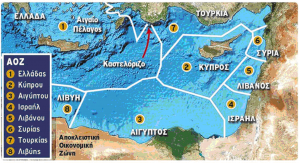
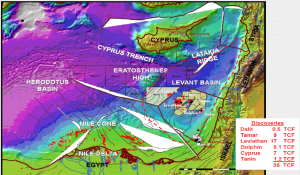
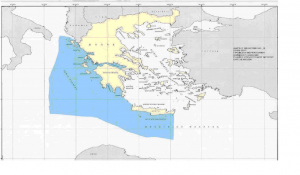
A second development, which is of particular interest of persons from the Eastern Mediterranean, is the discovery of large deposits of gas (and oil) in off-shore areas of Israel, Cyprus and Greece. Much work has already been accomplished, including exploration, drilling — and production in one of the Israeli fields (Figure 1).  Appraisal work has already started in the Cyprus Aphrodite field and production is expected to begin in 2017 or 2018 with large benefits in commercial development, employment, and revenues. Greece is also moving in the same direction, although with some delay in comparison to Cyprus but is making good progress with good expectations (Figure 2). An important aspect of this development is that Greece, Cyprus and Israel have decided to enter into joint, close and effective cooperation in developing the hydrocarbon deposits in their off-shore regions, and have already taken serious steps toward this goal. Needless to say that this raises the sensitive issue of the Exclusive Economic Zone (EEZ) which is imbedded into the United Nations Convention of the Law of the Sea (UNCLOS), and which raises problems with Turkey, a country that has not signed and does not recognize this Convention (see figure 3).

These are, of course, heady subjects and merit more extensive discussion and careful examination. In my capacity as an energy policy specialist, I have spent time and lectured on them on several occasions in the past few years. If the opportunity is offered by the Hellenic Link, I would be pleased to present my findings and conclusions to interested audiences.

109A

Figure 1.  Gas deposits in Off-shore areas of Cyprus and Israel

109B

Figure 2. Greece’s part of the EEZ planned for Oil and Gas Exploration


109C

Figure 3. Exclusive Economic Zones (EEZ) in the Eastern Mediterranean

———————————————————————————–


On-Line Course in Modern Greek Offered Free

In cooperation with the Institute for Language and Speech Processing (ILSP)/

“Athena” Research  Center, the Hellenic Link, Inc. is offering as a service to the community a series of Greek language lessons on its Web site: http://www.helleniclink.org ( on a 24/7 schedule)

On the home page of the site, upper left corner, click on “Learning Greek,

to be introduced to a series of fifteen lessons of the filoglossia+ courseware.

Please inform anyone who would be interested in learning Greek of this service.

THE HELLENIC LINK,  Inc.

A NON PROFIT CULTURAL AND SCIENTIFIC ASSOCIATION

OF HELLENES AND PHILHELLENES

INCORPORATED IN DELAWARE

Suite No. 278, 38-11 Ditmars Blvd, Astoria, New York 11105

Web Site: http://www.helleniclink.org Email: info@helleniclink.org

Contact Telephone: (718) 217- 0430


[1] Achilles G. Adamantiades is retired professor of nuclear engineering and energy policy; currently, he is Consultant in Energy and the Environment working intermittently for the World Bank, the African Development Bank (AfDB), the European Union Commission, and private sector clients.

Bulletin No. 108

Posted by: Editors  :  Category: News & Articles

THE HELLENIC LINK, Inc.logo

EllinikosSyndesmosBlack

Member Update- BULLETIN

Editorial Committee: Ahilleas Adamantiades, Alex Economides, Dean C. Lomis, Katherine Efthymiatou-Stabile, Contributing Editor: Evangelos Calamitsis,  Acting Editor: Costas Efthymiou

No. 108, April – May, 2013

Focus: The Greek/Cypriot Economic Crises

Following the presentation “Is there Hope for a Recovery of the Greek Economy?” by Dr. Evangelos A.
Calamitsis (Bulletin #106, February 2013), we received an extensive list of links referring to various aspects of the economic recession from Dr. Nicholas Economides, Professor at the Stern School of Business, New York University and Visiting Professor at the Haas School of Business, University of California, Berkeley. In the links, Prof. Economides offers enlightening comments on specific problems associated with the recession. His commentaries have appeared in a wide array of public and social media.

We take the liberty to reprint them in this Bulletin in order to update our readers. At the same time, we thank Prof. Economides for his care to keep the community, including our Hellenic Link “family”, informed about the state of the economy, a topic of universal concern nowadays. We warmly welcome this opportunity to include in the columns of this Bulletin presentation and discussion of vital economic issues by experts, afforded by the written contributions of Drs. Calamitsis and Economides. This editorial innovation, if continued, we believe would offer much needed enlightenment and render a great service to the Omogeneia as well as to our members and readers. Indeed, it would be highly desirable, if it were to be imitated by experts in other disciplines and for issues of high interest and concern to the Greek American public. We do hope that the idea will motivate our colleagues in additional fields of endeavor to respond positively by submitting articles of such interest for publication to our readership.
The links on the issues of the economy follow, as provided by Prof. Economides:

“I attach links of recent appearances on the EU crisis:

·    Presentation on the Greek crisis for non-economists, March 15, 2013  
·    FMVoice.gr, Athens, Greek Crisis, April 8, 2013
·    BBC World News TV, Cyprus banking crisis, March 23, 2013
·    SBC TV, Athens, Cyprus and EU crisis, March 22, 2013
·    Voice of America, Cyprus banking crisis after parliament rejects EU plan, March 19, 2013
·    Voice of America, Cyprus banking crisis (audio), March 19, 2013
·    Bloomberg News TV, Will Cyprus have to leave the euro, March 19, 2013
·    Bloomberg News TV, Bank run in Europe a possibility, March 18, 2013
·    BBC World News TV, Cyprus Crisis, March 18, 2013
·    BBC World News TV, Cyprus banking crisis, March 16, 2013
·    BBC World News TV, EU bankers’ bonus limits, February 28, 2013
·    Salon, Greece puts itself up for sale, January 19, 2013
·    Voice of America, Reforms in Greece, January 17, 2013
·    Kathimerini, The US Fiscal Cliff, January 5, 2013 (in Greek)
·    Kathimerini, The US Fiscal Cliff, January 5, 2013 (in English)

Also on Facebook at http://www.facebook.com/#!/Nick.Economidesattach links of recent appearances on the EU crisis:

I attach links of recent appearances on the EU crisis and on the Internet sales tax:
·    TheFresh Outlook, Internet Sales Tax, May 11, 2013
·    Voice of America, Structural changes in Greek economy, April 30, 2013
·    American Hellenic Professional Society, Sacramento, Greek and EU crisis, April 26, 2013
Also on Facebook at http://www.facebook.com/#!/Nick.Economides .

I attach a link of a recent appearance on “Greek recovery”:
·    Central Chinese TV (CCTV), Greek recovery, May 17, 2013
available also on Facebook at http://www.facebook.com/#!/Nick.Economides

Prof. Economides can be reached at the following addresses: Prof. Nicholas Economides
Stern School of Business, NYU,44 West 4th Street, New York, NY 10012-1126
tel. (917) 776-8777 , (212) 998-0864    
mailto:ECONOMIDES@stern.nyu.edu
http://www.stern.nyu.edu/networks/
http://www.stern.nyu.edu/networks/cvnoref.html
and Haas School of Business, UC Berkeley
Executive Director, NET Institute
http://www.NETinst.org/
http://www.facebook.com/NET.inst
Selected works and sign up for notification of my new work:
http://works.bepress.com/economides “                                                                                                           
CJE

An Outstanding Celebration of March 25, 1821 in New York City

The Hellenic American Chamber of Commerce and the Holy Trinity Cathedral , under the auspices of the Consulate General of Greece presented  a panel discussion of the topic “ Up from the Ashes – March 25, 1821: We All Are Greeks” in commemoration of the start of the revolutionary struggle. The event was held at the Holy Trinity Center, exactly on the anniversary date, March 25, 2013 at 7:30 p.m.
.There were three Panelists on the Program who respectively covered a particular aspect of the Greek War of Independence:
·    Dr. Christos P. Ioannides, Director of the Center for Byzantine and Modern Greek Studies, Queens College, CUNY, who spoke on “ Regas Feraios – The Apostle of Revolution”,
·    Dr. Constantine G. Hatzidimitriou, St. John’s University & CUNY, who presented
“The Impact in the United States of the Greek War of Independence 1821-1829”, and
·    Robert  G. Shaw, Past President – Chairman, Hellenic Chamber of Commerce, who described in picturesque detail “ The Battle of Navarino: A Precedent for Inernational Peacekeeping”

The Panel Discussion was introduced and moderated by Louis Katsos, President, Jekmar Associates and  Adjunct Professor at The Irwin S. Chanin School of Architecture, Cooper Union.
All presentations captivated the overflowing audience with their freshness and original style. They were well documented with historical data, some of which were presented for the first time. They also covered the individual topics succinctly and comprehensively; they drew very laudatory comments by His Eminence Archbishop Demetrios, who addressed the celebrants at the conclusion of the Program.
Members of the Hellenic Link who attended this extraordinary event were happy to recognize two of the participating panelists, Drs. Ioannides and Hatzidimitriou, as esteemed Members of the Advisory Council on Hellenic Education of our Association.
We have been informed that the texts of the presentations will be published by the Hellenic Chamber of Commerce.


Advisory Council Adds New Members

We are pleased to inform the Hellenic Link members that two scholars of the American academic community have joined the Advisory Council on Hellenic Education of our Association. Professor Dan Georgakas, Director of the Greek American Studies Project, Center for Byzantine and Modern Greek Studies, Queens College, City University of New York and noted author and film critic has accepted the invitation of the Council to join it as a Member-at-large. Dr. John P. Angelidis. Professor and Chairman, Department of Management, St. John’s University, N.Y., was similarly appointed to the Council as regular Member.                   
Along with our warm welcome extended to these esteemed colleagues, we congratulate them for their willingness to contribute to the fulfillment of the Mission of the Council and we express the wish that their tenure may be long, meaningful and eminently productive.

Fordham University Projects Theme of Hellenic-Christian Culture

We gladly bring to the attention of interested readers the following Announcement – Invitation we received from the University:
The Orthodox Christian Studies Center of Fordham Universityinvites you toThe Third Solon and Marianna PattersonTriennial Conference on Orthodox/Catholic RelationsCHRISTIANITY, DEMOCRACY,AND THE SHADOW OF CONSTANTINE Tuesday, June 11–Thursday, June 13, 2013ROSE HILL CAMPUS   |  FORDHAM UNIVERSITY  |  BRONX, N.Y.Perhaps the two most enduring legacies of Hellenism are Platonic philosophy and democracy. Yet the two are seemingly antithetical—Plato denied that democracy could lead a population to truth and, consequently, rejected the notion that democracy was good for the state.This conference explores the modern relationship between Christianity—with its Platonic roots—and democracy, and the extent to which it was shaped by the Constantinian revolution.SPEAKERS Timothy Barnes, Edinburgh School    of Divinity Luke Bretherton, Duke University Michael Budde, DePaul University *Father Emmanuel Clapsis, Holy Cross    Greek Orthodox School of Theology Mary Doak, University of San Diego Eric Gregory, Princeton University Perry Hamalis, North Central College Pascal Hämmerli, University of Fribourg*Stanley Hauerwas, Duke University*Father J. Bryan Hehir, Harvard University Peter Kaufman, University of Richmond Holger Klein, Columbia University James Skedros, Holy Cross Greek Orthodox    School of TheologyKristina Stoeckl, University of Vienna Nathaniel Wood, Fordham University  * Keynote speakers The conference is funded by grants received from the Patterson Triennial Conference Endowed Fund, the Archbishop Demetrios Chair in Orthodox Theology and Culture at Fordham University, the Kallinikeion Foundation, The Virginia H. Farah Foundation, and members of the Orthodox Christian Studies Center Advisory Council.The conference is co-sponsored by the Michael G. and Anastasia Cantonis Chair in Byzantine Studies and Early Christianity and the Center for Hellenic Studies at the Richard Stockton College of New Jersey.The Orthodox Christian Studies Center provides a space within a university setting for engagement with Orthodox Christianity by undergraduate and graduate students, faculty, alumni, and members of the community. Aristotle Papanikolaou and George Demacopoulos are co-founding directors.www.fordham.edu/orthodoxy

The Church: Vigilant over the Environment

Climate Change and the Duty of Orthodox Christians

(The contents of this article were presented, in a modified form, at the Prayer Breakfast organized by the National Religious Coalition for Creation Care (NRCCC) on Monday, 20-May-2013 in Washington, D.C.  The presentation was given by the Rev. Dimitrios Antokas, Presiding Priest of the St. George Parish of Bethesda, Maryland. It was co-authored by the Rev. Dimitrios Antokas and Dr. Achilles G. Adamantiades).

Religious organizations are increasingly feeling the obligation to speak up on behalf of the environment. This stems from the moral imperative to contribute actively to preserving the earth’s integrity and to exhort their faithful people to become engaged in this endeavor. Religious leaders are taking the initiative to not only speak to their flocks but also to approach political figures who make important policy decisions.  It is to this effect that a national prayer breakfast, in a practice established some time ago in Washington, D.C., was organized by the National Religious Coalition for Creation Care (NRCCC) on Monday, 20-May-2013.
It is not a secret, and is becoming increasingly clear, that human activity of various kinds is causing harm to the environment in more ways than we can count. For example, the release of noxious substances on land, pollution of lakes, rivers and oceans, and emissions into the atmosphere affect our health and endanger our future. At the same time, they place at risk biological species, for example, species of fish on which much of mankind depends for its food. Deforestation, expansion of human settlements, agricultural run-off and other sources of pollution cause significant loss of biodiversity by threatening with extinction a large number of animals and plants, whose loss will not only be  a loss of beauty but also a loss of substantial sources of food for many populations.  As an example, one should consider what is happening to the Chesapeake Bay, so near the nation’s capital, which is dying from pollution and overfishing.   Even excessive noise affects negatively a person’s physical and mental health.  The emission of greenhouse gases into the air in now the most critical concern as it is projected to cause, as it has already done, global warming. This issue has come into sharp focus on Thursday, May 9, 2013.  On that day, at Mauna Loa, Hawaii, measurements of carbon dioxide in the atmosphere, the main actor among greenhouse gases, recorded levels above 400 parts per million, a concentration not seen on the earth for millions of years.  It is the overwhelming consensus of scientists, bolstered by elaborate measurements, that this increase is due to human activity that started with the industrial revolution of the 19th century.  Again, the great majority of analyses of hundreds of independent scientists all over the world have concluded that the increasing concentration of greenhouse gases is the cause of climate warming. Climate forecasts indicate that this warming is expected to accelerate in the future unless drastic measures are taken to stabilize and decrease carbon emissions.
Scientists have also examined thoroughly what the dramatic changes of climate change might bring.  Without going into details, which do not fit in a short article, we need to note that they could be very significant and could affect agriculture, human health, population movements, weather conditions, biodiversity, polar ice melting, and rising sea level.  We can see some of these changes ourselves in daily newscasts, especially as they refer to extreme weather conditions that have become far more frequent and more severe in recent years (the year 2012 was proclaimed, based on NASA observations, the hottest year in the contiguous Unites States since records have been taken).  The recently appointed President of the World Bank, Dr. Jim Yong Kim, a medical doctor by profession and ex-President of Dartmouth College, has even stated that “the future earth would be unrecognizable (owing to climate change).”  It is important for us to take note that the predicted impacts of climate change would affect disproportionately poor and disadvantaged populations of the world, namely those who would be ill prepared to cope – the moral imperatives of this prediction are clear, especially for religious leaders and policy makers.
To be sure, the temperature predictions of climate change effects are subject to uncertainties.  We need to note, however, that actual measurements to date have exceeded predictions. These predictions have tended to under-predict temperature rises and effects. But even if we accept that the uncertainties are large, it should be clear that policy makers have an obligation to consider worst-case scenarios and take appropriate measures to prevent it or mitigate its effects; we do the same when we purchase insurance for auto accidents, floods, and fires.  More so, when we admit that the root cause of possible future calamities is human activity. With due respect to the skeptics and critics, we can ill-afford to ignore the warnings of science coming from our best institutions like MIT, Harvard, Columbia, Stanford, and the University of Colorado, just to mention a few, and from giant and credible scientific U.S. agencies such as NOAA and NASA.
In confronting these issues, the Orthodox Church has long ago adopted the biblical concept of “stewardship,” a principle going back thousands of years. The fundamental principle lies in Moses’ assertion that “the earth is the Lord’s, and all its fullness” (Exodus 32:6), repeated by St. Paul in 1 Co 10:26.  The earth, with all its marvels, land, water, air, plants, and all kind of animal, is not our possession for us to use (and abuse); rather, we are its “custodians” or “stewards,” charged by the Creator with its care and preservation so that we can bequeath it wholesome to future generations. The Church believes that the core of our malaise, environmental and otherwise, is greed, corruption, and egocentrism, spiritual ills that lead to overconsumption; therefore, their therapy is also spiritual.
We, in America, are, unfortunately, not in a good position to preach to others on this score. In fact, the problem of the world is that people of every nation want to become “American,” namely, to consume more and even to reach the American level of consumption. How are the developing countries of this world to accept our advice and meet our requests when our per-capita greenhouse emissions are about three times those of China and ten times those of India? It is this huge disparity in incomes, material consumption, and emissions that prevents the world from reaching binding agreements on limiting emissions. As the New Testament says in the case of the sinful woman, “he who is without sin among you, let him throw a stone at her first” (John 8:7).  We will continue to be in poor standing among nations until we make progress in mending our ways in our own home and in showing that we take seriously the command of the Lord to be good stewards.
We take great pride and satisfaction that our spiritual father, His All-Holiness Ecumenical Patriarch Bartholomew of Constantinople, has taken a leading role in the preservation of the environment and, more specifically, in mitigating climate change – for this reason, he has been accorded the surname “the Green Patriarch.” He, with his brother hierarchs of the Patriarchate and in collaboration with other spiritual leaders of the world, has made many pronouncements and organized eight international conferences (in the period 1995-2009) to highlight the plight of the earth and urge persons of all faiths to take an active part in its preservation. This can be accomplished, first, by changing one’s own life style and, second, by pressing public policy-makers to take appropriate measures.  His actions and pronouncements are too many to even outline in this brief article but can be read in papers produced by the Orthodox Fellowship of the Transfiguration of Santa Rosa, CA, the Standing Conference of Orthodox Bishops of America (SCOBA)  and the Archdiocesan Advisory Committee on Science and Technology of the Greek Orthodox Archdiocese of America.
The latter takes pride in the creation, in 2000, of the Archdiocesan Advisory Committee on Science and Technology (AACST), of which the Subcommittee on Energy, Environment and Economics focuses (among other topics) on Climate Change.  The Committee has prepared several papers on environmental issues that are posted on the Archdiocese web site. The Committee has organized seminars, panel discussions, and lectures in many parishes of the Archdiocese and in almost all biennial Clergy-Laity Congresses since 2000, including the last one in Phoenix Arizona, in July of 2012. Some of the Committee members are honored to be advising the Ecumenical Patriarch in his environmental campaigns.   Following the Patriarch’s urging and advice, parishes of the Greek Orthodox Archdiocese of America are organizing committees to “Green the Parish” using also the excellent and very helpful volume produced by Mr. Fred Krueger.   
As His All Holiness the Ecumenical Patriarch has affirmed, “offending nature and despoiling the environment is tantamount to sin,” and we also know that “the wages of sin is death” as the Apostle Paul writes to the Romans (Rm. 6:23).  All of us who are engaged in this struggle need to give the good example by practicing repentance which, in the Greek terminology (metanoia), means a change of mind, a new way of thinking – and acting. We need to convey the message to everyone that our consumption-driven economic model is unsustainable – this is now clear beyond doubt.  Only if we adopt a truly Christian way of life and resolve to practice ascesis, living with less, practice a life of simplicity and frugality, and renounce greed which, according to St. Paul, is tantamount to idolatry (Col 3:5) can we approach others to ask them to change their lives as well, and thus save the world and the Earth. In the words of Ecumenical Patriarch Bartholomew, “the crisis lies not in the environment but in the human heart” – this is the point on which the coalition of religious organizations should focus its attention.  It is a high order but it is imperative and can be done, with the Grace of God.
———————————————————

On-Line Course in Modern Greek Offered Free

In cooperation with the Institute for Language and Speech Processing (ILSP)/

“Athena” Research  Center, the Hellenic Link, Inc. is offering as a service to the community a series of Greek language lessons on its Web site: http://www.helleniclink.org ( on a 24/7 schedule)

On the home page of the site, upper left corner, click on “Learning Greek,

to be introduced to a series of fifteen lessons of the filoglossia+ courseware.

Please inform anyone who would be interested in learning Greek of this service.

THE HELLENIC LINK,  Inc.

A NON PROFIT CULTURAL AND SCIENTIFIC ASSOCIATION

OF HELLENES AND PHILHELLENES

INCORPORATED IN DELAWARE

Suite No. 278, 38-11 Ditmars Blvd, Astoria, New York 11105

Bulletin No. 107

Posted by: Editors  :  Category: News & Articles

THE HELLENIC LINK, Inc.logo

EllinikosSyndesmosBlack

Member Update- BULLETIN

Editorial Committee: Ahilleas Adamantiades, Alex Economides, Dean C. Lomis, Katherine Efthymiatou-Stabile Contributing Editor:  Evangelos Calamitsis  Acting Editor: Costas Efthymiou

No. 107, March, 2013

In  Loving Quest for the Rudiments of our Culture


KYRIE ELEISON’

Dean C. Lomis, Ph.D.

Three years ago this coming summer, in July 2010, I attended in Williamsport, Pennsylvania the Roman Catholic funeral of a ninety-five year old elderly grandmother. Being Greek Orthodox and not knowing any other than the immediate family, I sat at the last row of the Cathedral’s pews witnessing the solemn ceremony.

Somewhere in the middle of the service I felt jolted when I heard the priest chant: “Kyrie Eleison.” About a quarter of the service later he repeated the chant, as he did near the end also. After the funeral and during the ensuing — “makaria”-to-us- Greek-Orthodox — meal, I inquired of the Roman Catholic priest regarding the use of the Greek Orthodox “Kyrie Eleison” in a Roman Catholic Mass. His explanation was that the ‘Anglican’ version of the verse does not provide the real meaning of the prayer. He went on to inform me that the Roman Catholic Church was in the process of making revisions to be called “Missal,” a new text to be used during Mass intended to be closer to the Faith using New Words of Worship in the “liturgical Latin” used centuries in the past. As we may now know, of course, the new “Missal” has been put into practice as of a few months ago.

Shortly after returning home a couple of days later, I looked into our Greek Orthodox Liturgy Book and realized that I went to a Roman Catholic Church to hear the Greek Orthodox version of a prayer which in my Greek Orthodox Church I hear it in the Anglican version, when chanted in English. That is, I noticed that when “Kyrie Eleison” is chanted in English it becomes “Lord Have Mercy.” Immediately I recognized that we have a serious difference with the Anglican version, for the words “mercy” and “eleison” are not compatible, lacking identical meanings. Also, searching deeper into the terminology, it became apparent that the Roman Catholic Greek Orthodox version was correct because it is not possible to translate “Kyrie Eleison” correctly.

Looking up “mercy” we find the meanings of ‘forgive, don’t punish anymore, have pity,’ etc. However, “eleison” goes beyond the punishing and asking-for-forgiveness state; “eleison” includes ‘blessing, grace, assistance, help, guidance,’ which “mercy” does not. Why then should we Greek Orthodox not have our own “Missal” by always using the all-inclusive Greek Orthodox “Kyrie Eleison” rather than the restrictive Anglican “Lord Have Mercy?”

Etymology, the science of the origin and development of words, came from the meaning of the term. Later generations like the Anglicans translating the Greek “eleison” could not find an all-inclusive equivalent, thus compromising with “mercy,” which truly shortchanges the praying individual who constantly thinks only of sins and seeks only forgiveness, rather than also ask for ‘blessing and ‘guidance.’ If we look carefully into the Old Testament, we are constantly reminded of God’s wrath and need for forgiveness only, whereas in the New Testament we notice also blessing and guidance.

Philologists – linguistics specialists – inform us that when we hear a word or a phrase that is not of the ordinary we have the tendency to retain it because its meaning impresses us. Philologists also tell us that the constant use of ordinary terms becomes so routine that we often neglect the meaning, or even fail to comprehend because we merely repeat them automatically without thought, a practice the Greek language calls: papa?a??st??a, or parroting in English, thereby experiencing the proverbial “going in one ear and out of the other.”

An example of this occurred to me a few months back when my eight year old granddaughter – ten times my ‘junior’ to my eighty years – enlightened me by teaching me a lesson, endorsing another proverbial saying: “we’re never too old to learn.”Angelikoula — as she loves for me to address her and as she prides herself announcing her name to the priest when taking Holy Communion – asked me to teach her a Greek Orthodox prayer, since she is baptized Greek Orthodox. I proceeded to teach her «????? ? Te??, ????? ?s?????, ????? ????at??, e???s?? ?µ??. ?µ??!» which she now recites every night as the beginning of her bedtime prayers. When she asked me to translate in order to gain the meaning, I showed her the translation in our Greek Orthodox Liturgy Book: “Holy God, Holy Mighty, Holy Immortal, have mercy on us. Amen!” Then she asked me to go over the entire prayer, word-for-word, in order to comprehend what she would be saying. So, I said: “Holy the God, Holy Mighty, Holy Immortal, ‘forgive us and bless’ us. Amen!” defining for her the difference between “mercy” and “eleison.” And, that’s when she taught me the lesson. She could not understand as an early third grader why the English version of “Holy God…” contained only two words, whereas the Greek version of «????? ? Te??…» contained three. And when I explained that article omicron pertains to the One Omnipotent God, she excitedly responded; “Oh, the One God,” for that little omicron provided to her so much meaning. A couple of days later I found out how impressed she was, by having brought the subject to discussion among some of her ‘private school’ schoolmates, emphasizing the meaning of that little omicron article. It was a blessing of course that the discussion was at her private school, because had it been at a public one she might have been expelled.

Does all this therefore suggest that we should have our Greek Orthodox Liturgy in the ecclesiastical language that it was written, which perhaps only the educated people of Greece – secondary school graduates whose high school curriculum includes religion and tertiary education graduates – understand and therefore comprehend?  I, personally at least, think not.

Does this then mean that we should have more English as many advocate, or maintain the Greek as others desire? Or, as yet some others suggest, we should place some kind of percentages to each. Well, how much: 50% : 50%; 60% : 40%; 70% : 30% — I can go on. And what would this accomplish, for then we shall have portions that may be understood by neither.

Times have indeed changed. We, the offspring of our immigrant parents – and a good portion if not most of them with limited education (my own father coming to America in 1899 at the age of fourteen with a third-grade education), were provided with some pretty good and fairly solid foundations in our Greek Orthodox Faith and in the language. But, as the inevitable assimilation and inter-marriages – along with our own mistakes – have taken their toll, it is indeed very difficult to maintain intact the language of our Greek Orthodox Liturgy’s Founding Fathers.

Yes, we do need more English in our Greek Orthodox Liturgy; and, yes, we do need more Greek in our Greek Orthodox Liturgy; but the ‘percentage’ theory does not hold water. We all know that there are and will continue to be advocates for the complete elimination of the Greek language from our Liturgy. There are also many who advocate the renaming of the “Greek Orthodox Church” to the “Orthodox Church of America.”

I, for one, cannot adhere to this, for if so, we shall lose our identity. The Greek Orthodox Church is considered the First Christian Church. Yet, the Roman Catholic, or the Anglican, or the Russian or other Slavic “orthodox” churches are not contemplating forsaking their identity. Why should we, the First Christian Church!

Let us for a few moments look into the liturgies of all the “Christian” churches. Since Christianity emerged from the Jewish monotheistic faith, there are Hebrew language elements contained in the original, since appropriate equivalents cannot be found, if at all. Similarly, in our own Greek Orthodox Liturgy, we have those terms which have neither Greek nor English equivalents: Amen (“yes, we all agree that it is right and true”); Cherubim (“guardian angels of Paradise with ‘flaming swords’”); Hallelujah (“exclamation of joy, praise and gratitude to ‘Yahweh’); Hosanna (“’please save us now’ in praise and adoration in that ‘Blessed is He – the One (? ??a?) – who comes in the name of the Lord’”); Seraphim (“the ranking angels standing in the presence of God”); Savaoth (“the Hosts Lord of Special Armies” – ‘very difficult to attempt to translate or even describe’).

And just for emphasis in comparison, unique and untranslative terms are found in every language, borrowed by others who just cannot coin their own; just a few examples should suffice: eleison, leventis, palikari, philotimo from the Greek; fait accompli from the French; casus belli, ipso facto, ipso jure, from the Latin; macho and machismo from the Spanish; or the recent one, Tsunami, from the Japanese, not to disregard the myriad medical, technical and social terms from the Greek and the legal terms from the Latin.

What am I advocating, therefore? I am suggesting that all – and I mean all – passages of many words and long phrases and paragraphs recited by the priest be spoken only in English in order to be understood, even though they may not be well comprehended unless fully explained in Sunday School, a system today lacking widely. However, the few words and the very short phrases which bear so much deep meaning in the Greek unequalled in English should remain intact and be taught with detail in Sunday School.

Sunday School can be a yet additional instructive element in the liturgical process. After learning the Greek words and short phrases, and their meanings, Sunday School pupils   brought to the church for Holy Communion, remain for the duration, taking their designated places by classes, with each grade chanting the short prayers; for example: first grade: ?µ??;second grade: S??, ????e; third grade: ?a??s???, ????e; fourth grade: ????e, e???s??. In such a manner they can become contributors to the liturgical process quite delighted at the ages anxious to participate.

And in regard to Sunday School teachers, it should be of tremendous advantage if at the biennial clergy-laity conferences Sunday School teacher sessions were held, giving the opportunity for Sunday School teachers to interact and learn from each other and of their methods.

Although there are many issues requiring and deserving attention and discussion, there is one more which I like to bring to attention: the chanting of the choir.
Greek Orthodox liturgical chanting emanates from Byzantine musical sounds. The Greek tongue is a language of vowels and therefore elastic, contrary to the English of Anglo-Saxon and Germanic of consonants structure and therefore ‘rough’ and ‘rigid.’  Can the roughage and rigidity of the Anglo-Saxon Germanic-influenced music match the heavenly melodious sounds of the Byzantine? I wonder, for I as one have not yet found one, though some are worse than others. Choir chanting of Byzantine echoes are slow and precise, unlike the necessarily-lengthy priestly recitations which are also quite fast and difficult to follow. Chanting choir hymns can be adequately mastered to be followed and to sing, as both the beauty of the melodies and the meaning of the words add to the spiritual experience.

Yes, adjustments can and should be made so that the upcoming generations may become accustomed with knowledge and desire, unlike many of the “baby boomers” and especially their offspring of today’s teenagers and young adults who seem to have lost a significant if not a major part. I don’t know if the national rate is as dismal as it seems to be in our rather large community of 750 families – although I fear that it might be, but we were recently informed that of about 65 inter-marriages in recent years only 4 come to church, and of approximately 67 baptisms of inter-marriage couples only 9 attend Sunday School.

I understand that recent research reveals that it is mostly the wife and mother who promotes church attendance. Perhaps that is why the Old Testament of the Holy Bible adopted the Greek gender for “wisdom,” the feminine: «? S?f?a» as revealed in the Book of Proverbs: chapter 1, verses 20 and 21: “Wisdom cries loud in the street; in the market she raises her voice; on top of the wall she cries out; at the entrance of the city gates she speaks.”And possibly the Greek philosophical thought – ? e??????? f???s?f??? ???s?? – was perhaps so clearly and distinctively revealed in the New Testament of the Holy Bible, in John: chapter 12, verses 20 to 23: “Now some Greeks were among those who had gone to worship at the feast. So these approached Philip…and requested, ‘Sir, we would like to see Jesus.’ Jesus replied, ‘The time has come for the Son of Man to be glorified.’”

Ladies and Gentlemen: “Kyrie Eleison!”

Glossary of Terms

casus belli: an act that provokes injustice leading to justification for war.

fait accompli: a deed that has been accomplished and decided, and is presumed irreversible.

ipso facto: the very fact of an act, and the inevitable result and consequences.

ipso jure: phrase describing the operation of law and legal consequences.                                           

philotimo: “love of honor” – impossible to translate sufficiently as it describes a complex array of virtues. In essence, it is the right and expected way of the Socratic code for “quality of life.”

tsunami: catastrophic ocean waves generated by submarine movements caused by various occurrences such as trembling, earthquakes, volcanic eruptions, landslides beneath the ocean, or asteroid strikes. Seismic waves or tidal waves won’t do because “seismic” refers solely to earthquakes, whereas “tidal” provides neither specific nor general references.

eleison: forgive, don’t hit, have pity, feel sorry, etc. and/or bless, guide, assist, do not forsake, help, show the way, etc.

palikari: tough soldier, young fighting lad, best things in a man.

leventis: positive connotations of fearlessness and gallantry.

machismo: strong or exaggerated sense of masculinity.                                                                                              

macho: man of physical courage, virility, aggressiveness, and domination of women.

——————————————————————————————————————

In the interest of members and readers of the Bulletin we relay the following Announcement of the Cyprus-U.S. Chamber of Commerce concerning placement opportunities at a Career Fair:

Cyprus – U.S. Chamber of Commerce Career Fair

CareerFair

The Unquenchable Light of 1821 will sparkle again in Fort Lee, NJ this year

HL member Alex Floratos, who is chairing the event, informs us that the Hellenic Civic Club of Fort Lee will be celebrating Greek Independence Day on Saturday , March 23 2013 with participation  of a good number of officials holding office in this municipality, in addition  to a sizable presence of  townspeople. Invited dignitaries include the mayor of Fort Lee, the Superintendent of Schools, the Chief of Police along with a detachment of officers including several of Greek descent, and others. The dignitaries are expected to address the participants for the occasion; in addition, scheduled speakers from the local Greek American community will highlight the meaning and value of the War of Independence, for Greece and for Greeks everywhere. Invocation will be offered by the Dean of the Greek Orthodox Cathedral of St. John the Theologian, in Tenafly, NJ.  The event will feature a presentation of traditional Greek dances by teams of Junior and Senior GOYA members, and will be concluded with lunch for hundreds sponsored by 2 banks and over 10 Greek eating establishments in the vicinity of the city. The event will take place at the Recreation Center of Fort Lee, Stillwell Avenue, at 2:00 p.m.   We congratulate Mr. Floratos and his colleagues of the Fort Lee Hellenic Civic Club for the thoughtful and meaningful scope and high quality commemorative celebration they organized for the proclamation of the Revolution of 1821 and for the reclaiming by the Hellenes of their inalienable rights to freedom, thus breaking a centuries long  and bitter servitude to Ottoman  rule. This event and many more like this taking place throughout the country this month attest to the vitality of the Greek ethnic soul and the continuing attachment of the Greek American community to its heritage of Hellenic ideals, for the good of itself as well as of the entire American society.

On-Line Course in Modern Greek Offered Free

In cooperation with the Institute for Language and Speech Processing (ILSP)/

“Athena” Research  Center, the Hellenic Link, Inc. is offering as a service to the community a series of Greek language lessons on its Web site: http://www.helleniclink.org ( on a 24/7 schedule)

On the home page of the site, upper left corner, click on “Learning Greek,

to be introduced to a series of fifteen lessons of the filoglossia+ courseware.

Please inform anyone who would be interested in learning Greek of this service.


THE HELLENIC LINK,  Inc.                  
A NON PROFIT CULTURAL AND SCIENTIFIC ASSOCIATION
OF HELLENES AND PHILHELLENES
INCORPORATED IN DELAWARE
Suite No. 278, 38-11 Ditmars Blvd, Astoria, New York 11105          
Email: info@helleniclink.org
Contact Telephone: (718) 217-0430


Website created by Avekta Productions Inc., New York , NY

websites@avekta.com


Bulletin No. 106

Posted by: Editors  :  Category: News & Articles

logoTHE HELLENIC LINK, Inc.

EllinikosSyndesmosBlack

Member Update- BULLETIN

Editorial Committee: Ahilleas Adamantiades, Alex Economides, Dean C. Lomis, Katherine Efthymiatou-Stabile Contributing Editor: Evangelos Calamitsis Acting Editor: Costas Efthymiou

No. 106, February, 2013

A Current View of the Greek Economy

Is there Hope for a Recovery of the Greek Economy?

By Evangelos A. Calamitsis, Ph. D.*

After five years of a deepening economic recession and growing unemployment in Greece, one may wonder whether there is now hope (“elpida”) for an end to the Greek fiscal and debt crisis, the restoration of the country’s competitiveness, and a sustainable recovery of growth and jobs.

A number of prominent academics and media pundits have noted that Greece has recently gained some breathing space; but they still foresee only meager prospects for success of the Greek reform program, which was adopted with the support of the euro group and the IMF in May 2010 and revised in March 2012. On their part, Greek opposition parties have been waging a vigorous fight for the abandonment of this program, and its replacement by a strategy that would put an end to austerity, increase social transfers, and demand a far-reaching restructuring of the public debt. Yet, while conscious of the pains

imposed by the requisite austerity measures on much of the population, the Greek governing coalition which took office in June 2012 has been taking resolute actions to reinvigorate the reform program, and promote an early economic and financial recovery in cooperation with the country’s partners.

It should be recalled that the Greek reform program went significantly off track last spring, triggering great fears of an imminent Greek exit from the euro zone. To a large extent, this was due to substantial slippages in policy implementation, particularly in the area of structural reforms, and these slippages were exacerbated by the political uncertainties surrounding the national elections in May and again in June 2012. With the serious weakening of Greece’s policy credibility, public fears spread, the outflow of bank deposits accelerated, and domestic liquidity virtually dried up. Although justifiably disappointed with this turn of events, the country’s foreign lenders tended to place all program shortfalls on Greece’s door-step, leaving aside (until recently) their own responsibility for a number of program-design weaknesses (including an underestimation of the so-called “fiscal multipliers”). Furthermore, recurring pronouncements by some European officials questioning Greece’s position in the euro area tended to undermine confidence in the economy. As a result, economic conditions continued to deteriorate, with the decline in real gross domestic product (GDP) now estimated to have amounted to 6.0 percent in 2012, compared with 4.8 percent envisaged in the program, while the rate of unemployment surged to almost 27 percent (in October), as against a programmed annual average of 19 percent.

The larger-than-programmed contraction of national output and the delays in policy implementation thus worsened the already doubtful outlook for the sustainability of the public debt.

In this environment, the new Government faced enormous challenges to put the program back on track, and the negotiations with Greece’s partners proved very difficult and protracted. But the Government persevered, providing the necessary leadership for reform, despite the strong opposition of vested interests and a generally unfavorable public sentiment. Finally, after almost six months of deliberations, understandings were reached on an updated and recalibrated program, leading to the completion of the reviews of the medium-term arrangement with Greece’s euro area partners and the IMF. This unlocked loan disbursements to Greece of as much as 34.3 billion euro (about $45.6 billion) from the euro group in mid-December 2012, as well as some 3.3 billion euro from the IMF in January 2013; and an additional 14.8 billion euro of program loans are to be disbursed by the end of March, subject to the implementation of agreed measures.

In view of Greece’s spotty track record, there are doubts of course that “this time things will be different,” i.e., that the program will indeed be rigorously implemented and the economic crisis will recede. Nevertheless, some key aspects of the Greek authorities’ strategy and changes in approaches of their partners (all designed to render the program more realistic and manageable) augur well for an economic turnaround. The updated program envisages a decline in real GDP of 4.2 percent in 2013, followed by an increase of less than 1.0 percent in 2014 and more rapid growth thereafter.

Clearly, 2013 will be another very difficult year for Greece; but for the reasons noted below — which offer grounds for cautious optimism, a recovery could begin to be felt toward the end of 2013, especially if there is a pick-up in growth in the European Union as a whole.

The first and most important reason for cautious optimism is that the Greek authorities have given high priority to restoring the country’s policy credibility through a strong commitment to reform and important upfront actions; these actions have largely attenuated, if not eliminated, the prevailing fears of a Greek exit from the euro zone, which have had a pernicious impact throughout the economy. In this context, the Government adopted a reasonable fiscal policy package for 2013-14, placing greater emphasis on expenditure cuts and savings rather than new revenue measures (that weighed heavily in the initial program). The new package includes some socially difficult cuts in pensions, wages and social benefits, while carefully targeting these cuts to protect the most vulnerable groups; improved budgeting and monitoring rules; and corrective mechanisms to safeguard the achievement of the fiscal and privatization targets.

However, as a weak revenue performance remains the “Achilles heel” of the reform effort, I believe that decisive and unwavering measures will be needed to improve tax collections; otherwise, further painful reductions in government outlays (notably wages and pensions) may be unavoidable. To this end, high priority should be given to strengthening tax administration and vigorously combating tax evasion (especially by the wealthy and the self-employed). Also, the broader tax overhaul that is under preparation should seek to establish a simpler and fairer tax system, including a rationalization of property taxation and some cutbacks in value-added tax rates. Furthermore, strong efforts will be required to achieve a leaner and more effective public administration to better serve Greek society, especially its poorest members.

Second, in agreement with their partners, the Greek authorities have stretched out the time frame for realizing their fiscal objectives by two years, or from 2014 to 2016. This will help to cushion the impact of the requisite austerity measures, give the country more room for maneuver, and facilitate a faster economic recovery. Based on the progress made toward the end of 2012, Greece is now expected to bring its primary fiscal accounts (excluding interest payments) into balance in 2013, representing a major achievement relative to the deficit of 10.4 percent of GDP in 2009. It will then progressively generate a primary fiscal surplus of 4.5 percent of GDP, and largely eliminate the overall fiscal deficit by 2016.

Third, progress is now being made on structural reforms. Recent actions to reduce both wage and non-wage labor costs have been significant. But in my view, in order to close the remaining gap in the country’s competitiveness, it will be important to enhance productivity, as well as liberalize product and service markets so as to ensure that reductions in costs are adequately reflected in lower prices. The restoration of competitiveness will help boost the growth of output and exports of goods and services, notably in agriculture, manufacturing, and the key tourism industry. Also, in light of the disappointing record on privatization so far, there will be need to revitalize the privatization and development program of public assets so as to achieve — if not exceed — the lower targets recently established; this is critically important not only for mobilizing much-needed financial resources, but also for enhancing economic efficiency and potential growth.

Fourth, the updated program seeks to unleash a virtuous cycle of reforms and growth that would tend to reinforce each other. After more than two years of extremely tight liquidity conditions, with a build-up of large cross-arrears in the economy, the program now provides for substantial injections of liquidity in the system that would help speed a recovery. Importantly, a major recapitalization of Greek core banks is expected to be completed in the coming months, thereby restoring their solvency and facilitating the extension of credit to the real economy. The clearance of government payment arrears to domestic suppliers is also expected to play a crucial role, as these suppliers would be able in turn to settle their own overdue obligations, with salutary chain effects across major sectors of the economy. Concurrently, the authorities are restarting or accelerating the execution of a number of infrastructure and other projects that can be financed almost entirely by available European structural and cohesion funds; and, they have recently concluded agreements with the European Investment Bank to guarantee lending to small and medium enterprises, as well as support infrastructure and energy sector investments. Finally, steps are being taken to expedite the implementation of the already approved fast-track and other procedures designed to improve the business environment, and attract foreign direct investment. The convergence of these measures, if combined with the dismantling of bureaucratic hurdles, would help revive growth and begin to reduce unemployment.

And fifth, following the large “haircut” of the country’s privately-held sovereign debt in early 2012, euro area countries have undertaken significant initiatives aimed at contributing to the sustainability of Greece’s public debt. With the strong ncouragement of the IMF, the euro group agreed last December to reduce interest rates under the Greek Loan Facility; extend maturities on official loans and defer some interest rate payments; and transfer to Greece profits earned by the European Central Bank on Greek bond holdings. The Greek authorities also carried out in December a voluntary buyback of Greek government bonds from the private sector at a substantial discount. With these and other debt relief measures expected down the road, and contingent on progress in fiscal consolidation, it is now projected that Greece’s public debt ratio will be progressively reduced from a high of about 178 percent of GDP in 2013 to 124 percent of GDP in 2020 and substantially below 110 percent of GDP by 2022.

Although uncertainties remain regarding the debt dynamics, a further lowering of the country’s debt burden may still be needed; but this can be achieved only through continued close cooperation with creditors and an effective implementation of the program. These key elements should be coupled with a broader set of institutional reforms that would enhance social cohesion in support of the program and improve its prospects for success. The most important of these reforms are promoting transparency and accountability in government operations and the political system; combating corruption and cronyism in all their aspects; ensuring a speedy and equitable prosecution of justice; reforming the education system with a focus on practical learning; and fostering research and development to encourage productive initiatives.

In conclusion, judging from the authorities’ political commitment to reform and their recent upfront actions, there is reason to believe that Greece can meet its major challenges of restoring fiscal and debt sustainability, promoting competitiveness, and ensuring a recovery of growth and jobs over the medium term. Already, there are some signs of improving confidence in the economy, including a narrowing of long-term interest rate spreads and a reflow of deposits into the Greek banking system; but major downside risks remain, especially a possible flare-up of political difficulties and disruptive labor strike actions. Going forward, international support, particularly European solidarity, will be critical for Greece; but key to success will be the rigorous and sustained implementation of the updated program, notably in the areas of tax collection, public administration, privatization, and the liberalization of product and service markets.

* Dr. Evangelos A. Calamitsis is an economist and former director at the International Monetary Fund (IMF). This article appeared as a blog in the Huffington Post on February 8, 2013.

New Series of Broadcasts on Byzantium by ERT

We welcome and are pleased to bring to the attention of Hellenic Link members and Bulletin readers a promising cultural program on the world of Byzantium inaugurated by the “Voice of Greece” (http://www.ert.gr/voiceofgreece). The program, addressed to Hellenes living abroad, is directed by Dr. Taxiarchis Kolias, Professor of “Life and Civilization of the Byzantines” at the Department of Philology of the Kapodistrian University of Athens; it comes to fill a gap in the otherwise rich repertory of Hellenic heritage subjects of the national Greek radio carrier. To enable interested readers learn more about this program and to listen to the series of the broadcasts that have already begun, we reprint the press release announcement of the “Voice”:

ΠΈΜΠΤΟ ΠΡΟΓΡΑΜΜΑ-ΦΩΝΗ ΤΗΣ ΕΛΛΑΔΑΣ Δελτίο Τύπου

ΕΚΠΟΜΠΗ: «Βυζαντινός Πολιτισμός: Σπουδές και έρευνα»

H «Φωνή της Ελλάδας» εγκαινιάζει έναν νέο κύκλο εκπομπών με αντικείμενο «τον κόσμο του Βυζαντίου».Ο καθηγητής του Βίου και του Πολιτισμού των Βυζαντινών στο Τμήμα Φιλολογίας του Πανεπιστημίου Αθηνών κ. Ταξιάρχης Κόλιας θα παρουσιάζει, κάθε Πέμπτη 18.00 – 19.00, την εκπομπή «Βυζαντινός Πολιτισμός: Σπουδές και έρευνα». Θα προσκαλεί μαθητές, συνεργάτες και ομότεχνούς του και θα συζητούν για τον κόσμο του Βυζαντίου και για τον κόσμο των βυζαντινών σπουδών και, μέσω αυτών, για την έρευνα στη χώρα μας αλλά και διεθνώς. Η εκπομπή θα μεταδίδεται, ως παραγωγή της Φωνής της Ελλάδας, και στο Τρίτο Πρόγραμμα, κάθε Σάββατο 11.00 π.μ.

Eπιμέλεια-παρουσίαση: Ταξιάρχης Κόλιας

EΠΙΚΟΙΝΩΝΙΑ: Γραμματεία: +210 6066895; Studio: +210 606643

A BOOK OF FAITH AND WORSHIP

From the Press Office of the Greek Orthodox Archdiocese of America:

Speaking to God by Archbishop Demetrios of America

Speaking to God is a collection of over seventy prayers written by His Eminence Archbishop Demetrios of America. The book was originally written in Greek in the 1960s. In its third edition in Greek (2010), the book has been recently translated into English and was released by the Greek Orthodox Archdiocese of America on October 15, 2012.

In addressing the focus of the book in the Introduction, Archbishop Demetrios states, “We should speak to God. We should present our problems to Jesus. We should set in front of Him our hard times and our disappointments. We should place our plans, our worries, and desires in His hands. This is the meaning and message that this book wishes to bring to the world.”

Speaking to God has five sections or cycles: (1) asking God to teach us how to pray; (2) talking to God about ourselves and our problems; (3) singing the praises of His glory and majesty; (4) entreating Him on behalf of our brothers and sisters; and (5) addressing the need for a true approach to the Gospel.

Speaking to God is a helpful resource for daily prayer. It offers strength and inspiration through prayers that guide conversation with God and find in Him the love, wisdom, and peace needed in all of life’s experiences.

This new resource is available in both print and digital editions through the Orthodox Marketplace at www.orthodoxmarketplace.com. The Greek edition is also available through Orthodox Marketplace. The price is $12.95. The proceeds, as with all other publications authored by Archbishop Demetrios, will fund the Archbishop Demetrios Benevolent Fund.

We also wish to apprise our members and readers of a significant cultural publication by the American Hellenic Institute Foundation (AHIF) announced recently:

“AHIF is pleased to bring the Winter 2012-2013 Issue of the AHIF

Online Policy Journal

WASHINGTON, DC —The American Hellenic Institute Foundation (AHIF) announces its Winter 2012-13 Online Policy Journal.

Dan Georgakas, who is editor of the, Online Policy Journal and Director of the Greek American Studies Project, Center for Byzantine and Modern Greek Studies, Queens College (City University of New York) writes in his editorial foreword: “This issue of the AHI policy journal addresses a cluster of national and international issues pertinent to the interests of Greece, Cyprus, and the United States. Our coverage offers a mix of strategy, documentation, tactics, and analysis that aims to enrich public discourse on these issues.”

The issue may be accessed gratis on line at the site for the American Hellenic Institute—Publications. Past issues also are available at the same site. The contents for this issue:

  • Editorial Foreword by Dan Georgakas
  • The Eastern Mediterranean: The Times They Are A-Changing by Charles J. Mouratides
  • Joint Declaration by Archbishop Chrysostomos and Chief Rabbi Yona Metzger
  • The Advantages of Picking Low-Hanging Political Fruit by Patrick Theros
  • Why Macedonia Matters by Dr. Panayiotis Diamadis
  • The Parthenon Sculptures: The Cause for Reunification by John Papaspanos
  • Emerging Voices of Greek America by Alexis Angelo, Corinne Candilis, Andrew M. Pernokas,

Anna Tsiotsia, and Aletha Vassilakis

  • Socrates NOW: Bringing It All Home by Vicki James Yiannias
  • Book Review: The Genocide of the Ottoman Greeks edited by Tessa Hoffman, Matthias Bjornlund,

and Vasileios Meichanetsidis. Reviewed by Dr. Constantine G. Hatzidimitriou

The AHIF Policy Journal invites authors to submit articles on recent policy and historical developments that affect U.S. relations with Greece, Cyprus, Turkey, Southeastern Europe and the Eastern Mediterranean. Authors are encouraged to submit completed articles to Demetra Atsaloglou via email at: AHIFPolicyJournal@ahiworld.org

Smyrna Press
6 University Place
Suite 206 (PMB 161)
Amherst, MA 01002

Ph: 1-413-230-3488 begin_of_the_skype_highlighting 1-413-230-3488 FREE end_of_the_skype_highlighting
Fax- 1-413-230-3367

On-Line Course in Modern Greek Offered Free

In cooperation with the Institute for Language and Speech Processing (ILSP)/

“Athena” Research Center, the Hellenic Link, Inc. is offering as a service to the community a series of Greek language lessons on its Web site: http://www.helleniclink.org ( on a 24/7 schedule)

On the home page of the site, upper left corner, click on “Learning Greek,

to be introduced to a series of fifteen lessons of the filoglossia+ courseware.

Please inform anyone who would be interested in learning Greek of this service.


THE HELLENIC LINK, Inc.
A NON PROFIT CULTURAL AND SCIENTIFIC ASSOCIATION
OF HELLENES AND PHILHELLENES
INCORPORATED IN DELAWARE
Suite No. 278, 38-11 Ditmars Blvd, Astoria, New York 11105
Email: info@helleniclink.org
Contact Telephone: (718) 217-0430


.

THE HELLENIC LINK, Inc.logo

EllinikosSyndesmosBlack

Member Update- BULLETIN

Editorial Committee: Ahilleas Adamantiades, Alex Economides, Dean C. Lomis, Katherine Efthymiatou-Stabile Contributing Editor: Evangelos Calamitsis Acting Editor: Costas Efthymiou

No. 107, March, 2013

In Loving Quest for the Rudiments of our Culture


KYRIE ELEISON’

Dean C. Lomis, Ph.D.

Three years ago this coming summer, in July 2010, I attended in Williamsport, Pennsylvania the Roman Catholic funeral of a ninety-five year old elderly grandmother. Being Greek Orthodox and not knowing any other than the immediate family, I sat at the last row of the Cathedral’s pews witnessing the solemn ceremony.

Somewhere in the middle of the service I felt jolted when I heard the priest chant: “Kyrie Eleison.” About a quarter of the service later he repeated the chant, as he did near the end also. After the funeral and during the ensuing — “makaria”-to-us- Greek-Orthodox — meal, I inquired of the Roman Catholic priest regarding the use of the Greek Orthodox “Kyrie Eleison” in a Roman Catholic Mass. His explanation was that the ‘Anglican’ version of the verse does not provide the real meaning of the prayer. He went on to inform me that the Roman Catholic Church was in the process of making revisions to be called “Missal,” a new text to be used during Mass intended to be closer to the Faith using New Words of Worship in the “liturgical Latin” used centuries in the past. As we may now know, of course, the new “Missal” has been put into practice as of a few months ago.

Shortly after returning home a couple of days later, I looked into our Greek Orthodox Liturgy Book and realized that I went to a Roman Catholic Church to hear the Greek Orthodox version of a prayer which in my Greek Orthodox Church I hear it in the Anglican version, when chanted in English. That is, I noticed that when “Kyrie Eleison” is chanted in English it becomes “Lord Have Mercy.” Immediately I recognized that we have a serious difference with the Anglican version, for the words “mercy” and “eleison” are not compatible, lacking identical meanings. Also, searching deeper into the terminology, it became apparent that the Roman Catholic Greek Orthodox version was correct because it is not possible to translate “Kyrie Eleison” correctly.

Looking up “mercy” we find the meanings of ‘forgive, don’t punish anymore, have pity,’ etc. However, “eleison” goes beyond the punishing and asking-for-forgiveness state; “eleison” includes ‘blessing, grace, assistance, help, guidance,’ which “mercy” does not. Why then should we Greek Orthodox not have our own “Missal” by always using the all-inclusive Greek Orthodox “Kyrie Eleison” rather than the restrictive Anglican “Lord Have Mercy?”

Etymology, the science of the origin and development of words, came from the meaning of the term. Later generations like the Anglicans translating the Greek “eleison” could not find an all-inclusive equivalent, thus compromising with “mercy,” which truly shortchanges the praying individual who constantly thinks only of sins and seeks only forgiveness, rather than also ask for ‘blessing and ‘guidance.’ If we look carefully into the Old Testament, we are constantly reminded of God’s wrath and need for forgiveness only, whereas in the New Testament we notice also blessing and guidance.

Philologists – linguistics specialists – inform us that when we hear a word or a phrase that is not of the ordinary we have the tendency to retain it because its meaning impresses us. Philologists also tell us that the constant use of ordinary terms becomes so routine that we often neglect the meaning, or even fail to comprehend because we merely repeat them automatically without thought, a practice the Greek language calls: papa?a??st??a, or parroting in English, thereby experiencing the proverbial “going in one ear and out of the other.”

An example of this occurred to me a few months back when my eight year old granddaughter – ten times my ‘junior’ to my eighty years – enlightened me by teaching me a lesson, endorsing another proverbial saying: “we’re never too old to learn.”Angelikoula — as she loves for me to address her and as she prides herself announcing her name to the priest when taking Holy Communion – asked me to teach her a Greek Orthodox prayer, since she is baptized Greek Orthodox. I proceeded to teach her «????? ? Te??, ????? ?s?????, ????? ????at??, e???s?? ?µ??. ?µ??!» which she now recites every night as the beginning of her bedtime prayers. When she asked me to translate in order to gain the meaning, I showed her the translation in our Greek Orthodox Liturgy Book: “Holy God, Holy Mighty, Holy Immortal, have mercy on us. Amen!” Then she asked me to go over the entire prayer, word-for-word, in order to comprehend what she would be saying. So, I said: “Holy the God, Holy Mighty, Holy Immortal, ‘forgive us and bless’ us. Amen!” defining for her the difference between “mercy” and “eleison.” And, that’s when she taught me the lesson. She could not understand as an early third grader why the English version of “Holy God…” contained only two words, whereas the Greek version of «????? ? Te??…» contained three. And when I explained that article omicron pertains to the One Omnipotent God, she excitedly responded; “Oh, the One God,” for that little omicron provided to her so much meaning. A couple of days later I found out how impressed she was, by having brought the subject to discussion among some of her ‘private school’ schoolmates, emphasizing the meaning of that little omicron article. It was a blessing of course that the discussion was at her private school, because had it been at a public one she might have been expelled.

Does all this therefore suggest that we should have our Greek Orthodox Liturgy in the ecclesiastical language that it was written, which perhaps only the educated people of Greece – secondary school graduates whose high school curriculum includes religion and tertiary education graduates – understand and therefore comprehend? I, personally at least, think not.

Does this then mean that we should have more English as many advocate, or maintain the Greek as others desire? Or, as yet some others suggest, we should place some kind of percentages to each. Well, how much: 50% : 50%; 60% : 40%; 70% : 30% — I can go on. And what would this accomplish, for then we shall have portions that may be understood by neither.

Times have indeed changed. We, the offspring of our immigrant parents – and a good portion if not most of them with limited education (my own father coming to America in 1899 at the age of fourteen with a third-grade education), were provided with some pretty good and fairly solid foundations in our Greek Orthodox Faith and in the language. But, as the inevitable assimilation and inter-marriages – along with our own mistakes – have taken their toll, it is indeed very difficult to maintain intact the language of our Greek Orthodox Liturgy’s Founding Fathers.

Yes, we do need more English in our Greek Orthodox Liturgy; and, yes, we do need more Greek in our Greek Orthodox Liturgy; but the ‘percentage’ theory does not hold water. We all know that there are and will continue to be advocates for the complete elimination of the Greek language from our Liturgy. There are also many who advocate the renaming of the “Greek Orthodox Church” to the “Orthodox Church of America.”

I, for one, cannot adhere to this, for if so, we shall lose our identity. The Greek Orthodox Church is considered the First Christian Church. Yet, the Roman Catholic, or the Anglican, or the Russian or other Slavic “orthodox” churches are not contemplating forsaking their identity. Why should we, the First Christian Church!

Let us for a few moments look into the liturgies of all the “Christian” churches. Since Christianity emerged from the Jewish monotheistic faith, there are Hebrew language elements contained in the original, since appropriate equivalents cannot be found, if at all. Similarly, in our own Greek Orthodox Liturgy, we have those terms which have neither Greek nor English equivalents: Amen (“yes, we all agree that it is right and true”); Cherubim (“guardian angels of Paradise with ‘flaming swords’”); Hallelujah (“exclamation of joy, praise and gratitude to ‘Yahweh’); Hosanna (“’please save us now’ in praise and adoration in that ‘Blessed is He – the One (? ??a?) – who comes in the name of the Lord’”); Seraphim (“the ranking angels standing in the presence of God”); Savaoth (“the Hosts Lord of Special Armies” – ‘very difficult to attempt to translate or even describe’).

And just for emphasis in comparison, unique and untranslative terms are found in every language, borrowed by others who just cannot coin their own; just a few examples should suffice: eleison, leventis, palikari, philotimo from the Greek; fait accompli from the French; casus belli, ipso facto, ipso jure, from the Latin; macho and machismo from the Spanish; or the recent one, Tsunami, from the Japanese, not to disregard the myriad medical, technical and social terms from the Greek and the legal terms from the Latin.

What am I advocating, therefore? I am suggesting that all – and I mean all – passages of many words and long phrases and paragraphs recited by the priest be spoken only in English in order to be understood, even though they may not be well comprehended unless fully explained in Sunday School, a system today lacking widely. However, the few words and the very short phrases which bear so much deep meaning in the Greek unequalled in English should remain intact and be taught with detail in Sunday School.

Sunday School can be a yet additional instructive element in the liturgical process. After learning the Greek words and short phrases, and their meanings, Sunday School pupils brought to the church for Holy Communion, remain for the duration, taking their designated places by classes, with each grade chanting the short prayers; for example: first grade: ?µ??;second grade: S??, ????e; third grade: ?a??s???, ????e; fourth grade: ????e, e???s??. In such a manner they can become contributors to the liturgical process quite delighted at the ages anxious to participate.

And in regard to Sunday School teachers, it should be of tremendous advantage if at the biennial clergy-laity conferences Sunday School teacher sessions were held, giving the opportunity for Sunday School teachers to interact and learn from each other and of their methods.

Although there are many issues requiring and deserving attention and discussion, there is one more which I like to bring to attention: the chanting of the choir.
Greek Orthodox liturgical chanting emanates from Byzantine musical sounds. The Greek tongue is a language of vowels and therefore elastic, contrary to the English of Anglo-Saxon and Germanic of consonants structure and therefore ‘rough’ and ‘rigid.’ Can the roughage and rigidity of the Anglo-Saxon Germanic-influenced music match the heavenly melodious sounds of the Byzantine? I wonder, for I as one have not yet found one, though some are worse than others. Choir chanting of Byzantine echoes are slow and precise, unlike the necessarily-lengthy priestly recitations which are also quite fast and difficult to follow. Chanting choir hymns can be adequately mastered to be followed and to sing, as both the beauty of the melodies and the meaning of the words add to the spiritual experience.

Yes, adjustments can and should be made so that the upcoming generations may become accustomed with knowledge and desire, unlike many of the “baby boomers” and especially their offspring of today’s teenagers and young adults who seem to have lost a significant if not a major part. I don’t know if the national rate is as dismal as it seems to be in our rather large community of 750 families – although I fear that it might be, but we were recently informed that of about 65 inter-marriages in recent years only 4 come to church, and of approximately 67 baptisms of inter-marriage couples only 9 attend Sunday School.

I understand that recent research reveals that it is mostly the wife and mother who promotes church attendance. Perhaps that is why the Old Testament of the Holy Bible adopted the Greek gender for “wisdom,” the feminine: «? S?f?a» as revealed in the Book of Proverbs: chapter 1, verses 20 and 21: “Wisdom cries loud in the street; in the market she raises her voice; on top of the wall she cries out; at the entrance of the city gates she speaks.”And possibly the Greek philosophical thought – ? e??????? f???s?f??? ???s?? – was perhaps so clearly and distinctively revealed in the New Testament of the Holy Bible, in John: chapter 12, verses 20 to 23: “Now some Greeks were among those who had gone to worship at the feast. So these approached Philip…and requested, ‘Sir, we would like to see Jesus.’ Jesus replied, ‘The time has come for the Son of Man to be glorified.’”

Ladies and Gentlemen: “Kyrie Eleison!”

Glossary of Terms

casus belli: an act that provokes injustice leading to justification for war.

fait accompli: a deed that has been accomplished and decided, and is presumed irreversible.

ipso facto: the very fact of an act, and the inevitable result and consequences.

ipso jure: phrase describing the operation of law and legal consequences.

philotimo: “love of honor” – impossible to translate sufficiently as it describes a complex array of virtues. In essence, it is the right and expected way of the Socratic code for “quality of life.”

tsunami: catastrophic ocean waves generated by submarine movements caused by various occurrences such as trembling, earthquakes, volcanic eruptions, landslides beneath the ocean, or asteroid strikes. Seismic waves or tidal waves won’t do because “seismic” refers solely to earthquakes, whereas “tidal” provides neither specific nor general references.

eleison: forgive, don’t hit, have pity, feel sorry, etc. and/or bless, guide, assist, do not forsake, help, show the way, etc.

palikari: tough soldier, young fighting lad, best things in a man.

leventis: positive connotations of fearlessness and gallantry.

machismo: strong or exaggerated sense of masculinity.

macho: man of physical courage, virility, aggressiveness, and domination of women.

——————————————————————————————————————

In the interest of members and readers of the Bulletin we relay the following Announcement of the Cyprus-U.S. Chamber of Commerce concerning placement opportunities at a Career Fair:

Cyprus – U.S. Chamber of Commerce Career Fair

CareerFair

The Unquenchable Light of 1821 will sparkle again in Fort Lee, NJ this year

HL member Alex Floratos, who is chairing the event, informs us that the Hellenic Civic Club of Fort Lee will be celebrating Greek Independence Day on Saturday , March 23 2013 with participation of a good number of officials holding office in this municipality, in addition to a sizable presence of townspeople. Invited dignitaries include the mayor of Fort Lee, the Superintendent of Schools, the Chief of Police along with a detachment of officers including several of Greek descent, and others. The dignitaries are expected to address the participants for the occasion; in addition, scheduled speakers from the local Greek American community will highlight the meaning and value of the War of Independence, for Greece and for Greeks everywhere. Invocation will be offered by the Dean of the Greek Orthodox Cathedral of St. John the Theologian, in Tenafly, NJ. The event will feature a presentation of traditional Greek dances by teams of Junior and Senior GOYA members, and will be concluded with lunch for hundreds sponsored by 2 banks and over 10 Greek eating establishments in the vicinity of the city. The event will take place at the Recreation Center of Fort Lee, Stillwell Avenue, at 2:00 p.m. We congratulate Mr. Floratos and his colleagues of the Fort Lee Hellenic Civic Club for the thoughtful and meaningful scope and high quality commemorative celebration they organized for the proclamation of the Revolution of 1821 and for the reclaiming by the Hellenes of their inalienable rights to freedom, thus breaking a centuries long and bitter servitude to Ottoman rule. This event and many more like this taking place throughout the country this month attest to the vitality of the Greek ethnic soul and the continuing attachment of the Greek American community to its heritage of Hellenic ideals, for the good of itself as well as of the entire American society.

On-Line Course in Modern Greek Offered Free

In cooperation with the Institute for Language and Speech Processing (ILSP)/

“Athena” Research Center, the Hellenic Link, Inc. is offering as a service to the community a series of Greek language lessons on its Web site: http://www.helleniclink.org ( on a 24/7 schedule)

On the home page of the site, upper left corner, click on “Learning Greek,

to be introduced to a series of fifteen lessons of the filoglossia+ courseware.

Please inform anyone who would be interested in learning Greek of this service.


THE HELLENIC LINK, Inc.
A NON PROFIT CULTURAL AND SCIENTIFIC ASSOCIATION
OF HELLENES AND PHILHELLENES
INCORPORATED IN DELAWARE
Suite No. 278, 38-11 Ditmars Blvd, Astoria, New York 11105
Email: info@helleniclink.org
Contact Telephone: (718) 217-0430


Website created by Avekta Productions Inc., New York , NY

websites@avekta.com


Bulletin No. 105

Posted by: Editors  :  Category: News & Articles

THE HELLENIC LINK, Inc.logo

EllinikosSyndesmosBlack

Member Update- BULLETIN

Editorial Committee: Ahilleas Adamantiades, Alex Economides, Dean C. Lomis, Katherine Efthymiatou-Stabile, Contributing Editor: Evangelos Calamitsis, Asscociate Editor: Evangelos Gizis, Acting Editor: Constantine Efthymiou

No. 105, October, 2012 

A Decisive Convention for the Future of the Greek Language and Culture in the U.S.A.

It is brought to the attention of all members and readers, especially of the Greek Educators living and working in the USA, that at the forthcoming Annual Convention & World Language Expo of the Council on the Teaching of Foreign Languages (ACTFL) to be held at the Philadelphia Convention Center, November 16-18, 2012 the ad hoc Task Force working for Modern Greek Teaching Standards will formally present its work and submit for approval its prepared document. In connection with this Convention, a special Reception & Celebration is organized by and for Greek Teachers for the purpose of getting to know each other, for interactive exchange of ideas and experience and for establishing a basis for future cooperative efforts to utilize the National Greek Standards for professional development and promotion of teaching/learning of Modern Greek. For detailed information on both the ACTFL Convention and the Greek Teachers’ Reception & Celebration, a press release along with a special brochure and announcement have been prepared and communicated to the Bulletin by the Coordinator of the Task Force. In view of their great significance for the Greek American community, we reprint these announcements in this issue with the warmest recommendation for attendance of the upcoming events by anyyone cherishing the Greek language and culture.

Press Release for Modern Greek Language Standards 10/22/12

ACTFL (American Council on the Teaching of Foreign Languages) has led the way in the task of defining content standards — what students should know and be able to do — in foreign language education.  The final document first published 11 years ago, “Standards for Foreign Language Learning: Preparing for the 21st Century, represents an unprecedented consensus among educators, business leaders, government, and the community on the definition and role of foreign language instruction in American education. Teachers, administrators, and curriculum developers at both state and local levels, have used this visionary document, to begin to improve foreign language education in our nation’s schools for the past 11 years.  Noteworthy for the Greek community is that Modern Greek language standards will be added to this document in the upcoming 2013 edition. Establishing standards for Modern Greek language learning and teaching, will promote better learning and teaching practices, strong curricula at the local and national level, better assessment practices, and opportunities for the professionalization of teachers of Modern Greek.

It is brought to the attention of all interested persons and especially of teachers of Modern Greek living and working in the USA, that two exceptionally professional venues for the enhancement of the teaching and learning of Modern Greek are being planned on November 16, 2012.   First, at the forthcoming ACTFL Annual Convention & World Language Expo to be held at the Philadelphia Convention Center, November 16-18, 2012 they will be able to learn about the work of the ad hoc Task Force for Modern Greek Language Standards which will be formally presented at the Modern Greek Special Interest Group (SIG) meeting at the  convention, in addition to participating in four other professional Modern Greek Language seminars.  Secondly, a special community networking Reception & Celebration is being organized for Modern Greek Language Educators, Leaders and Friends at a premier Greek Restaurant in the heart of Philadelphia, Estia: A Greek Mediterranean Restaurant (15 minute walk from Pennsylvania Convention Center and by reservation only; parking garage immediately next to the restaurant). This special event will feature:  a Café of Ideas Reception at 5 pm [An interactive opportunity to learn from one another by sharing local best practices & projects], and at 6:30 pm a Dinner & Community Celebration of the Modern Greek Language Standards and other efforts to promote Modern Greek Language in America.

For more detailed information, an updated Brochure on the ACTFL Convention  and an invitation for the Modern Greek Language Reception & Celebration event are attached to this Bulletin.

Comprehensive and Handy Guide to the Greek Archaeological Museums made available.

We are very grateful to our avid reader and fervent supporter Dr. Calliope Spinellis, Professor Emeritus, School of Law of the University of Athens, for bringing to our attention the “Electronic Edition of the Guides to the Greek Archaeological Museums” with the request to share

it with our members; it represents a very useful reference to  the contents of all main Archaeological Museums of Greece (except the new Parthenon Museum of Athens). Indeed, it is a carry-along must for every tourist visiting Greece with a desire to delve productively into the origins of our common civilization, artistically and otherwise. We are gladly presenting these Guides in the current Bulletin issue for their direct use:

Ηλεκτρονική έκδοση των οδηγών των αρχαιολογικών μουσείων της Ελλάδας:


Το Μουσείο Ακροπόλεως (The Acropolis Museum)

E-Book GR

Το Εθνικό Αρχαιολογικό Μουσείο (The National  Archaeological Museum)

E-Book GR

Το Αρχαιολογικό Μουσείο Ολυμπίας (The Olympia Archaeological Museum)

E-Book GR

Το Αρχαιολογικό Μουσείο Πέλλας (The Pella Archaeological Museum)

E-Book GR

Ο Μαραθών και το Αρχαιολογικό Μουσείο (Marathon and the Archaeological Museum)

E-Book GR

Το Αρχαιολογικό Μουσείο Ηρακλείου (The Herakleion Archaeological Museum)

E-Book GR

Δήλος  (Delos)

E-Book GR

Το Αρχαιολογικό Μουσείο Πειραιώς

(The Archaeological Museum of Piraeus)

E-Book GR

Το Αρχαιολογικό Μουσείο Δελφών

(The Archaeological Museum at Delphi)

E-Book GR

Το Αρχαιολογικό Μουσείο Θεσσαλονίκης

(The Archaeological Museum of Thessaloniki)

E-Book GR

Ελευσίνα: Ο Αρχαιολογικός Χώρος και το Μουσείο

(Eleusina: The Archaeological Sites and Museum)

E-Book GR

InviteButton1

Click picture above to view your invitation to a dinner on November 16, 2012, celebrating, sharing and creating Modern Greek!

 Click picture above to view your invitation to the  2012 Annual Convention and World Languages  Expo in Philadelphia, Nov. 16-18, 2012!

Click picture above to view your invitation to the 2012 Annual Convention and World Languages Expo in Philadelphia, Nov. 16-18, 2012!


On-Line Course in Modern Greek Offered Free

In cooperation with the Institute for Language and Speech Processing (ILSP)/“Athena” Research  Center, the Hellenic Link, Inc. is offering as a service to the community a series of Greek language lessons on its Web site: http://www.helleniclink.org ( on a 24/7 schedule).

On the home page of the site, upper left corner, click on “Learning Greek,

to be introduced to a series of fifteen lessons of the filoglossia+ courseware.

Please inform anyone who would be interested in learning Greek of this service.

THE HELLENIC LINK,  Inc.

A NON PROFIT CULTURAL AND SCIENTIFIC ASSOCIATION

OF HELLENES AND PHILHELLENES

INCORPORATED IN DELAWARE

Suite No. 278, 38-11 Ditmars Blvd, Astoria, New York 11105

Web Site: http://www.helleniclink.org Email: info@helleniclink.org

Contact Telephone: (718) 217- 0430

SEMINAR ON THE MODERN  GREEK  STATE AT THE GRADUATE  CENTER OF

CUNY*

Thirty-seventh Year 1975-2012

The Center of Byzantine & Modern Greek Studies of Queens College,

The European Union Studies Center,

And The CUNY Academy of the Humanities & Sciences

Co-Sponsor a Panel Discussion to which they invite the Members of the HL:

THEME: The Greek Crisis and the Euro zone: The Endgame?

PANELISTS

Dr. Hugo Kaufmann, Professor of Economics at QC & GC & Director

of EU Studies Center at GC

Dr. Constantine Alexandrakis, Assist. Professor of Economics, HofstraUniversity

Dr. Aris Christodoulou, Former CEO of a US based Industrial

Business

MODERATOR

Dr. Christos P. Ioannides, Director, CBMGC

WHEN: Tuesday, October 30, 2012 at 7:00 – 9:00 p.m.

WHERE: CUNY Graduate Center, 365 Fifth Ave. & 34th Street

Segal Theater

For more information and RSVP please call the Center: 718-997-4520

E-mail:qc.byzantine.center@gmail.com

*The Seminar is made possible in part by a grant from the Alexander S. Onassis Public Benefit Foundation


On-Line Course in Modern Greek Offered Free

In cooperation with the Institute for Language and Speech Processing (ILSP)/

“Athena” Research  Center, the Hellenic Link, Inc. is offering as a service to the community a series of Greek language lessons on its Web site: http://www.helleniclink.org ( on a 24/7 schedule)

On the home page of the site, upper left corner, click on “Learning Greek,

to be introduced to a series of fifteen lessons of the filoglossia+ courseware.

Please inform anyone who would be interested in learning Greek of this service.

THE HELLENIC LINK,  Inc.

A NON PROFIT CULTURAL AND SCIENTIFIC ASSOCIATION

OF HELLENES AND PHILHELLENES

INCORPORATED IN DELAWARE

Suite No. 278, 38-11 Ditmars Blvd, Astoria, New York 11105

Web Site: http://www.helleniclink.org Email: info@helleniclink.org

Contact Telephone: (718) 217- 0430


Bulletin No. 104

Posted by: Editors  :  Category: News & Articles

THE HELLENIC LINK, Inc.logo

EllinikosSyndesmosBlack

Member Update- BULLETIN

Editorial Committee: Ahilleas Adamantiades, Alex Economides, Maria-Eleftheria Giatrakou, Dean C. Lomis, Katherine Efthymiatou-Stabile, Contributing Editor: Evangelos Calamitsis, Acting Editor: Constantine Efthymiou

No. 104, September, 2012


[Summer 2012 in Greece: Impressions of a Greek American Tourist]

THE TWO FACES OF GREECE: THE BEAUTY AND THE BEAST

by  Dean C. Lomis, Ph.D.

Introduction

I am 81 years old – or young, depending on how one looks at it, a native of Gary, Indiana. I just returned from a seven-week visit across Greece during which time I traveled in my very good rented car 2,512 miles across the land. It is my 13th visit to Greece, including my two-year stay as United States Air Force Officer in the late 1950s, having been transferred there from Germany along with seven other Greek American officers for reasons of linguistic ‘communication,’ since back in those days English was not yet the ‘lingua franca’ of Europe, and Greece was a very important component in the Western alliance confronting the dangers from the then-Soviet Union.

Due to my exposure to Greece, knowledge of its issues, and love for the country developed during my two-year stay, in 1982 I was elected Chairman of the American Hellenic Institute Public Affairs Committee (AHIPAC), serving four consecutive two-year terms until 1991. This involvement brought me even closer to Greece – and naturally to Cyprus – due to the dastardly Turkish invasion and subsequent illegal occupation of 37% of the Cypriot territory and the dangers to Greece.

The Beauty of Greece

Due to my travels during my Air Force military duty and subsequently to those as the Director of the International Center at the University of Delaware, I have visited 50 countries and have seen some fantastically beautiful places; yet, overall, the Beauty of Greece is unsurpassed. No country that I have visited has the gorgeously curving outline of its mainland, nor the myriad bright islands with their fantastic beaches. Every time I fly over the Aegean Sea, I am reminded of Homer’s description that the Greek islands are like bits of bread dipped in wine.

Yes, Greece is a very hot land in the summer months. Yet, it is a dry heat, not the kind that makes one swelter unbearably due to high humidity. And, at night, it always cools down with very pleasant breezes that make evening strolls comfortable and night life exquisite.

Visitors are always reminded of the pleasantries expressed by the Greek people toward them. Just like they did during the two years of my stay in the late 1950s, their untranslatable philotimo always being paramount. I have heard visitors often tell of their courteous reception by the locals. This time I was also truly amazed at the friendliness shown by young Greek children to the four of my six grandsons and to my 9-year-old granddaughter who accompanied us. They left with grand memories of new friends, with many of whom they exchanged email addresses to communicate in preparation for next year’s longer visit.  Perhaps the most interesting aspect of the entire experience was my granddaughter Angelikoula, who prides for her name, who, on the morning prior to departure, expressed that when she grows up she wants to marry a Greek. Now that’s what I consider developing bonds.

The entire scenery of Greece is like one of a painting rather than just photography. Photography by itself does not do it justice. The mountains, the gorges, the valleys, the rivers, the streams, the lakes, and of course the splendid colors of its vast sea waters, make it a remarkable sight with brilliance provided by the bright Greek sun.

It would be a pity if one were not to mention the Greek cuisine, the Greek ambrosia. The innumerable Greek dishes and desserts served in the different sections of the country leave such taste that one might not want to brush teeth or cleanse the mouth immediately after eating just so not to lose the taste too quickly. But along with Greek dishes, how can one not enjoy the aroma and taste of Greek fruits. In all frankness, never have I eaten more tasty fruits than those grown in Greece, and all five of my grandchildren who were with us always expressed their sentiments in similar manner.

Last — but definitely not least, for the list is very long, there is also the Greek music. Sitting in a taverna very late at night with a few glasses of nectar – Greek wine — not even noticing the changing of the day to the next at midnight, the venerable sounds of the immortal bouzouki singing like a lovebird in the night sky brings complete relaxation as if one had visited a guru or just completed a confession.

I have not mentioned the ‘historic’ richness of Greece by design. Greek history is everywhere, and visitors stumble upon it wherever they may go, the famous Acropolis being enchantingly inviting of course standing so majestically at the very center of the blue Athenian sky.

Visiting Greece must be a programmed plan for every Greek American family. Aside from the enormous experiences and enjoyment that such a visit will provide, it also a very significant factor in providing Greece in its hour of dire need with both monetary and moral support. Furthermore, I very strongly recommend that every Greek American organization make immediate changes to its plans for its next year’s annual convention, and from now make arrangements to make its 2013 Convention in Greece, and in the locale of its background. The AHEPA certainly can have it in Athens, but the PanArcadians, PanCretans, PanLakonians, PanMacedonians, and all the rest of the topical societies whatever their correct names might be, will experience and transmit back to their offspring the beauty of their ancestral roots, while giving that helping hand that the region of their origin so desperately needs. It must also be realized that new bonds will be developed, just like those of my five grandchildren this year, and the remaining three that I hope will join them next year.

The Greek  Beast

Just like most things in life, there is also the other side of the coin. The Greek beauty is marred by the Greek Beast.  The Beast is everywhere, and it begins with the political environment. Since 1981, the Greek political establishment has been uncontrollably corrupt, much more than at any time in the past. Greece’s entry into the European Union and then to the Euro monetary unit was to bring Greece to the 21th Century. Unfortunately, however, the corrupt political establishment, along with the unscrupulousness of many of the wealthy, mismanaged the European Union’s billions of financial assistance for development, using the funds to fill their pockets and to misappropriate for votes.

The Greek ‘labor unions’ deserve much blame also. Whereas labor bosses became wealthy at the expense of workers, at the same time they were instrumental in destroying what minute industries the country had developed.

Suddenly, therefore, in 2008 Greece found itself over $454 billion in debt, and on the road to bankruptcy. Now, four years later, the end is not anywhere in sight, and the specter of bankruptcy is still on the horizon. Unemployment is very high – some 24 per cent, with that of under the age of 25 closer to 45 per cent. Since the beginning of this year, over 20,000 youths have left the country. In addition, the remaining young have no faith in the current system, are dispirited, and don’t care about anything other than having a good time. All this is of course very unfortunate, for practically an entire generation is on the verge of becoming lost.

The desperation of the Greek people has reached their environment. Whereas Greek homes and personal belongings, including themselves, are clean and orderly, their outside surroundings are terribly messy and downright dirty. The streets are always with garbage, and the public beaches are with trash and cigarette butts. Graffiti is everywhere. The streets are overfilled with parked automobiles, most on sidewalks, making it impossible to walk on them. Of course driving has always been difficult in Greece, but now with so many automobiles, and the enormous amount of speeding motorcycles, it makes it very frightful to drive. Greek drivers must be very good; if not, there would be many more injuries and fatalities than the high number they already have.

Other than wonderful agricultural products, Greece produces practically nothing. Even the famous Greek Yogurt FAYE is said to be about to be bought by the Turkish American firm CHOBANI. In one Home Depot-size foreign store, I noticed only a card table with a sign “Greek Products” containing plastic bags, wrapping paper, scrubbing brushes, and water pales for mopping. But in “super markets” and other stores, I noticed small knives, drinking glasses, plates, etc. marked “Made in Germany…Italy…France…China” and in one store I noticed good-looking cooking pots marked “Made in Turkey.” Even cigarettes – and Greeks are very heavy smokers – are mostly foreign, usually British. Very few seem to smoke domestic cigarettes. I bought baseball-like caps with Greek insignia for my grandchildren, less than four dollars each, all with markings: “Made in China.”

Unlike the friendliness and courteousness exercised by the people of Hellas to foreigners, and to their own families, relatives, friends, and perhaps other acquaintances, they have become unruly to each other. I suppose that the current and continuous financial crisis has made them ‘hard,’ but the fact remains that to see them and hear them treat each other in such abrupt and disrespectful manners takes away the ancient Greek motto for “quality and not quantity of life.”

The magnitude of the Greek Beast is very large, but to continue the inadequacies (a kind description) is very disheartening. I rather refer to what might be appropriate to consider.

First of all, whatever may have happened, the people of Greece deserve a better future. The hierarchy of the country must realize it, and the Diaspora must become eager to assist. All the elements are there; all that is needed is the will and the wheel to carry it out.

Domestically, Greece needs to lower its overbearing high-tax level, while it puts assistance funds from the European Union into infrastructure projects to create jobs. It is only by the creation of jobs that the market can be resurrected and taxes not overburden the people as they do now under the heavy austerity measures. Of course, the system must equip itself to make certain that the past national game of tax evasion ceases. But with regard to tax evasion, it is an absolute requirement that the tax cheaters of the past be brought to justice, both for the sake of justice and for them to pay the penalties due.

I must at this point bring out one thought that can produce a considerable income to the country on a daily basis. During my 2,512 miles travel in the Peloponnesus, Aitoloakarnania, Epirus, Macedonia, Thrace, Thessaly and Attica,  I noticed every city, town and village overwhelmed with automobiles parked on practically every street. There must be thousands upon thousands of automobiles in Greece. Yet, by parking everywhere they create huge and unnecessary traffic jams, with more automobiles seeking to park without parking spaces. This anomaly forces ‘double-parking’ which clog the streets even more, creating more traffic havoc. If, therefore, parking meters were to be installed at say one Euro per hour fee, it is not inconceivable that hundreds of thousands of Euros would be collected daily. Furthermore, a certain percentage could be distributed to the local municipality and state, with the bulk of the income to the federal treasury. Greeks complain – and rightly so – of bad and insufficient roads, all due to insufficient funds. Here, therefore, is a manner by which the difficulty can be alleviated, while at the same time creating jobs.

The same can be said for cleansing the environment. As an example, ‘guards’ can be placed on beaches to ticket with a heavy fine – say 100 Euros – anyone tossing garbage and cigarettes. Furthermore, prisoners can be put to work to cleanse the beautiful beaches not only of human-created debris but also of rocks that cover the sandy beaches.

There is also the matter of governance. The overwhelming number of both public employees and ‘elected’ officials is an unnecessary burden to the Greek society. For comparison purposes only, the United States Congress is comprised of 545 legislators to serve over 310 million people. The Greek Parliament has 300 legislators for its 10 million people. A revision of the Constitution to reduce the number to no more than half – 150 – would be most beneficial from a wide spectrum. Furthermore, an upper house could be created to be comprised of everyday common citizens only, elected by the people of each of the 52 prefectures, one from each prefecture, to serve for only one year. This body, which should exclude anyone having served in any political position, would exist only to evaluate parliamentary actions to accept them or to reject them, sending them back to the Parliament for ‘revision.’ Such a ‘checks and balances system’ would be closer to the true democracy envisioned by our ancient ancestor-founders of democracy, and should make modern-day ‘representative’ democracy more efficient.

There are of course myriad other matters that cannot be addressed in the limited forum of an article. But, with a start – an honest start — more will come to mind as matters progress.

There is also the matter of the Diaspora which must not be omitted. Dr. Theodore Saloutos, the Milwaukee native of yesteryear and then- Chairman of the History Department at UCLA, one of America’s prime tertiary educational institutions, included in his 1964 perhaps best history book on Greek Americans: The Greeks of the United States, the contributions made by the Greek Diaspora in the United States, and some from other parts of our planet, to the reconstruction of Greece following its freedom from the yoke of 400 years of Turkish brutal occupation, and on several occasions thereafter, including following World War II, during which Greece was severely destroyed.

Today, there are many more Greeks of the Diaspora with ample means, and with much higher amounts. Here in the United States alone the top 50 wealthiest Greeks are listed every year, each from triple-figure millions to single-figure billions. Certainly there are similarly successful Greeks across the globe, perhaps as many as 150 more, a number that can comprise perhaps about 200 in all, and inducing their Helladic acquaintances and counterparts to participate – perhaps another 50, the number could rise to perhaps 250. If these ladies and gentlemen were to provide one million each to be invested to assist Greece in an economic recovery through production activities, it would be an immense assistance to the country of their ancestry. To be fair, they should not expect to make their investment in terms of profit — although not to lose it either, but to assist in the recovery of the Greek market. Being cognizant, of course, of the corrupt nature of the current Greek business mentality, whatever efforts are made in developing an industrial base must be administered and supervised by persons of their own trust, including specialists from their own countries and industries, until such time that a new breed of Greek business generation adopts the globalized mentality of fair and honest dealing.

Conclusion

If Greece is to successfully survive the current severe economic crisis and financial turmoil, it must change its course from that of the last three decades. It is not that the Greeks have been always all wrong. They have survived for over four millennia, so they must have done something right. It is only that the current state of ‘globalization’ came too soon and was too much for their not-yet-ready limited society. Yet, the Greek spirit endures like its native Olympic Flame and it can be extinguished only by the Greeks themselves, something their patriotic psyche and never-dying philotimo will refuse to allow.


We remind our readers that the Hellenic Link, Inc. accepts for publication on its Web Site articles on themes of Hellenic cultural interest and value. In this respect, the opinions expressed by any contributor are his/her own and they do not necessarily reflect those of the Association, its President, and Boar of Directors. On the same premise, bona fide responses and commentaries are encouraged to already published articles.


————————————————————————————————-


SEE ATTACHED BROCHURE

ON

NATIONAL STANDARDS

FOR MODERN GREEK

LANGUAGE EDUCATION


—————————————————————————-

On-Line Course in Modern Greek Offered Free

In cooperation with the Institute for Language and Speech Processing (ILSP)/“Athena” Research  Center, the Hellenic Link, Inc. is offering as a service to the community a series of Greek language lessons on its Web site: http://www.helleniclink.org ( on a 24/7 schedule)

On the home page of the site, upper left corner, click on “Learning Greek,to be introduced to a series of fifteen lessons of the filoglossia+ courseware.

Please inform anyone who would be interested in learning Greek of this service.

THE HELLENIC LINK,  Inc.

A NON PROFIT CULTURAL AND SCIENTIFIC ASSOCIATION

OF HELLENES AND PHILHELLENES

INCORPORATED IN DELAWARE

Suite No. 278, 38-11 Ditmars Blvd, Astoria, New York 11105

Web Site: http://www.helleniclink.org Email: info@helleniclink.org

Contact Telephone: (718) 217- 0430

Bulletin No. 103

Posted by: Editors  :  Category: News & Articles

THE HELLENIC LINK, Inc.logo

EllinikosSyndesmosBlack

Member Update- BULLETIN

Editorial Committee: Ahilleas Adamantiades, Alex Economides, Maria-Eleftheria Giatrakou, Dean C. Lomis, Katherine Efthymiatou-Stabile, Contributing Editor: Evangelos Calamitsis, Pandelis  Halamandaris , Acting Editor: Constantine Efthymiou

No. 103, August, 2012

From Our Correspondence with our Members

This Bulletin focuses on two issues currently of major concern to Greeks, everywhere.

One is the problems of climatic change caused by the thoughtless and abusive use of energy resources by man, very adversely affecting the natural environment. The dire consequences, manifested as extreme phenomena of increasing frequency and severity around the globe, have alarmed individuals, communities and governments, prompting them to take remedial actions. A most promising remedial approach is to limit industrial production and accumulation of offensive gases and the promoted introduction of “green energy” to satisfy a significant part of society’s energy needs.

Dr. Achilles Adamantiades, an expert of green-energy technologies, while vacationing in his birthplace of Volos in Greece this summer found that his compatriots and the local municipal authorities were well prepared to tackle the problem of climatic change in their area seeking real solutions. In the true spirit of Hellenic Link membership, Dr. Adamantiades promptly offered his voluntary expert help, combining it with his otherwise “strictly personal” vacation. In the following letter and article he describes in Greek his thoughts and experience, which we believe are valuable not only for the citizens of Volos and Greece, but for all of us here in the United States and also globally.


Αγαπητοί φίλοι και συνάδελφοι,

Για να μη νομίζετε ότι είμαι συνεχώς ξαπλωμένος στην άμμο και πίνω αναψυκτικά, σας αποστέλλω και το προϊόν του κόπου μου των τελευταίων ημερών που παρουσίασα χθες σε ένα Συνέδριο του Κοινού των Μαγνήτων στη Δημαρχία του Βόλου και που θα δημοσιευθεί στο ένθετο της εφημερίδας ΘΕΣΣΑΛΙΑΣ την ερχόμενη Κυριακή. Οι γνώμες και τα σχόλιά σας είναι πάντοτε ευπρόσδεκτα.

Κατά τα άλλα, ζέστη πρωτοφανής!

Αχιλλέας

Η Κλιματική Αλλαγή και οι Ενεργειακές Επιλογές του Δήμου Βόλου

Του Αχιλλέα Γ. Αδαμαντιάδη

Εισαγωγή. Τα σημάδια του κινδύνου πληθαίνουν σε παγκόσμια κλίμακα και μας προειδοποιούν πως η τροχιά της ζωής μας οδηγεί σε μια δυνητικά καταστροφική κατάληξη, μιά κατάληξη που θα έχει πρωτοφανή έκταση και που θα είναι μη αναστρέψιμη, δηλαδή πέραν των δυνατοτήτων μας να την ανατάξουμε ή ακόμα και να την σταματήσουμε. Μιλάω εδώ γιά την επερχόμενη κλιματική αλλαγή της οποίας τα συμπτώματα είναι όλο και πιό έντονα και αδιαμφισβήτητα, σε συνάρτηση με τις ενεργειακές πρωτοβουλίες του Δήμου Βόλου στις οποίες αφιερώθηκε μία ειδική συνεδρία του 4ου Συνεδρίου του Κοινού των Μαγνήτων. Προσωπικά, χαίρω που μου δόθηκε η ευκαιρία να συμμετάσχω και να κάνω μιά μικρή συμβολή στην προσπάθεια του Δήμου που στοχεύει στη σωστή κατεύθυνση. Στο σύντομο αυτό σημείωμα, δεν προτίθεμαι να κάνω αναφορές σε πολύ τεχνικά και λεπτομερειακά ζητήματα αλλά θέλω μάλλον να απευθυνθώ στο ευρύτερο κοινό του Δήμου και του Νομού, στους συμπολίτες μου που τους απασχολεί όχι μόνο το μέλλον του Βόλου αλλά ολόκληρης της χώρας, ακόμα και της υδρογείου.

Σημείο αντιλεγόμενο. Δυστυχώς, το ζήτημα της κλιματικής αλλαγής, των αιτίων της και της ενδεδειγμένης πολιτικής για την αντιμετώπισή του έχει γίνει μπαλάκι στο πολιτικό παιχνίδι, ιδιαίτερα των ΗΠΑ, ενώ είναι αντικείμενο και ζήτημα της επιστήμης και της αντικειμενικής έρευνας, πολύ πέραν των πολιτικών και κομματικών σκοπιμοτήτων. Υπάρχουν, όπως αναμένεται, ασάφειες στα δεδομένα, τις μεθόδους και τα συμπεράσματα της έρευνας. Παρά ταύτα όμως, η συντριπτική πλειοψηφία (σε ποσοστό 97%) των εκατοντάδων, αν μη χιλιάδων, ερευνητών, με λογισμικά εργαλεία ποικίλα και διάφορα και με έρευνες ανεξάρτητες αλλήλων, έχουν καταλήξει ότι η κλιματική αλλαγή είναι αναμφισβήτητη, και πως η κύρια αιτία είναι ανθρωπογενής, και για να είμαστε πιό συγκεκριμένοι, ειλικρινείς, και ρεαλιστές, η αχαλίνωτη και πέρα από έλεγχο αυξανόμενη κατανάλωση των συμβατικών καυσίμων, δηλαδή των υδρογονανθράκων, που εκλύουν διοξείδιο του άνθρακα από την καύση τους. Η περιεκτικότητα του διοξειδίου στην ατμοσφαιρα εκτινάχτηκε από ένα ποσοστό περίπου 260 ppm (μέρη στο εκατομμύριο) στην προ-βιομηχανική εποχή (δηλαδή πρίν από τα μέσα του 19ου αιώνα) σε επίπεδα 375 ppm σήμερα με έντονες ανοδικές τάσεις. Ακόμα και ο καθηγητής Richard S. Lindzen του γνωστoύ και διεθνώς εκτιμωμένου ΜΙΤ (του σχολείου στο οποίο οφείλω και εγώ το διδακτορικό μου), που είναι ο πιό γνωστός και αξιοπρόσεκτος αμφισβητίας, με την θεωρία πως η μειωμένη νέφωση θα σώσει τον πλανήτη, έγινε αντικείμενο δριμύας κριτικής από τους συναδέλφους τού τμήματός του επειδή επέτρεψε την εργασία του να γίνει όργανο της πολιτικής διελκυστίνδας.

Τα τελευταία δεδομένα. Είναι πολύ δύσκολο, αν όχι αδύνατο, να φιλονικήσει κανείς με την αμείλικτη γλώσσα των αριθμών και της μαθηματικής επιστήμης. Μέσα στο 2012, οι ΗΠΑ διανύουν το θερμότερο έτος που έχει ποτέ καταγραφεί και τα 13 θερμότερα χρόνια για το πλανήτη Γη έχουν συμβεί μετά το 1998 σύμφωνα με καταγραφές που ανάγονται ως το 1880. Η απότομη αυξητική τάση της θερμοκρασίας συμβαδίζει με απόλυτη συνάρτηση και συμφωνία με την έκλυση ου διοξειδίου που προανέφερα και την περιεκτικότητα της ατμόσφαιρας. Μόλις το περασμένο Μάïο η Διεθνής Επιτροπή Ενέργειας[1] ανακοίνωσε τα αποτελέσματα των ερευνών της πως, μέσα το 2010, η υδρογειακή έκλυση του διοξειδίου του άνθρακα έφτασε το πρωτοφανές ποσό των 31.6 γιγα-τόννων (δηλαδή δισεκατομμυρίων τόννων) μιά αύξηση 3.2% σε σχέση με το προηγούμενο έτος 2010, παρ’ όλες τις δηλώσεις γιά πρόοδο και την έκφραση καλών προθέσεων από μέρους κυβερνήσεων και οργανισμών. Μιά εύστοχη αμερικανική παροιμία λέει πως «ο δρόμος πρός την κόλαση είναι στρωμένος με καλές προθέσεις» απ’ τις οποίες υπάρχει μεγάλος πληθωρισμός. Οι αριθμοί που δείχνουν θερμοκρασιακή άνοδο, και τα ποικίλα φαινόμενα των επιπτώσεων της κλιματικής αλλαγής είναι χειρότερα και απ’ τις πιό δυσοίωνες προβλέψεις.

Επιδράσεις-επιπτώσεις. Οι προβλεπόμενες επιδράσεις έχουν γίνει αντικείμενο πολλών δημοσιεύσεων και ανακοινώσεων από μία πλειάδα οργανισμών σε διεθνές, εθνικό, και τοπικό επίπεδο. Εκτός της υψηλής θερμοκρασίας, που γίνεται αντιληπτή απ’ τον καθένα, υπάρχουν ακραία καιρικά φαινόμενα, επιτάχυνση της τήξης των πάγων και μεγάλη όξυνση των ωκεανών που προέρχεται απ’ την απορρόφηση του διοξειδίου του άνθρακα και που επηρεάζει την υγεία των κοραλλιογενών υφάλων και τα έμβια όντα της θάλασσας απ’ τα οποία όμως εξαρτάται άμεσα η ζωή των ανθρώπων του πλανήτη.

Αλλά δεν έχουμε ακόμα ιδεί και τα χειρότερα, που έπονται. Με την προϊούσα κλιματική αλλαγή, προβλέπεται να αυξηθούν και να επιδεινωθούν οι περίοδοι μεγάλης ξηρασίας, να υψωθεί η επιφάνεια των θαλασσών και να καταποντιστούν μεγάλες κατοικημένες περιοχές, να επηρεαστεί δραστικά η γεωργία και η γεωργική παραγωγή, να αλλάξει ο τύπος και η κατανομή των ασθενειών και να επιταχυνθεί η απώλεια βιοποικιλίας απ’ την οποία εξαρτάται άμεσα η ζωή πάνω στη Γή, και άλλα πολλά που το σύντομο αυτό σημείωμα δεν επιτρέπει να αναφερθούν διεξοδικά.

Υπάρχουν λύσεις; Προκύπτει, βέβαια, το εύλογο ερώτημα άν μπορούμε να κάνουμε κάτι για να σταματήσει η καταστροφική πορεία μας ή, τουλάχιστον, να μετριαστούν οι αναμενόμενες επιπτώσεις. Ασφαλώς και υπάρχουν και θα κάνω μιά σύντομη αναφορά σε ό,τι νομίζω συνιστά μιά σωστή και, ίσως, ελπιδοφόρα προσέγγιση. Αρχίζω με δύο σκέψεις που αποτελούν και το αντικείμενο δικών μου ενδιαφερόντων καθώς και ικανών επαγγελματικών εργασιών, δηλαδή με την τεχνολογία και την οικονομία.

Οι ανανεώσιμες πηγές ενέργειας. Η λέξη κλειδί είναι η «αειφορία.» Να προσανατολιστούμε σε πρακτικές και χρήσεις που δεν έχουν περιορισμένο χρονικό ορίζοντα αλλά εξασφαλίζουν (σχεδόν) απεριόριστη εφαρμογή χωρίς απαράδεκτες επιπτώσεις στην ακεραιότητα του πλανήτη, τη διατήρηση του περιβάλλοντος και στην ανθρώπινη υγεία. Αυτή είναι μιά ανεκπλήρωτη πρόταση επειδή, όπως το έχω τονίσει μυριάδες φορές και προφορικώς και γραπτώς, δεν υπάρχει τίποτε που μπορούμε να κάνουμε χωρίς κάποιες επιπτώστεις και κάποιο κόστος, αλλά είναι ανάγκη να αρκεστούμε σε επιπτώσεις και κόστη πού είναι παραδεκτά στην ευρύτερη κοινωνία και περιορισμένης κλίμακας. Πρός αυτόν το στόχο, μεγάλο ρόλο έχουν να παίξουν οι επιστήμονες και τεχνολόγοι αλλά και η κοινωνία στο σύνολό της με την επίτευξη κοινωνικής (και πολιτικής) συναίνεσης. Με αυτή την αρχή στο νού μας, δεν υπάρχει άλλη αειφόρος πηγή ενέργειας παρεκτός της ηλιακής και των παραγώγων της. Πέφτουν σ’ αυτή τη κατηγορία της αειφορίας η άμεση ηλιακή, η αιολική, αλλά και η υδροηλεκτρική, η βιομάζα, η παλιρροιακή και αυτή των κυμάτων (η γεωθερμία συμπεριλαμβάνεται συχνά μεταξύ των ανανεωσίμων πηγών αλλά βρίσκεται σε ορισμένες μόνο περιοχές της γής, έχει σημαντικές περιβαλλοντικές επιπτώσεις και, σε αυστηρό πλαίσιο, δεν είναι πραγματικά αειφόρος). Δεν έχουν όλες αυτές οι μορφές την ίδια βιωσιμότητα και οικονομικότητα αλλά θα επικεντρώσω τα σχολιά μου στις μορφές στις οποίες ο Δήμος Βόλου έχει αποφασίσει να πάρει πρωτοβουλίες. Το δεύτερο σκέλος της πρότασής μου είναι η οικονομία, δηλαδή οι τιμές και το κόστος, περιλαμβανομένου του φόρου, που αφ’ ενός προσδιορίζονται απ’ την αντικειμενική πραγματικότητα και αφ’ ετέρου απ’ τους κοινωνικούς στόχους, μέσω της φορολογίας. Το πιό κραυγαλέο παράδειγμα αποτελεί ο διαβόητος «φόρος του άνθρακα» που είναι, κατά τη γνώμη μου, ο πιό ρεαλιστικός τρόπος για να φορτωθεί το καύσιμο αυτό με τις πολυποίκιλες και εκτεταμένες οικονομικές ζημίες και βλάβες στην υγεία του πληθυσμού αλλά που αποτελεί σημείο ισχυρά αντιλεγόμενο σ’ολόκληρο σχεδόν τον κόσμο γιατί πολλοί, συντηρητικοί ιδίως, παθαίνουν σπαστική αλλεργία όταν ακούν τη λέξη «φόρος.»

Τα φωτοβολταïκά (Φ/Β). Αν και δεν έχω γίνει ενήμερος για πρόγραμμα εγκατάστασης Φ/Β στον Δήμο, αποτελεί αυτή η τεχνολογία εστία μεγάλου ενδιαφέροντος σε παγκόσμια κλίμακα. Η Γερμανία βρίσκεται στην πρωτοπορία παρά το γεγονός πως δεν έχει καλή ηλιοφάνεια αλλά η χώρα αυτή κινείται από μιά έντονη επιθυμία να βρίσκεται στην ηγεσία προηγμένων τεχνολογιών και να γίνει κύριος και ανταγωνιστικός προμηθευτής της τεχνολογίας μέσα στον κόσμο. Είναι εξόχως ενδιάφερον πως οι τιμές των Φ/Β έχουν πέσει κατά 70% στα τελευταία 4 χρόνια με το κόστος μονάδων πάνω από 100 κιλοβάττ (στην επιφάνεια της γής) να βρίσκεται στην περιοχή των 1600 για προμήθεια του υλικού και εγκατάσταση, όπως έχει επιβεβαιωθεί από πολλές πηγές, και το κόστος των οικιακών εγκαταστάσεων στη στέγη να βρίσκεται στην τιμή των 2.300/kW. Πρέπει να είμαστε ευγνώμονες στους φίλους μας Κινέζους γιά τη δραματική πτώση του κόστους αλλά δεν είμαι βέβαιος πως, μακροχρόνια, αυτή η πτώση θα είναι βιώσιμη γιατί δεν στηρίζεται σε ανάλογη τεχνολογική βελτίωση. Μόλις την προηγούμενη εβδομάδα, οι ΗΠΑ κατήγγειλαν την Κίνα στον Παγκόσμιο Οργανισμό Εμπορίου[2] για παράβαση των κανόνων επειδή ισχυρίζονται πως η Κίνα πουλάει κάτω του κόστους. Ο ανταγωνισμός είναι καλός και συμφέρει τον καταναλωτή αλλά σε κάθε παιχνίδι υπάρχουν και κανόνες που πρέπει να τους τηρούν οι παίκτες. Επί πλέον, η Pυθμιστική Aρχή Eνέργειας (ΡΑΕ) της Ελλάδας γνωμοδότησε, μόλις πρό ημερών, πως οι εγγυημένες στους παραγωγούς τιμές της κιλοβαττώρας από Φ/Β πρέπει να μειωθούν[3] για να αντανακλά το μειωμένο κόστος και την αυξημένη αποδοτικότητα (γά να μην πούμε και την οικονομική κατάσταση της χώρας, της ΔΕΗ, και των καταναλωτών). Η γνώμη μου είναι πως τα Φ/Β εξακολουθούν να είναι οικονομικώς αποδοτικά και ο Δήμος θα πρέπει να εκμεταλλευτεί την παρούσα συγκυρία και να εγκαταστήσει, είτε επί του εδάφους είτε στις στέγες των κτιρίων του, όσο μπορεί περισσότερα Φ/Β, που κατά την εκτίμησή μου μπορεί να φτάσουν μερικές εκατοντάδες κιλοβάττ ή και ένα ή δύο μεγαβάττ, ανάλογα με το τι εκτάσεις γής ή τί κτίρια διαθέτει για το σκοπό αυτό. Οι ντόπιοι επαγγελματίες του τομέα μπορούν να παίξουν ένα καλό ρόλο σε ένα τέτοιο έργο και να τονώσουν και την εντόπια απασχόληση. Έτσι ο Δήμος θα δώσει και το καλό παράδειγμα σε άλλους δήμους της επικράτειας και να πάρει την πρωτοπορία στον τομέα αυτόν.

Εκμετάλλευση της λυματο-ιλύος. Βασισμένος σε έργο που εξεπόνησα σε ένα απ’ τα Ηνωμένα Αραβικά Εμιράτα (Emirate of Fujairah), θεωρώ πολύ καίρια την πρωτοβουλία του Δήμου να εξετάσει τις εναλλακτικές επιλογές για την αξιοποίηση της ιλύος που παράγεται στο σταθμό επεξεργασίας λυμάτων για τη παραγωγή μεθανίου[4] που είναι πολύτιμη πηγή ενέργειας (όπως γνωρίζουν καλύτερα οι ειδικοί, το αέριο αυτό είναι η κύρια συνιστώσα του φυσικού αερίου σε ποσοστό ανάλογο με την ποιότητα του αερίου). Επί πλέον πρέπει να γνωρίζουμε πως το μεθάνιο είναι ένα απ’ τα κύρια αέρια του θερμοκηπίου και η έκλυσή του είναι περίπου 24 φορές πιό ζημιογόνα (ανά μονάδα μάζης) από εκείνη του διοξειδίου του άνθρακα. Επομένως, η αποτροπή της έκλυσης μεθανίου, που θα γινόταν είτε με την αργή παραγωγή και διαφυγή του στην ζύμωση των βιο-καταλοίπων, είτε η αποτροπή έκλυσης διοξειδίου του άνθρακα απ’ την μη παραγωγική καύση του (flaring) πιστώνεται (carbon credits) με σημαντικό χρήμα στη διεθνή αγορά. Επομένως, και χωρίς να εισέλθω σε τεχνολογικές λεπτομέρειες, η προγραμματισμένη και ελεγχομένη παραγωγή μεθανίου μέσα σε ειδικές εγκαταστάσεις (βιο-χωνευτήρια ή biodigestors) ενέχει δύο πλεονεκτήματα: (α) την παραγωγή ωφέλιμης ενέργειας και (β) την αποτροπή της έκλυσης ενός πολύ ισχυρού αερίου του θερμοκηπίου που συντελεί στην κλιματική αλλαγή. Και τα δύο αυτά πλεονεκτήματα αποφέρουν σημαντικά οικονομικά (και χρηματικά) ωφέλη.

Συνιστώ την παραγωγή βιο-αερίου σε βιο-χωνευτήρια και τη χρήση του καθαρισμένου μεθανίου για την παραγωγή ηλεκτρικής ενέργειας με ειδικές μηχανές Diesel που έχουν μετα-σχεδιασθεί για το σκοπό αυτό και που διατίθενται ανταγωνιστικά την διεθνή αγορά. Είναι αυτονόητο πως οι τελικές αποφάσεις του Δήμου θα εξαρτηθούν από την ενδελεχή και προσεκτική μελέτη της τεχνολογίας, του κόστους τού τεχνολογικού εξοπλισμού, του κόστους των εναλλακτικών μορφών ενέργειας που ο Δήμος θα μπορούσε να προσποριστεί, καθώς και την περιβαλλοντική μελέτη που πρέπει απαραιτήτως να προηγηθεί (ας μην το ξεχνούμε αυτό ποτέ γιατί, όπως προανέφερα, δεν υπάρχει απολύτως τίποτε που θα μπορούσαμε να κάνουμε χωρίς κάποιες επιπτώσεις στο περιβάλλον). Εχω ήδη συζητήσει με το τεχνικά στελέχη του Δήμου (της ΔΕΥΑΜΒ) να οργανώσουμε μιά μικρή ομάδα όπου θα συζητήσουμε τεχνικές λεπτομέρειες, θα προσφέρω τις σκέψεις και προτάσεις μου, θα ακούσω τα ανάλογα των στελεχών και να δούμε αν μπορούμε να διατηρήσουμε μιά συνεχιζόμενη, και κάπως μακροχρόνια (εθελοντική) συνεργασία, στο μέτρο, φυσικά, που ο Δήμαρχος και τα στελέχη του Δήμου θα το θεωρούσαν χρήσιμο, εφικτό, και επιθυμητό.

Εκμετάλλευση των υδατικών πόρων του Δήμου. Έχει ήδη υλοποιηθεί ένα τέτοιο μικρό υδρο-ηλεκτρικό (Υ/Η) έργο στη θέση Σαρακηνός του Πηλίου και προγραμματίζονται μερικά ακόμη παρόμοια έργα.[5] Έργα αυτού του τύπου έχουν προσελκύσει την προσοχή πολλών διεθνών οργανισμών ανάπτυξης και πιστωτικών ιδρυμάτων επειδή τα μεγάλα Υ/Η έχουν πολλά προβλήματα, απαιτούν μακρούς χρόνους προετοιμασίας, και τείνουν να είναι πολυδάπανα ενώ δυνατότητες για μικρά έργα (οριζόμενα κάτω των 10 MW) υπάρχουν σε πολλές περιοχές της υδρογείου, ακόμα και σε πολύ φτωχές, υποανάπτυκτες χώρες, έχουν σχετικά χαμηλό επενδυτικό κόστος, παράγουν ανταγωνιστική ενέργεια, προξενούν μικρές περιβαλλοντικές επιπτώσεις, και τείνουν να τονώνουν την τοπική οικονομία. Επί πλέον, μειώνουν την έκλυση των αερίων του θερμοκηπίου που θα εκλύοντο αν η παραγωγή ενέργειας επρόκειτο να βασισθεί σε συμβατικά καύσιμα. Με όλες τις θεωρήσεις αυτές, που είναι θετικές, η Παγκόσμια Τράπεζα έχει στηρίξει ποικιλοτρόπως την εγκατάσταση μικρών Υ/Η έργων σε πολλές χώρες και είχα και εγώ την ευκαιρία να ερευνήσω αρκετά από αυτά και να συμμετάσχω στη μελέτη και υλοποίησή τους.

Συγχαίρω το Δήμου Βόλου για την πρωτοβουλία του να αξιοποιήσει το υδατικό δυναμικό της περιοχής με την μελέτη και εγκατάσταση μικρών Υ/Η έργων. Είναι αυτονόητο, και πάλι, πως πρέπει τα έργα αυτά να μελετηθούν διεξοδικά με μεθοδολογίες που είναι διεθνώς παραδεδεγμένες και με αποφάσεις βασισμένες σε αντικειμενικά κριτήρια και στο συμφέρον των πολιτών του Δήμου. Οι προϋποθέσεις είναι ευνοϊκές διότι η τεχνολογία είναι κατασταλαγμένη με τυποποιημένες, έτοιμες μηχανές, υπάρχουν αρκετοί προμηθευτές στο διεθνές εμπόριο ώστε να γίνει μιά προμήθεια ανταγωνιστική, η κατασκευή είναι σχετικά εύκολη και σύντομη, η διάρκεια ζωής του εξοπλισμού και των έργων μακρά, και η λειτουργία των μονάδων αυτοματοποιημένη και σχετικά εύκολη. Δεν θα πρέπει όμως ούτε προς στιγμή να σκεφθούμε πως δεν χρειάζεται να γίνεται η λειτουργία τους με μεγάλη τεχνογνωσία και προσοχή και η επισκόπηση και συντήρηση με απαρέγκλιτη ευσυνειδησία και συνέπεια. Όπως προείπα και στην περίπτωση του μεθανίου, έχω προσφέρει τη στήριξή μου και τη συμβουλευτική μου επιθεώρηση στην προσπάθεια του Δήμου και των στελεχών του στο έργο των μικρών Υ/Η έργων και είμαι διαθέσιμος για πιό τεχνικές και λεπτομερειακές συζητήσεις.

Συμπερασματικά. Η μελλοντική μας πορεία στον ενεργειακό τομέα αλλά και γενικώτερα στην οικονομική μας ζωή πρέπει να στηριχθεί, αναπόφευκτα, στις ανανεώσιμες πηγές και στην εξοικονόμηση που θα την κάνουν δυνατή τόσο η τεχνολογία με νεώτερες μεθόδους παραγωγής και αποθήκευσης και η οικονομία, όταν υιοθετήσουμε την αρχή πως κάθε ζημία καί κάθε κόστος, συμπεριλαμβανομένου του λεγομένου εξωτερικού κόστους (που δεν επιμετράται ή που είναι δύσκολο να επιμετρηθεί) πρέπει να πληρώνεται απ΄τον δημιουργό του κόστους. Γιά να είμαστε όμως ειλικρινείς με τον εαυτό μας και τους συνανθρώπους μας, πρέπει να παραδεχτούμε πως η ενεργειακή και γενικώτερη οικονομική κρίση που περνάμε έχουν βαθύτερες ρίζες, μιά ηθική κρίση που προέρχεται από την πλεονεξία, τον εγωκεντρισμό, την προσήλωση σε μιά ρηχή ευζωΐα και τη αδιαφορία για το συλλογικό-κοινωνικό καλό. Άν όλοι οι κάτοικοι της υφηλίου θελήσουν να ζήσουν στο επίπεδο κατανάλωσης των λεγομένων προηγμένων λαών, δεν θα αρκούσαν όλοι οι φυσικοί πόροι δύο υδρογείων να ικανοποιήσουν τις υποτιθέμενες υλικές αυτές ανάγκες. Υπάρχει λοιπόν μιά επιτακτική και πραγματική ανάγκη για αλλαγή νοός, γιά μιά μετάνοια, για να το πούμε με εκκλησιαστική γλώσσα, που θα μας βάλει σε διαφορετική τροχιά και ύφος ζωής. Πρωταρχικές γραμμές και επιταγές του μελλοντικού ανθρώπου θα είναι, νομίζω, οι εξής:

Η αειφορία, δηλαδή σκόπευση σε μιά μακροχρόνια, αν όχι απέραντη, προοπτική που θα εξασφαλίζει τους αναγκαίους πόρους ζωής γιά όλους με λιτότητα και απλότητα (που είναι απαραίτητες και για την πνευματική μας υγεία). Η εξοικονόμηση ενέργειας και ποικίλων άλλων φυσικών πόρων θα είναι απαραίτητη συνιστώσα της αειφορίας αυτής.

Η ανακύκλωση όλων των υλικών. Χρήση και επανάχρηση του υλικού κόσμου με σεβασμό στο πεπερασμένο των φυσικών πόρων και την ανάγκη όλων για επιβίωση και κοινά αποδεκτή ζωή σε διατροφή, περίθαλψη, αναψυχή, και άλλες συνθήκες καλής ζωής.

Απόλυτος σεβασμός για τη φύση και το περιβάλλον, αποφυγή των ρύπων στην ξηρά, τα ύδατα και τον αέρα, ανάταξη των διαταράξεων, με υψηλό κόστος (ίσως και αυστηρή ποινή) για οποιαδήπορε ρύπανση και διαταραχή (περιλαμβανομένης της ηχητικής ρύπανσης). Μιά νέα φιλοσοφία και πεποίθηση πως είμαστε επιστάτες και όχι ιδιοκτήτες και χρήστες, και μάλιστα άφρονες και αλόγιστοι, της φυσικής κληρονομιάς.

Αυτοπειθαρχία και αυτοέλεγχος και όχι ασυδοσία, ανευθυνότητα, και ροπή προς αχαλίνωτη κατανάλωση και ευμάρεια θα είναι τα βασικά χαρακτηριστικά του νέου ανθρώπου.

Σε κάθε πράξη μας και κάθε προγραμματισμό, ας σκεφθούμε αν συντελούμε ώστε ο άνθρωπος να υπάρχει επι της Γής σε 1.000 χρόνια (και σε ποιά κατάσταση και υπό ποιές συνθήκες). Αν πορευθούμε με αυτό το κριτήριο, ίσως, τελικά, υπάρχει κάποια ελπίδα.

————————————————–

For the members of the Greek American community especially, which already faces the problem of long range preservation of the Greek Language in America, a new insidious threat against the language came to fore from a least expected source. Professor Pandelis Halamandaris (Ph.D, Ed.D.), known to the Bulletin readers from his contributions in support of Hellenic Education, informs us about this threat with a message forwarded under the title:

Η ΕΛΛΗΝΙΚΗ ΓΛΩΣΣΑ ΕΚΠΕΜΠΕΙ SOS. ΑΣ ΞΥΠΝΗΣΟΥΜΕ ΠΡΙΝ ΝΑ ΕΙΝΑΙ ΑΡΓΑ
His forwarded message from the Association of Teachers of Eastern Attica, Greece “Alexandros Delmouzos” gives detailed evidence of an official (!) attempt to mutilate the body or structure of the Greek language beyond recognition, in the name of simplification; the message also states the reaction of the Association to the untoward educational attempt. We gladly reprint the message in order to make our members and readers aware and ready to do what they can in defense of the integrity and continuity of our language that has been respected by the world for millennia and constitutes the basic and most valuable asset of our Hellenic patrimony and heritage.

O Σύλλογος Δασκάλων Ανατολικής Αττικής Αλέξανδρος Δελμούζος ( www.syllogosdelmouzos.gr)(τελευταίες αναρτήσεις) , ανάρτησε άρθρο στο διαδίκτυο με τίτλο ” Η ΕΛΛΗΝΙΚΗ ΓΛΩΣΣΑ ΠΡΕΠΕΙ ΝΑ ΜΕΙΝΕΙ ΑΝΕΠΑΦΗ” προκηρύσσοντας συγχρόνως ψηφοφορία αναγνωστών με σκοπό να αποσταλεί στο Υπουργείο Παιδείας για να αποσυρθεί το σχετικό διδακτικό βιβλίο που εισάγει ανεπίτρεπτες μεταβολές στην Ελληνική γλώσσα.

Η ΕΛΛΗΝΙΚΗ ΓΛΩΣΣΑ ΠΡΕΠΕΙ ΝΑ ΜΕΙΝΕΙ ΑΝΕΠΑΦΗ!

Αναρτήθηκε από την olympiada Ιουλίου 4, 2012

Με μεγάλη μας έκπληξη διαπιστώσαμε πως πρόσφατα (Νοέμβριος 2011) διανεμήθηκε προς διδασκαλία, στα δημοτικά σχολεία της χώρας μας ένα καινούργιο βιβλίο γραμματικής, για την Ε΄ και ΣΤ΄ τάξη, αντικαθιστώντας την μέχρι τώρα ισχύουσα γραμματική του Μανώλη Τριανταφυλλίδη, η οποία εδιδάσκετο πλέον των 30 χρόνων.
Σύμφωνα με την καινούργια γραμματική που.
συντάχθηκε από τους: κ. Ειρήνη Φιλιππάκη – Warburton, κ. Μιχάλη Γεωργιαφέντη, κ. Γεώργιο Κοτζόγλου και την κ. Μαργαρίτα Λουκά και εκδόθηκε από τον Οργανισμό Εκδόσεως Διδακτικών Βιβλίων, με την ευθύνη του Παιδαγωγικού Ινστιτούτου, ανακαλύπτουμε πως: τα φωνήεντα της Ελληνικής Γλώσσας είναι 5 (πέντε)!!!

Τα: α, ε, ι, ο, και το ου. Καθώς και ότι τα φωνήεντα η, υ, ω έχουν καταργηθεί!!!

Και τα σύμφωνα από 17, έμειναν μόνον τα 15!!! Τα ξ και ψ δεν υπάρχουν πλέον!!!

Σημειωτέον, πως στα φωνήεντα συγκαταλέγεται και ο δίφθογγος «ου», καθώς και στα σύμφωνα συμπεριλαμβάνονται τα δίψηφα σύμφωνα ντ, μπ, γκ!.
Σύμφωνα με τους συγγραφείς στον πρόλογο του βιβλίου : «Στόχος του εγχειριδίου είναι να οδηγήσει με τρόπο ευχάριστο και παιγνιώδη τους μικρούς μαθητές στην συνειδητοποίηση του συστηματικού χαρακτήρα της γλώσσας. .Τα ιδιαίτερα αυτά χαρακτηριστικά του βιβλίου Γραμματική Ε΄ και ΣΤ΄ Δημοτικού υπαγόρευσαν κάποιες απαραίτητες απλοποιήσεις αλλά και ορισμένες σημαντικές διαφοροποιήσεις από τις παραδοσιακές γραμματικές»!!!!!!!
Και παρακάτω :
«Δεν εξετάζουμε λεπτομερώς τους φθόγγους της γλώσσας μας, γιατί δεν θέλουμε να προκαλέσουμε σύγχυση σε μαθητές και δασκάλους με την ανάλυση φαινομένων αλλοφωνίας.»
Έτσι λοιπόν ο Βρασίδας, ο συμβολικός δάσκαλος του βιβλίου, ο οποίος βοηθά τον μαθητή να εξιχνιάσει τα μυστήρια της γλώσσας στις σελίδες 35 και 36 όπου γίνεται αναφορά στους φθόγγους, παρουσιάζει τα παραπάνω. Το αλφάβητό μας, τα πραγματικά φωνήεντα και σύμφωνα δεν παρουσιάζονται ξεκάθαρα πουθενά αλλού στο βιβλίο, παρά μόνον σε ένα σχέδιο τύπου ταχυμέτρου αυτοκινήτου (σελ. 39)! Όσο για τα φωνήεντα, δεν γίνεται καμία μνεία, παρά μόνον η ελλιπής αυτή αναφορά των πέντε φθόγγων!
Με την προγενέστερη Γραμματική του Μαν. Τριανταφυλλίδη, γαλουχήθηκαν γενιές Ελλήνων που μάθανε να ομιλούνε την Ελληνική Γλώσσα. Αλλά και αλλοδαποί που γεννήθηκαν, έζησαν και σπούδασαν σε ελληνικά σχολεία, και πέτυχαν στα ελληνικά πανεπιστήμια είχαν γαλουχηθεί με την ίδια γραμματική χωρίς να δυσκολευτούν!. Εφ’ όσον οι συνθήκες δεν έχουν αλλάξει, ποιόν λόγο εξυπηρετεί η αλλαγή της κλασσικής γραμματικής σε «φωνητική» γραμματική;
Η γλώσσα μας, η αρχαιότερη όλων των λαών, τις τελευταίες δεκαετίες έχει υποστεί αλλεπάλληλους βιασμούς από τους εκάστοτε υπευθύνους, οι οποίοι εντελώς ανεύθυνα λειτουργώντας ωσάν γλωσσοπλάστες, αποφάσιζαν για την «εκλαΐκευση» της, και ταυτόχρονα την καταστροφή της!
Με τις αλλεπάλληλες αλλαγές ανά 15 – 20 χρόνια (βλέπε: αυγό ή αβγό; Ξύδι ή ξίδι; Μονοτονικό σύστημα!) οι γενιές των Ελλήνων μαθαίνουν η κάθε μία και από μια ελαφρώς διαφοροποιημένη ελληνική γραμματική, μη μπορώντας καν να παρακολουθήσουν ούτε οι γονείς τα παιδιά τους!!
Θέλω να πιστεύω πως το βιβλίο αυτό εκδόθηκε χωρίς τον ενδελεχή έλεγχο, και ως εκ τούτου, εκ παραδρομής δημοσιοποιήθηκε κάποια πρόταση κάποιου ανθέλληνα φιλόλογου, και όχι εσκεμμένα, πάρθηκε η απόφαση ενός ακόμα βιασμού της ελληνικής γλώσσας, μιας γλώσσας που τόσο διψασμένα άνθρωποι από όλο τον κόσμο προσπαθούν να κάνουν κτήμα τους.
Και ερωτώ, όχι μόνο εγώ αλλά και όλοι οι Έλληνες:

1) Δεν μας φτάνει η οικονομική κατακρήμνιση της πατρίδος μας, πρέπει να υποστούμε και την εθνική μας εξολόθρευση;
2) Πρέπει να θυσιάσουμε την γλώσσα μας για να μοιάσουμε στους Δυτικούς, για να γίνουμε αρεστοί από αυτούς; Οι οποίοι, επανήλθαν και ζητούν πλέον την ίδια μας την πατρίδα;
3) Σύμφωνα με πληροφορίες μέσα από το Παιδαγωγικό Ινστιτούτο, το βιβλίο είχε εγκριθεί από το 2007, αλλά λόγω αντιρρήσεων δεν εκδίδετο. Υπ’ όψιν, ότι οι αποσπασμένοι δάσκαλοι στο Ινστιτούτο όταν ερωτήθηκαν σχετικώς έκριναν το βιβλίο ΑΠΑΡΑΔΕΚΤΟ!!!
4) Τι περίμεναν άραγε για να εκδώσουν αυτό το βιβλίο της Γραμματικής; Μήπως την εγκατάσταση στον υπουργικό θώκο της κ. Διαμαντοπούλου, που θεωρεί ότι «η αγγλική γλώσσα πρέπει να γίνει επίσημη γλώσσα της Ελλάδος»;;;
5) Σύμφωνα με σύγχρονες μελέτες επιστημόνων, το μονοτονικό σύστημα έφερε την δυσλεξία στην πρώτη θέση των μαθησιακών δυσκολιών, εξαιτίας της ελλείψεως βασικών κανόνων γραμματικής και τονισμού. Με τόσα πολλά παιδιά να δυσκολεύονται από την απουσία των κανόνων, σκέφτεστε τι θα συμβεί με την απουσία των φωνηέντων τα οποία ενυπάρχουν στο
DNA μας από την αρχή της υπάρξεως μας στον πλανήτη;;;

Εφαρμόζοντας την νέα Γραμματική, η ΕΤΥΜΟΛΟΓΙΑ ΤΩΝ ΛΕΞΕΩΝ ΘΑ ΧΑΘΕΙ και η ελληνική γλώσσα θα γίνει μια συμβατική γλώσσα όπως και τόσες άλλες.
Οι δάσκαλοι τελικά καλούνται να «μορφώσουν» Έλληνες;;;;;;;;;;;;;;;;;
Με ποια γλώσσα;;;;;;;;;;;;;;;;;;;;;;;;;;;;
Με ποια γραμματική;;;;;;;;;;;;;;;;;;;;;;;;;;;;;;;;;;;;;;;;

Ας θυμηθούμε τις ομολογίες των ιδίων των πρωταγωνιστών των προηγούμενων αλλαγών (π.χ. δηλώσεις Ράλλη) και ας αξιώσουμε να διατηρηθεί η Ελληνική γλώσσα, έτσι όπως μας παραδόθηκε, με την ετυμολογία της, με την μουσικότητα της και το βασικότερο όλων την σημασιολογία της! Γιατί το κάθε γράμμα μας έχει την βαρύτητά του, ο κάθε φθόγγος έχει την μουσικότητα του, και ο κάθε τόνος είχε την αξία του. Ας εκτιμήσουμε την ελληνική μας γλώσσα για να μας σεβαστούνε και οι εταίροι μας σαν λαό με θέληση, με δυναμισμό και με υπόσταση!

Σε αυτές τις σελίδες θα παρατηρήσετε αλλαγές και παραλήψεις που κάνουν οι συγγραφείς, έτσι ώστε το βιβλίο να τείνει να μοιάσει στην αγγλική γραμματική.

Μιας και ο κύριος Βρασίδας μας κάνει εισαγωγή στα φωνήεντα και στα σύμφωνα, στην επόμενη σελίδα, λογικό θα ήταν να μας συστήσει τα (7) επτά φωνήεντα της ελληνικής γλώσσας.
Όμως,…

Τα φωνήεντα (4 + 1) εμφανίζονται μόνον στο εξώφυλλο της τσάντας! Τα η, υ, ω είναι ανύπαρκτα!
Αλλά και τα σύμφωνα: ξ και ψ έχουν εξαφανιστεί!

Και η ανάλυση στις επόμενες 2 σελίδες συνεχίζει μόνο με τα σύμφωνα. Ουδέν σχόλιο για τα φωνήεντα.

Τα χειλικά, οδοντικά και λαρυγγικά σύμφωνα ενώθηκαν, ανακατεύθηκαν και ξαναχωρίστηκαν όπως βόλευε τους συγγραφείς σε τριβόμενα και κλειστά !
Και η «ανάμιξη» των συμφώνων συνεχίζεται.
Ευτυχώς που υπάρχει και το «ταχύμετρο» για να διδάσκονται τα παιδιά μας την αλφάβητο! – βέβαια, με στροβιλισμό το δίχως άλλο!

Και ολοκληρώνοντας την ενότητα, γίνεται και μια μικρή αναφορά για τα ξ και ψ σαν διπλά γράμματα, ενώ καθιερώνονται τα γκ, μπ, ντ στην αλφάβητο.

.http://www.syllogosdelmouzos.gr/012/elgl12.pdf


[1] International Energy Agency (IEA), μιά υπηρεσία του Οργανισμού Οικονομικής Συνεργασίας και Ανάπτυξης (ΟΟΣΑ) εδραζόμενη στο Παρίσι.

[2] World Trade Organization (WTO).

[3] Για έργα κάτω των 100 KW, από €305,6/MWh ευρώ η μεγαβατώρα (με βάση την προβλεπόμενη αναπροσαρμογή από 1η Aυγούστου) θα πάει στα €245/MWh, γιά έργα άνω των 100 KW, από €271,64/MWh σήμερα θα πάει στα €190/MWh, και για τα οικιακά φωτοβολταϊκά συστήματα, από €470,25/MWh θα πάει στα €270/MWh.

[4] Μεθάνιο: 65-70%; CO2: 25-30%; Άλλα αέρια (N2, H2, H2S, etc.): ολίγα εκατοστά (%).

[5] (α) Νέος Υδροηλεκτρικός Σταθμός στη Θέση Μετερίζα Πηλίου, (β) νέος 2ος Μικρός Υδροηλεκτρικός Σταθμός στη Θέση Σαρακηνός, και (γ) νέος 2ος Μικρός Υδροηλεκτρικός Σταθμός στη Θέση Μετερίζα Πηλίου.

On-Line Course in Modern Greek Offered Free

In cooperation with the Institute for Language and Speech Processing (ILSP)/

“Athena” Research Center, the Hellenic Link, Inc. is offering as a service to the community a series of Greek language lessons on its Web site: http://www.helleniclink.org ( on a 24/7 schedule)

On the home page of the site, upper left corner, click on “Learning Greek,

to be introduced to a series of fifteen lessons of the filoglossia+ courseware.

Please inform anyone who would be interested in learning Greek of this service.

THE HELLENIC LINK, Inc.

A NON PROFIT CULTURAL AND SCIENTIFIC ASSOCIATION

OF HELLENES AND PHILHELLENES

INCORPORATED IN DELAWARE

Suite No. 278, 38-11 Ditmars Blvd, Astoria, New York 11105

Web Site: http://www.helleniclink.org Email: info@helleniclink.org

Contact Telephone: (718) 217- 0430


This Bulletin focuses on two issues currently of major concern to Greeks, everywhere.

One is the problems of climatic change caused by the thoughtless and abusive use of energy resources by man, very adversely affecting the natural environment. The dire consequences, manifested as extreme phenomena of increasing frequency and severity around the globe, have alarmed individuals, communities and governments, prompting them to take remedial actions. A most promising remedial approach is to limit industrial production and accumulation of offensive gases and the promoted introduction of “green energy” to satisfy a significant part of society’s energy needs.

Dr. Achilles Adamantiades, an expert of green-energy technologies, while vacationing in his birthplace of Volos in Greece this summer found that his compatriots and the local municipal authorities were well prepared to tackle the problem of climatic change in their area seeking real solutions. In the true spirit of Hellenic Link membership, Dr. Adamantiades promptly offered his voluntary expert help, combining it with his otherwise “strictly personal” vacation. In the following letter and article he describes in Greek his thoughts and experience, which we believe are valuable not only for the citizens of Volos and Greece, but for all of us here in the United States and also globally.


Αγαπητοί φίλοι και συνάδελφοι,

Για να μη νομίζετε ότι είμαι συνεχώς ξαπλωμένος στην άμμο και πίνω αναψυκτικά, σας αποστέλλω και το προϊόν του κόπου μου των τελευταίων ημερών που παρουσίασα χθες σε ένα Συνέδριο του Κοινού των Μαγνήτων στη Δημαρχία του Βόλου και που θα δημοσιευθεί στο ένθετο της εφημερίδας ΘΕΣΣΑΛΙΑΣ την ερχόμενη Κυριακή. Οι γνώμες και τα σχόλιά σας είναι πάντοτε ευπρόσδεκτα.

Κατά τα άλλα, ζέστη πρωτοφανής!

Αχιλλέας

Η Κλιματική Αλλαγή και οι Ενεργειακές Επιλογές του Δήμου Βόλου

Του Αχιλλέα Γ. Αδαμαντιάδη

Εισαγωγή. Τα σημάδια του κινδύνου πληθαίνουν σε παγκόσμια κλίμακα και μας προειδοποιούν πως η τροχιά της ζωής μας οδηγεί σε μια δυνητικά καταστροφική κατάληξη, μιά κατάληξη που θα έχει πρωτοφανή έκταση και που θα είναι μη αναστρέψιμη, δηλαδή πέραν των δυνατοτήτων μας να την ανατάξουμε ή ακόμα και να την σταματήσουμε. Μιλάω εδώ γιά την επερχόμενη κλιματική αλλαγή της οποίας τα συμπτώματα είναι όλο και πιό έντονα και αδιαμφισβήτητα, σε συνάρτηση με τις ενεργειακές πρωτοβουλίες του Δήμου Βόλου στις οποίες αφιερώθηκε μία ειδική συνεδρία του 4ου Συνεδρίου του Κοινού των Μαγνήτων. Προσωπικά, χαίρω που μου δόθηκε η ευκαιρία να συμμετάσχω και να κάνω μιά μικρή συμβολή στην προσπάθεια του Δήμου που στοχεύει στη σωστή κατεύθυνση. Στο σύντομο αυτό σημείωμα, δεν προτίθεμαι να κάνω αναφορές σε πολύ τεχνικά και λεπτομερειακά ζητήματα αλλά θέλω μάλλον να απευθυνθώ στο ευρύτερο κοινό του Δήμου και του Νομού, στους συμπολίτες μου που τους απασχολεί όχι μόνο το μέλλον του Βόλου αλλά ολόκληρης της χώρας, ακόμα και της υδρογείου.

Σημείο αντιλεγόμενο. Δυστυχώς, το ζήτημα της κλιματικής αλλαγής, των αιτίων της και της ενδεδειγμένης πολιτικής για την αντιμετώπισή του έχει γίνει μπαλάκι στο πολιτικό παιχνίδι, ιδιαίτερα των ΗΠΑ, ενώ είναι αντικείμενο και ζήτημα της επιστήμης και της αντικειμενικής έρευνας, πολύ πέραν των πολιτικών και κομματικών σκοπιμοτήτων. Υπάρχουν, όπως αναμένεται, ασάφειες στα δεδομένα, τις μεθόδους και τα συμπεράσματα της έρευνας. Παρά ταύτα όμως, η συντριπτική πλειοψηφία (σε ποσοστό 97%) των εκατοντάδων, αν μη χιλιάδων, ερευνητών, με λογισμικά εργαλεία ποικίλα και διάφορα και με έρευνες ανεξάρτητες αλλήλων, έχουν καταλήξει ότι η κλιματική αλλαγή είναι αναμφισβήτητη, και πως η κύρια αιτία είναι ανθρωπογενής, και για να είμαστε πιό συγκεκριμένοι, ειλικρινείς, και ρεαλιστές, η αχαλίνωτη και πέρα από έλεγχο αυξανόμενη κατανάλωση των συμβατικών καυσίμων, δηλαδή των υδρογονανθράκων, που εκλύουν διοξείδιο του άνθρακα από την καύση τους. Η περιεκτικότητα του διοξειδίου στην ατμοσφαιρα εκτινάχτηκε από ένα ποσοστό περίπου 260 ppm (μέρη στο εκατομμύριο) στην προ-βιομηχανική εποχή (δηλαδή πρίν από τα μέσα του 19ου αιώνα) σε επίπεδα 375 ppm σήμερα με έντονες ανοδικές τάσεις. Ακόμα και ο καθηγητής Richard S. Lindzen του γνωστoύ και διεθνώς εκτιμωμένου ΜΙΤ (του σχολείου στο οποίο οφείλω και εγώ το διδακτορικό μου), που είναι ο πιό γνωστός και αξιοπρόσεκτος αμφισβητίας, με την θεωρία πως η μειωμένη νέφωση θα σώσει τον πλανήτη, έγινε αντικείμενο δριμύας κριτικής από τους συναδέλφους τού τμήματός του επειδή επέτρεψε την εργασία του να γίνει όργανο της πολιτικής διελκυστίνδας.

Τα τελευταία δεδομένα. Είναι πολύ δύσκολο, αν όχι αδύνατο, να φιλονικήσει κανείς με την αμείλικτη γλώσσα των αριθμών και της μαθηματικής επιστήμης. Μέσα στο 2012, οι ΗΠΑ διανύουν το θερμότερο έτος που έχει ποτέ καταγραφεί και τα 13 θερμότερα χρόνια για το πλανήτη Γη έχουν συμβεί μετά το 1998 σύμφωνα με καταγραφές που ανάγονται ως το 1880. Η απότομη αυξητική τάση της θερμοκρασίας συμβαδίζει με απόλυτη συνάρτηση και συμφωνία με την έκλυση ου διοξειδίου που προανέφερα και την περιεκτικότητα της ατμόσφαιρας. Μόλις το περασμένο Μάïο η Διεθνής Επιτροπή Ενέργειας[1] ανακοίνωσε τα αποτελέσματα των ερευνών της πως, μέσα το 2010, η υδρογειακή έκλυση του διοξειδίου του άνθρακα έφτασε το πρωτοφανές ποσό των 31.6 γιγα-τόννων (δηλαδή δισεκατομμυρίων τόννων) μιά αύξηση 3.2% σε σχέση με το προηγούμενο έτος 2010, παρ’ όλες τις δηλώσεις γιά πρόοδο και την έκφραση καλών προθέσεων από μέρους κυβερνήσεων και οργανισμών. Μιά εύστοχη αμερικανική παροιμία λέει πως «ο δρόμος πρός την κόλαση είναι στρωμένος με καλές προθέσεις» απ’ τις οποίες υπάρχει μεγάλος πληθωρισμός. Οι αριθμοί που δείχνουν θερμοκρασιακή άνοδο, και τα ποικίλα φαινόμενα των επιπτώσεων της κλιματικής αλλαγής είναι χειρότερα και απ’ τις πιό δυσοίωνες προβλέψεις.

Επιδράσεις-επιπτώσεις. Οι προβλεπόμενες επιδράσεις έχουν γίνει αντικείμενο πολλών δημοσιεύσεων και ανακοινώσεων από μία πλειάδα οργανισμών σε διεθνές, εθνικό, και τοπικό επίπεδο. Εκτός της υψηλής θερμοκρασίας, που γίνεται αντιληπτή απ’ τον καθένα, υπάρχουν ακραία καιρικά φαινόμενα, επιτάχυνση της τήξης των πάγων και μεγάλη όξυνση των ωκεανών που προέρχεται απ’ την απορρόφηση του διοξειδίου του άνθρακα και που επηρεάζει την υγεία των κοραλλιογενών υφάλων και τα έμβια όντα της θάλασσας απ’ τα οποία όμως εξαρτάται άμεσα η ζωή των ανθρώπων του πλανήτη.

Αλλά δεν έχουμε ακόμα ιδεί και τα χειρότερα, που έπονται. Με την προϊούσα κλιματική αλλαγή, προβλέπεται να αυξηθούν και να επιδεινωθούν οι περίοδοι μεγάλης ξηρασίας, να υψωθεί η επιφάνεια των θαλασσών και να καταποντιστούν μεγάλες κατοικημένες περιοχές, να επηρεαστεί δραστικά η γεωργία και η γεωργική παραγωγή, να αλλάξει ο τύπος και η κατανομή των ασθενειών και να επιταχυνθεί η απώλεια βιοποικιλίας απ’ την οποία εξαρτάται άμεσα η ζωή πάνω στη Γή, και άλλα πολλά που το σύντομο αυτό σημείωμα δεν επιτρέπει να αναφερθούν διεξοδικά.

Υπάρχουν λύσεις; Προκύπτει, βέβαια, το εύλογο ερώτημα άν μπορούμε να κάνουμε κάτι για να σταματήσει η καταστροφική πορεία μας ή, τουλάχιστον, να μετριαστούν οι αναμενόμενες επιπτώσεις. Ασφαλώς και υπάρχουν και θα κάνω μιά σύντομη αναφορά σε ό,τι νομίζω συνιστά μιά σωστή και, ίσως, ελπιδοφόρα προσέγγιση. Αρχίζω με δύο σκέψεις που αποτελούν και το αντικείμενο δικών μου ενδιαφερόντων καθώς και ικανών επαγγελματικών εργασιών, δηλαδή με την τεχνολογία και την οικονομία.

Οι ανανεώσιμες πηγές ενέργειας. Η λέξη κλειδί είναι η «αειφορία.» Να προσανατολιστούμε σε πρακτικές και χρήσεις που δεν έχουν περιορισμένο χρονικό ορίζοντα αλλά εξασφαλίζουν (σχεδόν) απεριόριστη εφαρμογή χωρίς απαράδεκτες επιπτώσεις στην ακεραιότητα του πλανήτη, τη διατήρηση του περιβάλλοντος και στην ανθρώπινη υγεία. Αυτή είναι μιά ανεκπλήρωτη πρόταση επειδή, όπως το έχω τονίσει μυριάδες φορές και προφορικώς και γραπτώς, δεν υπάρχει τίποτε που μπορούμε να κάνουμε χωρίς κάποιες επιπτώστεις και κάποιο κόστος, αλλά είναι ανάγκη να αρκεστούμε σε επιπτώσεις και κόστη πού είναι παραδεκτά στην ευρύτερη κοινωνία και περιορισμένης κλίμακας. Πρός αυτόν το στόχο, μεγάλο ρόλο έχουν να παίξουν οι επιστήμονες και τεχνολόγοι αλλά και η κοινωνία στο σύνολό της με την επίτευξη κοινωνικής (και πολιτικής) συναίνεσης. Με αυτή την αρχή στο νού μας, δεν υπάρχει άλλη αειφόρος πηγή ενέργειας παρεκτός της ηλιακής και των παραγώγων της. Πέφτουν σ’ αυτή τη κατηγορία της αειφορίας η άμεση ηλιακή, η αιολική, αλλά και η υδροηλεκτρική, η βιομάζα, η παλιρροιακή και αυτή των κυμάτων (η γεωθερμία συμπεριλαμβάνεται συχνά μεταξύ των ανανεωσίμων πηγών αλλά βρίσκεται σε ορισμένες μόνο περιοχές της γής, έχει σημαντικές περιβαλλοντικές επιπτώσεις και, σε αυστηρό πλαίσιο, δεν είναι πραγματικά αειφόρος). Δεν έχουν όλες αυτές οι μορφές την ίδια βιωσιμότητα και οικονομικότητα αλλά θα επικεντρώσω τα σχολιά μου στις μορφές στις οποίες ο Δήμος Βόλου έχει αποφασίσει να πάρει πρωτοβουλίες. Το δεύτερο σκέλος της πρότασής μου είναι η οικονομία, δηλαδή οι τιμές και το κόστος, περιλαμβανομένου του φόρου, που αφ’ ενός προσδιορίζονται απ’ την αντικειμενική πραγματικότητα και αφ’ ετέρου απ’ τους κοινωνικούς στόχους, μέσω της φορολογίας. Το πιό κραυγαλέο παράδειγμα αποτελεί ο διαβόητος «φόρος του άνθρακα» που είναι, κατά τη γνώμη μου, ο πιό ρεαλιστικός τρόπος για να φορτωθεί το καύσιμο αυτό με τις πολυποίκιλες και εκτεταμένες οικονομικές ζημίες και βλάβες στην υγεία του πληθυσμού αλλά που αποτελεί σημείο ισχυρά αντιλεγόμενο σ’ολόκληρο σχεδόν τον κόσμο γιατί πολλοί, συντηρητικοί ιδίως, παθαίνουν σπαστική αλλεργία όταν ακούν τη λέξη «φόρος.»

Τα φωτοβολταïκά (Φ/Β). Αν και δεν έχω γίνει ενήμερος για πρόγραμμα εγκατάστασης Φ/Β στον Δήμο, αποτελεί αυτή η τεχνολογία εστία μεγάλου ενδιαφέροντος σε παγκόσμια κλίμακα. Η Γερμανία βρίσκεται στην πρωτοπορία παρά το γεγονός πως δεν έχει καλή ηλιοφάνεια αλλά η χώρα αυτή κινείται από μιά έντονη επιθυμία να βρίσκεται στην ηγεσία προηγμένων τεχνολογιών και να γίνει κύριος και ανταγωνιστικός προμηθευτής της τεχνολογίας μέσα στον κόσμο. Είναι εξόχως ενδιάφερον πως οι τιμές των Φ/Β έχουν πέσει κατά 70% στα τελευταία 4 χρόνια με το κόστος μονάδων πάνω από 100 κιλοβάττ (στην επιφάνεια της γής) να βρίσκεται στην περιοχή των 1600 για προμήθεια του υλικού και εγκατάσταση, όπως έχει επιβεβαιωθεί από πολλές πηγές, και το κόστος των οικιακών εγκαταστάσεων στη στέγη να βρίσκεται στην τιμή των 2.300/kW. Πρέπει να είμαστε ευγνώμονες στους φίλους μας Κινέζους γιά τη δραματική πτώση του κόστους αλλά δεν είμαι βέβαιος πως, μακροχρόνια, αυτή η πτώση θα είναι βιώσιμη γιατί δεν στηρίζεται σε ανάλογη τεχνολογική βελτίωση. Μόλις την προηγούμενη εβδομάδα, οι ΗΠΑ κατήγγειλαν την Κίνα στον Παγκόσμιο Οργανισμό Εμπορίου[2] για παράβαση των κανόνων επειδή ισχυρίζονται πως η Κίνα πουλάει κάτω του κόστους. Ο ανταγωνισμός είναι καλός και συμφέρει τον καταναλωτή αλλά σε κάθε παιχνίδι υπάρχουν και κανόνες που πρέπει να τους τηρούν οι παίκτες. Επί πλέον, η Pυθμιστική Aρχή Eνέργειας (ΡΑΕ) της Ελλάδας γνωμοδότησε, μόλις πρό ημερών, πως οι εγγυημένες στους παραγωγούς τιμές της κιλοβαττώρας από Φ/Β πρέπει να μειωθούν[3] για να αντανακλά το μειωμένο κόστος και την αυξημένη αποδοτικότητα (γά να μην πούμε και την οικονομική κατάσταση της χώρας, της ΔΕΗ, και των καταναλωτών). Η γνώμη μου είναι πως τα Φ/Β εξακολουθούν να είναι οικονομικώς αποδοτικά και ο Δήμος θα πρέπει να εκμεταλλευτεί την παρούσα συγκυρία και να εγκαταστήσει, είτε επί του εδάφους είτε στις στέγες των κτιρίων του, όσο μπορεί περισσότερα Φ/Β, που κατά την εκτίμησή μου μπορεί να φτάσουν μερικές εκατοντάδες κιλοβάττ ή και ένα ή δύο μεγαβάττ, ανάλογα με το τι εκτάσεις γής ή τί κτίρια διαθέτει για το σκοπό αυτό. Οι ντόπιοι επαγγελματίες του τομέα μπορούν να παίξουν ένα καλό ρόλο σε ένα τέτοιο έργο και να τονώσουν και την εντόπια απασχόληση. Έτσι ο Δήμος θα δώσει και το καλό παράδειγμα σε άλλους δήμους της επικράτειας και να πάρει την πρωτοπορία στον τομέα αυτόν.

Εκμετάλλευση της λυματο-ιλύος. Βασισμένος σε έργο που εξεπόνησα σε ένα απ’ τα Ηνωμένα Αραβικά Εμιράτα (Emirate of Fujairah), θεωρώ πολύ καίρια την πρωτοβουλία του Δήμου να εξετάσει τις εναλλακτικές επιλογές για την αξιοποίηση της ιλύος που παράγεται στο σταθμό επεξεργασίας λυμάτων για τη παραγωγή μεθανίου[4] που είναι πολύτιμη πηγή ενέργειας (όπως γνωρίζουν καλύτερα οι ειδικοί, το αέριο αυτό είναι η κύρια συνιστώσα του φυσικού αερίου σε ποσοστό ανάλογο με την ποιότητα του αερίου). Επί πλέον πρέπει να γνωρίζουμε πως το μεθάνιο είναι ένα απ’ τα κύρια αέρια του θερμοκηπίου και η έκλυσή του είναι περίπου 24 φορές πιό ζημιογόνα (ανά μονάδα μάζης) από εκείνη του διοξειδίου του άνθρακα. Επομένως, η αποτροπή της έκλυσης μεθανίου, που θα γινόταν είτε με την αργή παραγωγή και διαφυγή του στην ζύμωση των βιο-καταλοίπων, είτε η αποτροπή έκλυσης διοξειδίου του άνθρακα απ’ την μη παραγωγική καύση του (flaring) πιστώνεται (carbon credits) με σημαντικό χρήμα στη διεθνή αγορά. Επομένως, και χωρίς να εισέλθω σε τεχνολογικές λεπτομέρειες, η προγραμματισμένη και ελεγχομένη παραγωγή μεθανίου μέσα σε ειδικές εγκαταστάσεις (βιο-χωνευτήρια ή biodigestors) ενέχει δύο πλεονεκτήματα: (α) την παραγωγή ωφέλιμης ενέργειας και (β) την αποτροπή της έκλυσης ενός πολύ ισχυρού αερίου του θερμοκηπίου που συντελεί στην κλιματική αλλαγή. Και τα δύο αυτά πλεονεκτήματα αποφέρουν σημαντικά οικονομικά (και χρηματικά) ωφέλη.

Συνιστώ την παραγωγή βιο-αερίου σε βιο-χωνευτήρια και τη χρήση του καθαρισμένου μεθανίου για την παραγωγή ηλεκτρικής ενέργειας με ειδικές μηχανές Diesel που έχουν μετα-σχεδιασθεί για το σκοπό αυτό και που διατίθενται ανταγωνιστικά την διεθνή αγορά. Είναι αυτονόητο πως οι τελικές αποφάσεις του Δήμου θα εξαρτηθούν από την ενδελεχή και προσεκτική μελέτη της τεχνολογίας, του κόστους τού τεχνολογικού εξοπλισμού, του κόστους των εναλλακτικών μορφών ενέργειας που ο Δήμος θα μπορούσε να προσποριστεί, καθώς και την περιβαλλοντική μελέτη που πρέπει απαραιτήτως να προηγηθεί (ας μην το ξεχνούμε αυτό ποτέ γιατί, όπως προανέφερα, δεν υπάρχει απολύτως τίποτε που θα μπορούσαμε να κάνουμε χωρίς κάποιες επιπτώσεις στο περιβάλλον). Εχω ήδη συζητήσει με το τεχνικά στελέχη του Δήμου (της ΔΕΥΑΜΒ) να οργανώσουμε μιά μικρή ομάδα όπου θα συζητήσουμε τεχνικές λεπτομέρειες, θα προσφέρω τις σκέψεις και προτάσεις μου, θα ακούσω τα ανάλογα των στελεχών και να δούμε αν μπορούμε να διατηρήσουμε μιά συνεχιζόμενη, και κάπως μακροχρόνια (εθελοντική) συνεργασία, στο μέτρο, φυσικά, που ο Δήμαρχος και τα στελέχη του Δήμου θα το θεωρούσαν χρήσιμο, εφικτό, και επιθυμητό.

Εκμετάλλευση των υδατικών πόρων του Δήμου. Έχει ήδη υλοποιηθεί ένα τέτοιο μικρό υδρο-ηλεκτρικό (Υ/Η) έργο στη θέση Σαρακηνός του Πηλίου και προγραμματίζονται μερικά ακόμη παρόμοια έργα.[5] Έργα αυτού του τύπου έχουν προσελκύσει την προσοχή πολλών διεθνών οργανισμών ανάπτυξης και πιστωτικών ιδρυμάτων επειδή τα μεγάλα Υ/Η έχουν πολλά προβλήματα, απαιτούν μακρούς χρόνους προετοιμασίας, και τείνουν να είναι πολυδάπανα ενώ δυνατότητες για μικρά έργα (οριζόμενα κάτω των 10 MW) υπάρχουν σε πολλές περιοχές της υδρογείου, ακόμα και σε πολύ φτωχές, υποανάπτυκτες χώρες, έχουν σχετικά χαμηλό επενδυτικό κόστος, παράγουν ανταγωνιστική ενέργεια, προξενούν μικρές περιβαλλοντικές επιπτώσεις, και τείνουν να τονώνουν την τοπική οικονομία. Επί πλέον, μειώνουν την έκλυση των αερίων του θερμοκηπίου που θα εκλύοντο αν η παραγωγή ενέργειας επρόκειτο να βασισθεί σε συμβατικά καύσιμα. Με όλες τις θεωρήσεις αυτές, που είναι θετικές, η Παγκόσμια Τράπεζα έχει στηρίξει ποικιλοτρόπως την εγκατάσταση μικρών Υ/Η έργων σε πολλές χώρες και είχα και εγώ την ευκαιρία να ερευνήσω αρκετά από αυτά και να συμμετάσχω στη μελέτη και υλοποίησή τους.

Συγχαίρω το Δήμου Βόλου για την πρωτοβουλία του να αξιοποιήσει το υδατικό δυναμικό της περιοχής με την μελέτη και εγκατάσταση μικρών Υ/Η έργων. Είναι αυτονόητο, και πάλι, πως πρέπει τα έργα αυτά να μελετηθούν διεξοδικά με μεθοδολογίες που είναι διεθνώς παραδεδεγμένες και με αποφάσεις βασισμένες σε αντικειμενικά κριτήρια και στο συμφέρον των πολιτών του Δήμου. Οι προϋποθέσεις είναι ευνοϊκές διότι η τεχνολογία είναι κατασταλαγμένη με τυποποιημένες, έτοιμες μηχανές, υπάρχουν αρκετοί προμηθευτές στο διεθνές εμπόριο ώστε να γίνει μιά προμήθεια ανταγωνιστική, η κατασκευή είναι σχετικά εύκολη και σύντομη, η διάρκεια ζωής του εξοπλισμού και των έργων μακρά, και η λειτουργία των μονάδων αυτοματοποιημένη και σχετικά εύκολη. Δεν θα πρέπει όμως ούτε προς στιγμή να σκεφθούμε πως δεν χρειάζεται να γίνεται η λειτουργία τους με μεγάλη τεχνογνωσία και προσοχή και η επισκόπηση και συντήρηση με απαρέγκλιτη ευσυνειδησία και συνέπεια. Όπως προείπα και στην περίπτωση του μεθανίου, έχω προσφέρει τη στήριξή μου και τη συμβουλευτική μου επιθεώρηση στην προσπάθεια του Δήμου και των στελεχών του στο έργο των μικρών Υ/Η έργων και είμαι διαθέσιμος για πιό τεχνικές και λεπτομερειακές συζητήσεις.

Συμπερασματικά. Η μελλοντική μας πορεία στον ενεργειακό τομέα αλλά και γενικώτερα στην οικονομική μας ζωή πρέπει να στηριχθεί, αναπόφευκτα, στις ανανεώσιμες πηγές και στην εξοικονόμηση που θα την κάνουν δυνατή τόσο η τεχνολογία με νεώτερες μεθόδους παραγωγής και αποθήκευσης και η οικονομία, όταν υιοθετήσουμε την αρχή πως κάθε ζημία καί κάθε κόστος, συμπεριλαμβανομένου του λεγομένου εξωτερικού κόστους (που δεν επιμετράται ή που είναι δύσκολο να επιμετρηθεί) πρέπει να πληρώνεται απ΄τον δημιουργό του κόστους. Γιά να είμαστε όμως ειλικρινείς με τον εαυτό μας και τους συνανθρώπους μας, πρέπει να παραδεχτούμε πως η ενεργειακή και γενικώτερη οικονομική κρίση που περνάμε έχουν βαθύτερες ρίζες, μιά ηθική κρίση που προέρχεται από την πλεονεξία, τον εγωκεντρισμό, την προσήλωση σε μιά ρηχή ευζωΐα και τη αδιαφορία για το συλλογικό-κοινωνικό καλό. Άν όλοι οι κάτοικοι της υφηλίου θελήσουν να ζήσουν στο επίπεδο κατανάλωσης των λεγομένων προηγμένων λαών, δεν θα αρκούσαν όλοι οι φυσικοί πόροι δύο υδρογείων να ικανοποιήσουν τις υποτιθέμενες υλικές αυτές ανάγκες. Υπάρχει λοιπόν μιά επιτακτική και πραγματική ανάγκη για αλλαγή νοός, γιά μιά μετάνοια, για να το πούμε με εκκλησιαστική γλώσσα, που θα μας βάλει σε διαφορετική τροχιά και ύφος ζωής. Πρωταρχικές γραμμές και επιταγές του μελλοντικού ανθρώπου θα είναι, νομίζω, οι εξής:

Η αειφορία, δηλαδή σκόπευση σε μιά μακροχρόνια, αν όχι απέραντη, προοπτική που θα εξασφαλίζει τους αναγκαίους πόρους ζωής γιά όλους με λιτότητα και απλότητα (που είναι απαραίτητες και για την πνευματική μας υγεία). Η εξοικονόμηση ενέργειας και ποικίλων άλλων φυσικών πόρων θα είναι απαραίτητη συνιστώσα της αειφορίας αυτής.

Η ανακύκλωση όλων των υλικών. Χρήση και επανάχρηση του υλικού κόσμου με σεβασμό στο πεπερασμένο των φυσικών πόρων και την ανάγκη όλων για επιβίωση και κοινά αποδεκτή ζωή σε διατροφή, περίθαλψη, αναψυχή, και άλλες συνθήκες καλής ζωής.

Απόλυτος σεβασμός για τη φύση και το περιβάλλον, αποφυγή των ρύπων στην ξηρά, τα ύδατα και τον αέρα, ανάταξη των διαταράξεων, με υψηλό κόστος (ίσως και αυστηρή ποινή) για οποιαδήπορε ρύπανση και διαταραχή (περιλαμβανομένης της ηχητικής ρύπανσης). Μιά νέα φιλοσοφία και πεποίθηση πως είμαστε επιστάτες και όχι ιδιοκτήτες και χρήστες, και μάλιστα άφρονες και αλόγιστοι, της φυσικής κληρονομιάς.

Αυτοπειθαρχία και αυτοέλεγχος και όχι ασυδοσία, ανευθυνότητα, και ροπή προς αχαλίνωτη κατανάλωση και ευμάρεια θα είναι τα βασικά χαρακτηριστικά του νέου ανθρώπου.

Σε κάθε πράξη μας και κάθε προγραμματισμό, ας σκεφθούμε αν συντελούμε ώστε ο άνθρωπος να υπάρχει επι της Γής σε 1.000 χρόνια (και σε ποιά κατάσταση και υπό ποιές συνθήκες). Αν πορευθούμε με αυτό το κριτήριο, ίσως, τελικά, υπάρχει κάποια ελπίδα.

————————————————–

For the members of the Greek American community especially, which already faces the problem of long range preservation of the Greek Language in America, a new insidious threat against the language came to fore from a least expected source. Professor Pandelis Halamandaris (Ph.D, Ed.D.), known to the Bulletin readers from his contributions in support of Hellenic Education, informs us about this threat with a message forwarded under the title:

Η ΕΛΛΗΝΙΚΗ ΓΛΩΣΣΑ ΕΚΠΕΜΠΕΙ SOS. ΑΣ ΞΥΠΝΗΣΟΥΜΕ ΠΡΙΝ ΝΑ ΕΙΝΑΙ ΑΡΓΑ
His forwarded message from the Association of Teachers of Eastern Attica, Greece “Alexandros Delmouzos” gives detailed evidence of an official (!) attempt to mutilate the body or structure of the Greek language beyond recognition, in the name of simplification; the message also states the reaction of the Association to the untoward educational attempt. We gladly reprint the message in order to make our members and readers aware and ready to do what they can in defense of the integrity and continuity of our language that has been respected by the world for millennia and constitutes the basic and most valuable asset of our Hellenic patrimony and heritage.

O Σύλλογος Δασκάλων Ανατολικής Αττικής Αλέξανδρος Δελμούζος ( www.syllogosdelmouzos.gr)(τελευταίες αναρτήσεις) , ανάρτησε άρθρο στο διαδίκτυο με τίτλο ” Η ΕΛΛΗΝΙΚΗ ΓΛΩΣΣΑ ΠΡΕΠΕΙ ΝΑ ΜΕΙΝΕΙ ΑΝΕΠΑΦΗ” προκηρύσσοντας συγχρόνως ψηφοφορία αναγνωστών με σκοπό να αποσταλεί στο Υπουργείο Παιδείας για να αποσυρθεί το σχετικό διδακτικό βιβλίο που εισάγει ανεπίτρεπτες μεταβολές στην Ελληνική γλώσσα.

Η ΕΛΛΗΝΙΚΗ ΓΛΩΣΣΑ ΠΡΕΠΕΙ ΝΑ ΜΕΙΝΕΙ ΑΝΕΠΑΦΗ!

Αναρτήθηκε από την olympiada Ιουλίου 4, 2012

Με μεγάλη μας έκπληξη διαπιστώσαμε πως πρόσφατα (Νοέμβριος 2011) διανεμήθηκε προς διδασκαλία, στα δημοτικά σχολεία της χώρας μας ένα καινούργιο βιβλίο γραμματικής, για την Ε΄ και ΣΤ΄ τάξη, αντικαθιστώντας την μέχρι τώρα ισχύουσα γραμματική του Μανώλη Τριανταφυλλίδη, η οποία εδιδάσκετο πλέον των 30 χρόνων.
Σύμφωνα με την καινούργια γραμματική που.
συντάχθηκε από τους: κ. Ειρήνη Φιλιππάκη – Warburton, κ. Μιχάλη Γεωργιαφέντη, κ. Γεώργιο Κοτζόγλου και την κ. Μαργαρίτα Λουκά και εκδόθηκε από τον Οργανισμό Εκδόσεως Διδακτικών Βιβλίων, με την ευθύνη του Παιδαγωγικού Ινστιτούτου, ανακαλύπτουμε πως: τα φωνήεντα της Ελληνικής Γλώσσας είναι 5 (πέντε)!!!

Τα: α, ε, ι, ο, και το ου. Καθώς και ότι τα φωνήεντα η, υ, ω έχουν καταργηθεί!!!

Και τα σύμφωνα από 17, έμειναν μόνον τα 15!!! Τα ξ και ψ δεν υπάρχουν πλέον!!!

Σημειωτέον, πως στα φωνήεντα συγκαταλέγεται και ο δίφθογγος «ου», καθώς και στα σύμφωνα συμπεριλαμβάνονται τα δίψηφα σύμφωνα ντ, μπ, γκ!.
Σύμφωνα με τους συγγραφείς στον πρόλογο του βιβλίου : «Στόχος του εγχειριδίου είναι να οδηγήσει με τρόπο ευχάριστο και παιγνιώδη τους μικρούς μαθητές στην συνειδητοποίηση του συστηματικού χαρακτήρα της γλώσσας. .Τα ιδιαίτερα αυτά χαρακτηριστικά του βιβλίου Γραμματική Ε΄ και ΣΤ΄ Δημοτικού υπαγόρευσαν κάποιες απαραίτητες απλοποιήσεις αλλά και ορισμένες σημαντικές διαφοροποιήσεις από τις παραδοσιακές γραμματικές»!!!!!!!
Και παρακάτω :
«Δεν εξετάζουμε λεπτομερώς τους φθόγγους της γλώσσας μας, γιατί δεν θέλουμε να προκαλέσουμε σύγχυση σε μαθητές και δασκάλους με την ανάλυση φαινομένων αλλοφωνίας.»
Έτσι λοιπόν ο Βρασίδας, ο συμβολικός δάσκαλος του βιβλίου, ο οποίος βοηθά τον μαθητή να εξιχνιάσει τα μυστήρια της γλώσσας στις σελίδες 35 και 36 όπου γίνεται αναφορά στους φθόγγους, παρουσιάζει τα παραπάνω. Το αλφάβητό μας, τα πραγματικά φωνήεντα και σύμφωνα δεν παρουσιάζονται ξεκάθαρα πουθενά αλλού στο βιβλίο, παρά μόνον σε ένα σχέδιο τύπου ταχυμέτρου αυτοκινήτου (σελ. 39)! Όσο για τα φωνήεντα, δεν γίνεται καμία μνεία, παρά μόνον η ελλιπής αυτή αναφορά των πέντε φθόγγων!
Με την προγενέστερη Γραμματική του Μαν. Τριανταφυλλίδη, γαλουχήθηκαν γενιές Ελλήνων που μάθανε να ομιλούνε την Ελληνική Γλώσσα. Αλλά και αλλοδαποί που γεννήθηκαν, έζησαν και σπούδασαν σε ελληνικά σχολεία, και πέτυχαν στα ελληνικά πανεπιστήμια είχαν γαλουχηθεί με την ίδια γραμματική χωρίς να δυσκολευτούν!. Εφ’ όσον οι συνθήκες δεν έχουν αλλάξει, ποιόν λόγο εξυπηρετεί η αλλαγή της κλασσικής γραμματικής σε «φωνητική» γραμματική;
Η γλώσσα μας, η αρχαιότερη όλων των λαών, τις τελευταίες δεκαετίες έχει υποστεί αλλεπάλληλους βιασμούς από τους εκάστοτε υπευθύνους, οι οποίοι εντελώς ανεύθυνα λειτουργώντας ωσάν γλωσσοπλάστες, αποφάσιζαν για την «εκλαΐκευση» της, και ταυτόχρονα την καταστροφή της!
Με τις αλλεπάλληλες αλλαγές ανά 15 – 20 χρόνια (βλέπε: αυγό ή αβγό; Ξύδι ή ξίδι; Μονοτονικό σύστημα!) οι γενιές των Ελλήνων μαθαίνουν η κάθε μία και από μια ελαφρώς διαφοροποιημένη ελληνική γραμματική, μη μπορώντας καν να παρακολουθήσουν ούτε οι γονείς τα παιδιά τους!!
Θέλω να πιστεύω πως το βιβλίο αυτό εκδόθηκε χωρίς τον ενδελεχή έλεγχο, και ως εκ τούτου, εκ παραδρομής δημοσιοποιήθηκε κάποια πρόταση κάποιου ανθέλληνα φιλόλογου, και όχι εσκεμμένα, πάρθηκε η απόφαση ενός ακόμα βιασμού της ελληνικής γλώσσας, μιας γλώσσας που τόσο διψασμένα άνθρωποι από όλο τον κόσμο προσπαθούν να κάνουν κτήμα τους.
Και ερωτώ, όχι μόνο εγώ αλλά και όλοι οι Έλληνες:

1) Δεν μας φτάνει η οικονομική κατακρήμνιση της πατρίδος μας, πρέπει να υποστούμε και την εθνική μας εξολόθρευση;
2) Πρέπει να θυσιάσουμε την γλώσσα μας για να μοιάσουμε στους Δυτικούς, για να γίνουμε αρεστοί από αυτούς; Οι οποίοι, επανήλθαν και ζητούν πλέον την ίδια μας την πατρίδα;
3) Σύμφωνα με πληροφορίες μέσα από το Παιδαγωγικό Ινστιτούτο, το βιβλίο είχε εγκριθεί από το 2007, αλλά λόγω αντιρρήσεων δεν εκδίδετο. Υπ’ όψιν, ότι οι αποσπασμένοι δάσκαλοι στο Ινστιτούτο όταν ερωτήθηκαν σχετικώς έκριναν το βιβλίο ΑΠΑΡΑΔΕΚΤΟ!!!
4) Τι περίμεναν άραγε για να εκδώσουν αυτό το βιβλίο της Γραμματικής; Μήπως την εγκατάσταση στον υπουργικό θώκο της κ. Διαμαντοπούλου, που θεωρεί ότι «η αγγλική γλώσσα πρέπει να γίνει επίσημη γλώσσα της Ελλάδος»;;;
5) Σύμφωνα με σύγχρονες μελέτες επιστημόνων, το μονοτονικό σύστημα έφερε την δυσλεξία στην πρώτη θέση των μαθησιακών δυσκολιών, εξαιτίας της ελλείψεως βασικών κανόνων γραμματικής και τονισμού. Με τόσα πολλά παιδιά να δυσκολεύονται από την απουσία των κανόνων, σκέφτεστε τι θα συμβεί με την απουσία των φωνηέντων τα οποία ενυπάρχουν στο
DNA μας από την αρχή της υπάρξεως μας στον πλανήτη;;;

Εφαρμόζοντας την νέα Γραμματική, η ΕΤΥΜΟΛΟΓΙΑ ΤΩΝ ΛΕΞΕΩΝ ΘΑ ΧΑΘΕΙ και η ελληνική γλώσσα θα γίνει μια συμβατική γλώσσα όπως και τόσες άλλες.
Οι δάσκαλοι τελικά καλούνται να «μορφώσουν» Έλληνες;;;;;;;;;;;;;;;;;
Με ποια γλώσσα;;;;;;;;;;;;;;;;;;;;;;;;;;;;
Με ποια γραμματική;;;;;;;;;;;;;;;;;;;;;;;;;;;;;;;;;;;;;;;;

Ας θυμηθούμε τις ομολογίες των ιδίων των πρωταγωνιστών των προηγούμενων αλλαγών (π.χ. δηλώσεις Ράλλη) και ας αξιώσουμε να διατηρηθεί η Ελληνική γλώσσα, έτσι όπως μας παραδόθηκε, με την ετυμολογία της, με την μουσικότητα της και το βασικότερο όλων την σημασιολογία της! Γιατί το κάθε γράμμα μας έχει την βαρύτητά του, ο κάθε φθόγγος έχει την μουσικότητα του, και ο κάθε τόνος είχε την αξία του. Ας εκτιμήσουμε την ελληνική μας γλώσσα για να μας σεβαστούνε και οι εταίροι μας σαν λαό με θέληση, με δυναμισμό και με υπόσταση!

Σε αυτές τις σελίδες θα παρατηρήσετε αλλαγές και παραλήψεις που κάνουν οι συγγραφείς, έτσι ώστε το βιβλίο να τείνει να μοιάσει στην αγγλική γραμματική.

Μιας και ο κύριος Βρασίδας μας κάνει εισαγωγή στα φωνήεντα και στα σύμφωνα, στην επόμενη σελίδα, λογικό θα ήταν να μας συστήσει τα (7) επτά φωνήεντα της ελληνικής γλώσσας.
Όμως,…

Τα φωνήεντα (4 + 1) εμφανίζονται μόνον στο εξώφυλλο της τσάντας! Τα η, υ, ω είναι ανύπαρκτα!
Αλλά και τα σύμφωνα: ξ και ψ έχουν εξαφανιστεί!

Και η ανάλυση στις επόμενες 2 σελίδες συνεχίζει μόνο με τα σύμφωνα. Ουδέν σχόλιο για τα φωνήεντα.

Τα χειλικά, οδοντικά και λαρυγγικά σύμφωνα ενώθηκαν, ανακατεύθηκαν και ξαναχωρίστηκαν όπως βόλευε τους συγγραφείς σε τριβόμενα και κλειστά !
Και η «ανάμιξη» των συμφώνων συνεχίζεται.
Ευτυχώς που υπάρχει και το «ταχύμετρο» για να διδάσκονται τα παιδιά μας την αλφάβητο! – βέβαια, με στροβιλισμό το δίχως άλλο!

Και ολοκληρώνοντας την ενότητα, γίνεται και μια μικρή αναφορά για τα ξ και ψ σαν διπλά γράμματα, ενώ καθιερώνονται τα γκ, μπ, ντ στην αλφάβητο.

.http://www.syllogosdelmouzos.gr/012/elgl12.pdf


[1] International Energy Agency (IEA), μιά υπηρεσία του Οργανισμού Οικονομικής Συνεργασίας και Ανάπτυξης (ΟΟΣΑ) εδραζόμενη στο Παρίσι.

[2] World Trade Organization (WTO).

[3] Για έργα κάτω των 100 KW, από €305,6/MWh ευρώ η μεγαβατώρα (με βάση την προβλεπόμενη αναπροσαρμογή από 1η Aυγούστου) θα πάει στα €245/MWh, γιά έργα άνω των 100 KW, από €271,64/MWh σήμερα θα πάει στα €190/MWh, και για τα οικιακά φωτοβολταϊκά συστήματα, από €470,25/MWh θα πάει στα €270/MWh.

[4] Μεθάνιο: 65-70%; CO2: 25-30%; Άλλα αέρια (N2, H2, H2S, etc.): ολίγα εκατοστά (%).

[5] (α) Νέος Υδροηλεκτρικός Σταθμός στη Θέση Μετερίζα Πηλίου, (β) νέος 2ος Μικρός Υδροηλεκτρικός Σταθμός στη Θέση Σαρακηνός, και (γ) νέος 2ος Μικρός Υδροηλεκτρικός Σταθμός στη Θέση Μετερίζα Πηλίου.

Bulletin No. 102

Posted by: Editors  :  Category: News & Articles

THE HELLENIC LINK, Inc.logo

EllinikosSyndesmosBlack

Member Update- BULLETIN

Editorial Committee: Ahilleas Adamantiades, Alex Economides, Maria-Eleftheria Giatrakou, Dean C. Lomis, Katherine Efthymiatou-Stabile, Contributing Editor: Evangelos Calamitsis, Acting Editor: Constantine Efthymiou

No. 102, July, 2012

SPECIAL EDITION – URGENT!

National Standards for Teaching Modern Greek:Draft is now in Public View

We are pleased to report that the 12-Member Task Force (TF) of Educators, who were invited two years ago by the Hellenic Link to collaboratively develop a set of professional standards to guide the teaching/learning of Modern Greek, has reached the terminal stage of its task. A semi-final draft of “Greek National Standards”, evolved from a series of continually revised rough copies and passed through a two-tier scrutiny and improvement process by expert Reviewers and Advisory Scholars, is now presented to the educational community and the public at large for feedback comments and final tuning. The Hellenic Link, Inc. is happy to make this document accessible to everyone interested in the Modern Greek language and culture, by posting it on its Web Site: http://www.helleniclink.org For consideration and possible incorporation in the final draft of offered feedback comments, all interested readers are advised by the Coordinator of TF, Dr. Vasiliki Tsigas-Fotinis to return their comments as soon as possible. As previously announced, the final version of the “Modern Greek Standards Document” will be submitted for review and approval to the American Council for Teaching Foreign Languages (ACTFL) at its Annual Conference in Philadelphia, PA, November 16-18, 2012 (For more details, see HL Bulletin 101,June 2012). The approved document will be included for the first time in the 4th Edition of the “Standards for Foreign Language Learning in the 21st Century,” to be published by ACTFL. This development will inaugurate the introduction of relevant curricula and the instruction of Modern Greek in schools of primary and secondary education of the U.S.A.

Constantine J. Efthymiou, Ph.D. Coordinator,

Advisory Council on Hellenic Education, Hellenic Link, Inc.


—————————————————————————-

On-Line Course in Modern Greek Offered Free

In cooperation with the Institute for Language and Speech Processing (ILSP)/

“Athena” Research Center, the Hellenic Link, Inc. is offering as a service to the community a series of Greek language lCATIONessons on its Web site: http://www.helleniclink.org ( on a 24/7 schedule)

On the home page of the site, upper left corner, click on “Learning Greek,

to be introduced to a series of fifteen lessons of the filoglossia+ courseware.

Please inform anyone who would be interested in learning Greek of this service.

THE HELLENIC LINK, Inc.

A NON PROFIT CULTURAL AND SCIENTIFIC ASSOCIATION

OF HELLENES AND PHILHELLENES

INCORPORATED IN DELAWARE

Suite No. 278, 38-11 Ditmars Blvd, Astoria, New York 11105

Web Site: http://www.helleniclink.org Email: info@helleniclink.org

Contact Telephone: (718) 217- 0430


Modern Greek in the 21st Century

Posted by: Editors  :  Category: News & Articles

STANDARDS FOR LEARNING MODERN GREEK LANGUAGE in the United States

Task Force on Standards for the Learning of Modern Greek
Vasiliki Tsigas-Fotinis, (Coordinator) Caldwell College and Kean University, Hellenic Link, Inc., Caldwell & Union, NJ
Eva Prionas, (Co-Chair) Stanford University, Modern Greek Language Teachers Association – President, Stanford, CA
Vassiliki Rapti (Co-Chair), Harvard University, Cambridge, MA
Elpida Bairaktaris, Odyssey Charter School, Wilmington, DE
Peter Bien, Dartmouth College, Hanover, NH
Nancy Biska, Adelphi University, Garden City, NY
Gregory Fulkerson, Delaware Department of Education, Wilmington, DE
Maria Hnaraki, Drexel University, Philadelphia, PA
Louiza Kondilis, Portland State University, Portland, OR
Ioanna Lekkakou, Yuba Environmental Science Charter School, Dobbins, CA
Aristotle Michopoulos, Greek Studies Department at Hellenic College/Holy Cross, Brookline, MA
Maribeth Przywara, Odyssey Charter School, Wilmington, DE

The Task Force is also extremely grateful to the Theodore and Erika Spyropoulos Foundation for its generous financial assistance for Task Force meetings and its sustained support through the development of the Standards for Learning Modern Greek K-16.

Advisory Board
James Alatis, Georgetown University, Washington, DC
Dimitri Dandolos, Odyssey Charter School, Wilmington, DE
Dimitri Gondicas, Princeton University, Princeton, NJ
Gus Hatzidimitriou, New York City Department of Education Support, NY
Richard Martin, Stanford University, Stanford, CA
June K. Phillips, ACTFL Standards for Foreign Language Learning Project Director, Pittsburgh, PA
John Rassias, Dartmouth College, Hanover, NH
Panagiotis Roilos, Harvard University, Cambridge, MA
Gonda Van Steen, University of Florida, Gainesville, FL
Judson R. Shaver, Marymount Manhattan College, New York, NY
Gregory Nagy, Harvard University, Harvard Center for Hellenic Studies, Washington, DC
Carol Thomas, University of Washington, Seattle, WA
Athan Anagnostopoulos, The Greek Institute, Cambridge, MA

Reviewers
Advisory Council on Greek Education of the Hellenic Link, Inc., Jamaica, NY
Elsa Amanatidou, Brown University, Providence, RI
Amalia Arvaniti, University of California, San Diego, CA
Chrysanthi Yiannakou-Bien, Dartmouth College, Hanover, NH
Effie Christie, Kean University, Union, NJ
Brian Joseph, The Ohio State University, Columbus, OH
Athena Kromidas, William Spyropoulos Greek-American School of St. Nicholas, Flushing, NY
George Melikokis, Jamaica Day School of St. Demetrios, Jamaica, NY
Stavroula Sellountos, Hellenic American Academy, Chicago, IL
Georgia Thanasoulis, Bronx High School of Science, New York, NY
Lida Triantafillidou, Aristotle University, Thessaloniki, Greece
Mary E. Voyatzis, The University of Arizona, Tucson, AZ
Stella Kokolis, Federation of Hellenic Educators and Cultural Associations, New York, NY
Heracles Panagiotides, University of Washington, Seattle, WA

Contributors to the Learning Scenarios
In addition to the Task Force members, the following people contributed to the writing of the learning scenarios:
From Odyssey Charter School: [Elpida, please furnish first names & check the list]

Elpida Bairaktari (Project coordinator)
C. Anastasiadis
F. Belafemine
H. Davis
G. Dounavis
M. Galantomou
V. Guidoglou
G. Kokkinomalis
E. Latifi
K. Parascharaki
G. Sporidis
A. Stoupaki
T. Tsourka
S. Vazou
Vasiliki Zouka, University of Athens, Athens, Greece

Table of Contents

STANDARDS FOR MODERN GREEK LANGUAGE LEARNING 003

INTRODUCTIO N 003

Statement of Philosophy 004

Characteristics of the Greek Language 004
A Short History of Standard Modern Greek 004

Importance of Modern Greek in the World 005

MODERN GREEK LANGUAGE EDUCATION IN THE UNITED STATES 005

COMMUNICATION GOAL 1 007
Interpersonal Communication
Interpretive Communication
Presentational Communication
CULTURES GOAL 2 010
Practices of Culture
Products of Culture
CONNECTIONS GOAL 3 013
Making Connections
Acquiring Information
COMPARISONS GOAL 4 016
Language Comparisons
Cultural Comparisons
COMMUNITIES GOAL 5 018
School and Community
Lifelong Learning

SAMPLE MODERN GREEK LEARNING SCENARIOS 000
Theme: Healthy Living
Mediterranean Food And Living 5-8
Theme: Community and People
A Trip to Greece 5-8
Cities & Neighborhoods 5-8
Planning to attend a Greek Summer Camp in Greece 5-8
Trojan Horse
Plato Cave
A Royal Coin
The City of Athens through different lenses 16
The Bridge of Arta
The Five Senses
Metamorphoses Final Project

REFERENCES AND RESOURCES 020

STANDARDS FOR MODERN GREEK LANGUAGE LEARNING

COMMUNICATION Goal One
Communicate in the Modern Greek Language

Interpersonal Communication: Students engage in conversations, provide and obtain information, express feelings and emotions, and exchange opinions in the Modern Greek language.

Interpretive Communication: Students understand and interpret written and spoken language on a variety of topics

Presentational Communication: Students present information, concepts, and ideas to an audience of listeners or readers on a variety of topics.

CULTURES Goal Two
Gain Knowledge and Understanding of the Modern Greek Language and Its Cultural Contexts
Practices of Culture: Students demonstrate an understanding of the relationship between the practices and perspectives of the Greek culture past and present.
Products of Culture: Students demonstrate an understanding of the relationship between the products and perspectives of the Greek culture.

CONNECTIONS Goal Three
Connect with Other Disciplines and Acquire Information, and Expand Knowledge
Making Connections: Students reinforce and further their knowledge of other disciplines and their historical development through the Modern Greek language and cultural contexts and perspectives.
Acquiring information: Students acquire information, expand their knowledge, and recognize the distinctive viewpoints that are only available through the Greek language and its culture through the ages.

COMPARISONS Goal Four
Develop Insight into the Nature of Language and Culture
Language Comparisons: Students demonstrate an understanding of the nature of language through comparisons of Modern Greek with their own language.
Cultural Comparisons: Students demonstrate understanding of the concept of culture through comparisons of the Greek culture with their own.

COMMUNITIES Goal Five
Participate in Diverse Communities of Language and Culture
School and Community: Students use their knowledge of Modern Greek in a multilingual world.
Lifelong learning: Students show evidence of becoming life-long learners by using the Modern Greek language for personal enjoyment and enrichment.

INTRODUCTION

The Standards for Modern Greek Language Learning is part of a series of language specific documents that complement the Standards for Foreign Language Learning in the 21st Century (2012). Within the content of the latter generic standards, these Modern Greek specific standards are intended to provide an attainable vision for the future of Modern Greek language education in the United States.

These Modern Greek Standards were developed by a Task Force committee, a team of Reviewers, and an Advisory Board representing all levels of education, in both private and public sectors, from a variety of geographic settings. Together they shared their respective insights and expertise to serve the needs of the diverse teaching and learning of the Modern Greek language and culture. Their ultimate goal is to enhance the curriculum and professional development of the field that fosters lifelong personal and community growth. It is anticipated that these standards will create a concise connection among learners, school, and society; will enhance student critical thinking and creative skills; will provide opportunities for learners of Modern Greek to maintain and deepen their proficiency; and will develop a strong foundation for lifelong learning. These standards will also improve the continuity and cumulative effect of Modern Greek language learning and will provide bridges to connect Modern Greek programs from kindergarten to the senior year of college.

Statement of Philosophy

Αιέν ἀριστεύειν! “Ever to Excel” is a Greek adage—from Homer’s Iliad (6.208)—that aptly applies in setting goals or standards for what students should know and be able to do as they engage in the journey of Modern Greek language learning. Aligning with The Partnership for 21st Century Skills (2011) of communication, innovative, critical and creative thinking and praxis, this quest reflects the simultaneous breadth and depth of what can be learned. Set in the context of the global community, the Modern Greek standards empower a cross-cultural learning experience and envision a society of sensitive leadership.

Characteristics of the Greek Language

The Modern Greek alphabet consists of 24 letters. As a phonetic language, there is a one-to-one correspondence between letters and sounds with the exception of the (ι, η, υ) letters that correspond to the /i/ sound (e.g., η φίλη /i fili/, το παιδί /to pedi/, τo κυνήγι) and (ο, ω) letters that correspond to the /o/ sound (e.g., το μωρό). Also, Greek vowels and consonants always have the same length, which contributes toward easier literacy skills. The Greek and English language can adhere to the Subject-Verb-Object syntactic order (e.g., George reads the book/Ο Γιώργος διαβάζει το βιβλίο). However, the Greek language can also present syntactic variations in the word order structure (e.g., Το βιβλίο διαβάζει ο Γιώργος/ *The book reads George), which is ungrammatical in English. The Greek language nouns and adjectives have three grammatical genders and they must show agreement with one another (e.g., Ο μεγάλος ωκεανός (masculine), η μεγάλη λίμνη (feminine) και το μεγάλο δέντρο (neuter)/(The big ocean, the big lake, the big tree).
In Modern Greek the nouns are marked for case. So subject nouns have different forms from object nouns
(Είδα τον έξοχο δάσκαλο. Ο έξοχος δάσκαλος διάβασε το βιβλίο. Accents (always the “acute”) go over the stressed syllable, but most single-syllable words have no accent at all. What to Western alphabets is a semicolon ( ; ) in Greek denotes the question mark. Yes, there is enough to learn concerning the Greek alphabet, but once it is mastered it becomes relatively easy to read and pronounce.

A Short History of Standard Modern Greek

Standard Modern Greek has the longest documented history of all European languages. Modern Greek is in fact a direct offspring of Ancient Greek, a language spoken before the time of Homer, as early as the 15th century BC, until the death of Alexander the Great in 323 BC. The very long history of the language continues with Hellenistic Koine (Common) Greek for six hundred years—the language of the New Testament, some of which is already quite close to Modern Greek. The transfer of the capital of the Roman Empire to Byzantium (Constantinople) in AD 330 provides a convenient starting point for Byzantine Greek, which became the linguistic medium of a vast body of literature for over more than 1000 years, until Constantinople fell to the Turks in 1453. Since that time people have been speaking Demotic (the language of the people), although much of the literature of the time, influenced as it was by the Greek Orthodox Church and by continued adulation of the ancients, typically used a form of Attic Greek. A further challenge to the Demotic came from an artificial compromise between Ancient and Modern Greek called Katharevousa (Puristic Greek) that the Greek State adopted 400 years later as its official language after winning its independence from the Ottoman Empire. In 1976, however, Demotic was declared an official language and in 1982 the system of largely non-functional stresses and breath marks that it had inherited from the past was greatly simplified. This form of monotonic (single-stressed) Demotic is now termed Standard Modern Greek.

Importance of Modern Greek in the World

The Greek language is not only spoken in Greece, Cyprus, and the Greek diaspora; it has also been widely revived through its alphabet, vocabulary, and structure in many other languages. Many concepts, such as democracy, dialogue, philosophy, as well as humanistic principles that define our western thought, were conceived and found their expression in the Greek language. Greek linguistic elements—e.g., λόγος, νόμος, δια-, επι-, αντι- μεγα- μικρο- νεο- μετα- περι-—are integral components of an impressively large number of English words such as methodology, archeology, morphology), astronomy, autonomy, economy, dialogue, epilogue, anti-establishment, mega-church, microfilm, metamorphosis, perimeter. Having the longest uninterrupted use of any European language, it encompasses a culture which constitutes one of the foundations of Western civilization. For instance, some of the most precious texts of Western civilization—from Homer’s Iliad and Odyssey, Plato’s and Aristotle’s philosophy, classical poetry and tragedy, to the New Testament—were written in Greek. Likewise, Modern Greek poetry has a special place in the global scene, boasting two Nobel laureates, George Seferis and Odysseus Elytis, while C.P. Cavafy’s poetry has profoundly affected modern poetry worldwide. Moreover, the Greek language is not only the prime material of a unique poetry and literature; it is also at the heart of the work of world-class directors like Theo Angelopoulos, whose poetic movies have reoriented the Seventh Art toward new directions.

Learning Greek avails itself to educational, business, and cultural opportunities. Located at the crossroads of the Mediterranean Basin, between east and west, north and south, Greece has remained the preeminent leader in the shipping world and thus has been an important factor in cultural commerce and linguistic interchange, facilitating the exchange of cultural products around the globe. World markets feature an array of Greek products, from traditional food delicacies to emerging alternative energies.

MODERN GREEK LANGUAGE EDUCATION IN THE UNITED STATES

Greek has a long history in the USA. Many of the founding fathers of the United States of America spoke, wrote, read, and understood Ancient Greek—Thomas Jefferson for example. The first Modern Greek school, opened by John Giannopoulos in St. Augustine, Florida, in 1777, is still extant; it is known as America’s “Oldest Wooden School House.” Giannopoulos moved to St. Augustine with many other Greeks from the failed New Smyrna colony in Florida, which lasted from1768 until 1777.

In 1907, more than a hundred years later, the Cadmos school opened in Boston, but it closed later on. About the same time, two new Church schools opened in Chicago: “Socrates” in 1908 and “Koraes” in 1910. Also in 1908, a school opened in Lowell, Massachusetts. In 1911 the first Modern Greek day school, the Greek American Institute, which is still in operation, was established in The Bronx, NY. At the college level, Alexander Negris became the first Instructor of Modern Greek in 1828, succeeded by Evangelinos Apostolides Sophocles (c. 1807-1883), both at Harvard University.

After the influx of over 350,000 Greek immigrants during the 1901–1920 period, various Greek communities under the auspices of their churches opened many afternoon and Saturday schools. By 1932 there were 284 afternoon schools with 12,712 students and 330 teachers; in 1942 there were 500 schools with 21,834 students and 553 teachers. By the 1970s the Archdiocesan day school system had increased to eighteen schools, mostly in New York City, with approximately 5,000 students attending from kindergarten through the eighth grade. One of these schools, Saint Demetrios in Astoria, Queens, offered kindergarten through twelfth grade and served around 900 students. In 1978 there were about 400 afternoon schools under the Greek Orthodox Archdiocese, with an enrollment of over 30,000 students. In the 2001–2002 school year the number of day schools was still only eighteen with 4,104 students, whereas afternoon schools numbered approximately 300 with 25,000–30,000 students. Finally, in the 2010–2011 school year the Archdiocese had thirty day schools with 4,492 students. The corresponding number for the afternoon schools was more than 340 with approximately 22,650 students. In addition to these Church schools there were also a number of private schools/academies, public schools, some Language Institutes and several charter schools teaching Modern Greek in the USA, quite aside from Modern Greek instruction in numerous universities. A comprehensive list of academic programs in North America and Canada, as well as a portal of resources for the instruction of Modern Greek language and culture are offered in the official site of the Modern Greek Studies Association, founded in 1968: http://mgsa.org/index.html.

In 1945 the Greek Orthodox Archdiocese founded St. Basil’s Academy in Garrison, New York, in order to prepare teachers to serve within the Archdiocesan school system. After the Academy was moved to the campus of Hellenic College in Brookline, Massachusetts in 1978, students followed a more rigorous, accredited program leading to a B.A. degree in education. In addition to teachers trained in America in this way, a number of teachers from Greece and Cyprus have also served the Archdiocesan school system over the years.

Modern Greek language community-based parochial schools have provided one of the oldest models of heritage education in the US and other countries. Besides promoting Modern Greek language and culture, they offer a connection to university education in the classics. Course offerings address multiple levels of proficiency in Modern Greek. Their goal is to advance linguistic and cultural competencies. Since the year 2000, a number of Charter schools specializing in Modern Greek have developed.

COMMUNICATION GOAL 1

RATIONALE
The communication goal focuses on the essential relationship between generating and receiving language. This dual relationship is expressed in three communicative modes: Interpersonal (two-way communication via conversation or written exchanges), interpretive (Identifying what one hears or reads), and presentational (expressing one’s ideas in speech acts or writing). Conversations—both virtual and face-to-face, with people, text, and media, about a variety of topics and events—are central to this goal.

COMMUNICATION
Communicate in the Modern Greek Language

Interpersonal Communication: Students engage in conversations, provide and obtain information, express feelings and emotions, and exchange opinions and negotiate meaning in the Modern Greek language.

DISCUSSION

The first of the three modes, the interpersonal, is a two-way communication mode that requires the student to negotiate meaning with another individual. Accuracy in exchanging information will develop over time. Students need opportunities to develop interpersonal skills through interaction with native speakers or through social media.

NOVICE

Sample Progress Indicators
· Students greet classmates and teachers using appropriate expressions and gestures.
Examples: Γεια σας (formal). Γεια σου (informal).
· Students identify and name certain objects and places.
· Students follow and issue commands and instructions used in everyday classroom activities (e.g., “Open your book”, “Practice your dialogue with your partner”, “Only Greek please”, “Take out your iPads”).
· Students role-play in Modern Greek everyday situations such as ordering/buying fast food/snacks/beverages in a coffee shop, καντίνα or καφετερία.
· Students talk about/describe aspects of daily Greek life such as food, clothing, types of dwelling-places, modes of transportation, buildings and monuments.
· Students share their likes and dislikes (e.g., about foods, personalities, issues, greetings) with each other or with students in other schools via e-mails and/or other technologies.
· Students ask and answer questions in Modern Greek about topics such as family, friends, school, pets, and traveling. (The exchanges may be done in person or using technology.)
· Students ask and answer questions about family events, school events, holidays, and celebrations (e.g., Pascha (Ανάσταση), summertime activities, Name Day celebration).
· Students acquire goods, services, or information orally and/or in writing (e.g., in a deli, bakery or restaurant, library, museum).
· Students share ideas about potential careers or jobs.

INTERMEDIATE

Sample Progress Indicators
· Students give and follow multiple instructions in sequence in Modern Greek related to daily school/classroom activities.
· Students engage in role-play situations in Modern Greek where they request and receive information, goods and services, such as going to a store/restaurant and buying goods and ordering food.
· Students share opinions, preferences, and feelings in Modern Greek with their classmates.
· Students follow and give directions to places in a neighborhood or city using Google Maps.
· Students describe orally or in writing topics such as family vacations, memorable experiences, school activities or events (e.g., Greek Independence Day), hobbies, and other interests.
· Students compose letters or e-mails in Modern Greek to inquire about rates and services in hotels, to obtain travel brochures and other travel-related information.
· Students work with peers on topics meaningful to them to develop and propose solutions to issues related to school or community (e.g., ecology, violence, bullying, friendship).
· Students use Modern Greek to discuss reading selections, films, videos, or a work of art.
· Students respond appropriately to simple commands, questions, or statements.
· Students narrate a past experience or a future plan.

ADVANCED

Sample Progress Indicators
· Students use Modern Greek to initiate, sustain, and close a conversation on a variety of real life situations and everyday topics, such as family, friends, hobbies.
· Students discuss orally and in writing current or past events of significant importance to the Greek- speaking community.
· Students exchange commentary on issues and problems that are of concern to the Greek-speaking community.
· Students share their opinions orally and/or in writing on topics of interest, based on information gathered from a variety of sources (Internet, video, written documents).
· Students engage in role-playing familiar and unfamiliar situations in Modern Greek and exchange information, request clarification, compare and contrast people and things.
· Students formulate, persuade, and debate opinions on a variety of issues.

Interpretive Communication: Students understand and interpret written and spoken language on a variety of topics.

DISCUSSION

The Interpretive mode of communication involves the student as a listener- viewer or reader-writer of authentic material. Students can read, view, and interpret a wide array of Greek materials. Beginners read brochures; more advanced learners listen to broadcasts and take virtual tours using Google earth maps or other on-line resources. For instance, they can virtually travel in space and time to the Greek islands or to other locales or even to the Acropolis Museum. All these e-tools enhance their linguistic and cultural competence.

NOVICE

Sample Progress Indicators
· Students listen to and/or read in Modern Greek a weather report and list what they would wear that day.
· Students dramatize and illustrate in Modern Greek familiar Greek songs, stories, and fairy tales (e.g., Aesop’s Fables, Greek myths).
· Students identify items in the contents of simple Modern Greek-language realia, such as signs, menus, posters, or advertisements.
· Students identify the meaning of gestures, intonation, and other visual and auditory cues.
· Students summarize the contents of short personal written messages and short personal notes or e-mails from other students on familiar topics, such as family, school events and celebrations.
· Students comprehend the main themes and ideas and identify the principal characters of short stories, novels, or biographies.
· Students identify the main ideas from various media, such as illustrated texts, posters, advertisements, brochures.
· Students divide into appropriate categories the various parts of a culinary recipe in Modern Greek.

INTERMEDIATE

Sample Progress Indicators
· Students list key information from announcements and messages connected to daily life and travel (e.g., weather, programs from Greek radio or TV, maps of main Greek cities).
· Students compare and contrast several television schedules, restaurant menus, building floor-plans.
· Students create a timeline for the lives of Greek and American historical personages using short biographical sketches.
· Students list the main themes and significant details on a variety of topics as presented on TV, radio, Internet, live presentations, youth magazines.
· Students identify the main ideas and principal characters in brief reading or video selections.
· Students interpret and create a dish from a recipe in a Modern Greek cookbook.

ADVANCED

Sample Progress Indicators
· Students answer questions about a passage or dialogue in Modern Greek.
· Students read and understand literary works written in Modern Greek.
· Students deliver an opinion on literary works written in Modern Greek.
· Students express the main theme of a Modern Greek poem, short story, or the lyrics of a song.
· Students keep a journal to identify cultural products, practices, and perspectives in literary and non-literary documents in Modern Greek.
· Students compare and contrast news articles on the same event from different Greek newspapers.

Presentational Communication: Students present information, concepts, and ideas to an audience of listeners or readers on a variety of topics.

DISCUSSION

The presentational mode involves preparing speech or writing for an audience. It gives an opportunity to get feedback, to reflect on what has been composed and presented by a learner who demonstrates linguistic andcultural skills and who shares with the audience.

NOVICE

Sample Progress Indicators
· Students prepare and present in Modern Greek short illustrated personal descriptions of topics like their home, their family, and weekend activities.
· Students write a short autobiographical profile for a Facebook page.
· Students create a video as they act as storytellers in oral or written Modern Greek.
· Students create cards or invitations for a Name Day, birthday, or party.
· Students design posters to promote healthy living or environmental awareness.
· Students dramatize Modern Greek songs and poems, such as “Πλάθω κουλουράκια” (I am making Greek cookies).
· Students compose shopping lists and simple messages.
· Students play a game of charades using the vocabulary words of the current unit.

INTERMEDIATE

Sample Progress Indicators
· Students prepare and present in Modern Greek short announcements such as weather reports, emergency alerts, and commercials.
· Students prepare short messages and notes or brief reports in Modern Greek about personal experiences, school, and current events.
· Students present short plays and skits, recite poems, and perform songs in Modern Greek for a school-related event (e.g., holiday concert, end-of-the-year assembly).
· Students design posters in Modern Greek illustrating issues such as environmental awareness or civic responsibilities, and post them in their schools or on their websites.
· Students post book reviews, film and art criticism based on a Greek cultural source.
· Students mime a story as it is being read by others in class.

ADVANCED

Sample Progress Indicators
· Students prepare reports in Modern Greek on a topic of individual interest based upon research on the Internet or other sources.
· Students present their research reports concerning an electronic forum or Hellenic Club.
· Students write an op-ed piece to explain and explore an aspect of Ancient Greek or Modern Greek culture.
· Students create a rubric to evaluate, analyze, and interpret authentic materials intended for native Modern Greek speakers.
· Students develop a theme and present it in various genres (e.g., essay, personal letter, poem).
· Students write and perform their own short play.

CULTURES GOAL 2

RATIONALE

Developing cultural affinity with rich Modern Greek perspectives, practices, and products is important for this goal. Specific foods, games, and rituals are at the center of the distinct manifestations and celebrations that fuel Modern Greek life. Cultural perspectives are creatively broadened by means of emerging technologies and are reflected in practices or patterns of social interaction. In understanding the perspectives of Greek people, and the way they live their daily life, students come to know Greek cultural values. In addition, world markets feature a significant array of Greek cultural products, spanning from the traditional food industry and tourism to emerging alternative energies, as well as to fine and performing arts, all of which have an effect on our cognitive, affective, sensorimotor, and social experiences and perspectives.

CULTURES
Gain Knowledge and Understanding of the Modern Greek Language and Its Cultural Contexts

Practices of Culture: Students demonstrate an understanding of the relationship between the practices and perspectives of Greek culture, past and present.

DISCUSSION

Practices of culture represent the knowledge of the patterns of behavior that determine what people do, when and where. Such doings reflect contemporary and past ideals, attitudes, and values of Greek culture that have been accepted by Greek society. For example, when one meets someone you greet that person, female or male, with a kiss on two cheeks, or if you meet a priest you kiss his hand.

NOVICE

Sample Progress Indicators
· Students observe and identify patterns of interactions in family, church, and community settings.
· Students use appropriate gestures and oral expressions for greetings, leave-takings, and common interactions (e.g., handshaking).
· Students participate in age-appropriate cultural activities such as games, songs, celebrations, dramatizations, storytelling, or computer games.
· Students identify social customs that interest them; topics may be aspects of family and social life, and typical Greek holidays.

INTERMEDIATE

Sample Progress Indicators
· Students examine the traditions and modes of celebration of Greek holidays, special events, folkloric festivals (e.g., OXI Day, Αποκριές και Kαθαρή Δευτέρα, Πρωτομαγιά, Ανάσταση, Greek Letters Day).
· Students identify and talk about various forms of entertainment (e.g., coffee shop lifestyle, going for walks, Greek dancing, backgammon (τάβλι), outings with one’s παρέα).
· Students learn about and participate in activities enjoyed by young Greeks, such as games, sports, music, dance, after-school activities, and hobbies.
· Students enjoy and evaluate their experience with outdoor cinema, theatrical productions.
· Students crystallize their understanding of Greek Folk Dance by performing for others in the community, e.g., senior citizens.

ADVANCED

Sample Progress Indicators
· Students discuss the daily life of Greece, gained from the texts they read in Modern Greek, and the images they see.
· Students interact in a culturally appropriate manner with Greek-speaking individuals across all age levels in a variety of contexts using appropriate verbal and nonverbal cues.
· Students identify, analyze, and discuss contemporary issues in Greece related to the economy, immigration, employment, politics, violence, environment, and religion.
· Students identify, analyze and discuss the changing cultural practices of families and society in 20th century and 21st century Greece.
· Students construct new ways—for example, by creating a skit— to express Greek concepts like φιλοξενία (hospitality) in their class, at home, and in the community.

Products of Culture: Students demonstrate an understanding of the relationship between the products and perspectives of Greek culture.

DISCUSSION

This standard focuses on how the products of culture reflect the perspectives of that culture. Modern Greek products of culture may be tangible (bouzouki, Greek yogurt & wine, komboloi) or intangible (e.g., Aesop’s fables, a Zembekiko dance, blessing of the home). Whatever the form of the cultural product, its presence within the culture is required or justified by the underlying beliefs and values of that culture. For example, in Greece the bouzouki is central to particular dance expressions such as the χασάπικο (butchers’ dance). The Mediterranean diet (olive oil, fish, etc.) is indicative of the value of healthy eating.

NOVICE

Sample Progress Indicators
· Students identify and observe the types of food they eat at various times of day (e.g., σπανακόπιτα, τσουρέκι [Paschal bread], κουλουράκια, γιαούρτι).
· Students listen to and sing traditional and popular Greek songs.
· Students read chorally to deepen their experience of Greek theater.
· Students identify, discuss, and produce artwork and crafts enjoyed or made by Greeks in their peer group (e.g., shadow puppets, Greek flags, pottery, weaving, embroidery, worry beads).
· Students identify Greek products and tell why they are so popular worldwide (e.g., olive oil, olives, Greek yogurt, feta, χαλούμι cheese).
· Students recognize and distinguish the types of clothing worn from ancient times until today in Greece.

INTERMEDIATE

Sample Progress Indicators
· Students identify, and use where possible, Greek products absent from their own culture (e.g., μπρίκι, μπουζούκι).
· Students read, listen to, and perform Greek stories, music, and traditional dances.
· Students identify and discuss major scientific, academic, and historical contributions by Greeks (e.g., Archimedes’s screw and buoyancy, Erotosthenes and the great library in Alexandria Egypt, Pythagoras of Samos’s theorem)
· Students learn about and report on artistic contributions of Greek culture in areas such as art, architecture, theater, medicine, mathematics, and philosophy from ancient times until today.

ADVANCED

Sample Progress Indicators
· Students recognize basic patterns in various Greek art forms.
· Students identify perspectives of Greek culture in selected texts.
· Students participate in discussions with Greek speakers about social, political and religious institutions as they appear in literature and film.
· Students analyze and discuss cultural perspectives as featured in newscasts (available online).
· Students appraise the authors’ perspectives from current news reports and articles found on Greek websites or interviews on YouTube.
· Students examine cultural and historical perspectives through stamps and currencies.
· Students recognize and distinguish the types of traditional clothing worn in various regions of Greece.
· Students organize and participate in Socratic Circles discussing philosophical issues of daily life.

CONNECTIONS GOAL 3
RATIONALE

The Greek language, as one of the foundational language of the arts and sciences, ideally connects the dots and deepens the connections among disciplines. Ample opportunities exist for cooperative interdisciplinary work. Learners activate their previously acquired knowledge in a variety of disciplines, connecting, growing, and deepening their understanding. Connections flow from other content areas to the language classroom and also originate in the classroom, adding enriched experiences to the rest of the curriculum.

CONNECTIONS
Connect with other disciplines, acquire Information, and expand knowledge

Making Connections: Students reinforce and further their knowledge of other disciplines and their historical development through the Greek language and cultural contexts and perspectives.

DISCUSSION

True learning never happens in isolation. It is naturally connected to pre-existing knowledge, to associations with familiar concepts, and to the common linguist patterns of other disciplines. Students discover how to learn by exploring how shared interdisciplinary themes enhance fluency. One example of an interpretive task may show how graphs in mathematics might help to create language-based graphs. In another example, students who are interested in endangered species could explore websites and enhance their Modern Greek vocabulary of endangered species, geography, and various related disciplines. Some good interdisciplinary areas enabling the student of Modern Greek to enlarge his or her focus from language acquisition to a broader learning experience include mathematics, logic, philosophy, theater, biology, geography, and of course Greek mythology.

NOVICE

Sample Progress Indicators
· Students name basic items that they learn in other classes such as weather, calendar, seasons, climate, planets, math facts, simple measurements (e.g., pounds vs. kilograms), and plant and animal life.
· Students expand their knowledge, through Modern Greek, of other subject areas such as geography by learning the names and locations of major countries in Europe and around the world.
· Students identify significant contributions of Greeks and the Greek language in the arts and sciences as well in the culture of their own country (e.g., Euclid for geometry, Hippocrates for medicine, contemporary Greek scientists and Nobel Prize winning poets).
· Students read an English passage in which many of the words stem from the Greek language, and they identify these words.
· Students compare and contrast the architecture of buildings in Ancient Greece and their influence on notable building in America.

INTERMEDIATE

Sample Progress Indicators
· Students talk in Modern Greek about topics from other school subjects, such as geographical and weather information, mathematical and scientific facts, measurements (conversion to and from the metric system, Fahrenheit vs. Celsius), as well as historical facts and highlights.
· Students use mathematical and scientific terminology derived from Greek roots (e.g., hexagon, dodecahedron, chemistry, physics, etc.).
· Students make connections with Greek influence and terminology in the social sciences, history, and arts (Athens, philosophy, myths, music, metropolis, Philadelphia, etc.).
· Students initiate and sustain simple conversations in Modern Greek about ecology, climate change, and their community.
· Students compare and contrast, physically and aesthetically, the theatrical venues in Ancient Greece and in America.
· Students trace geometric and other patterns in forms of art through the ages.
· Students compare and contrast the dietary practices of Greece with those of America.

ADVANCED

Sample Progress Indicators
· Students make connections with Greek concepts from the social sciences, philosophy, and history.
· Students discuss in Modern Greek a variety of topics that are being studied in other courses.
· Students use background knowledge from other disciplines to discuss current events in Greece in areas such as politics, economy, and ecology.
· Students use a variety of Modern Greek sources to research topics in their field of study and personal interests.
· Students dramatize connections with Greek art and theater.
· Students theatrically reconstruct life in a Greek village.
· Students compare and contrast farming practices in Greece with those in America.

Acquiring information: Students acquire information, expand their knowledge, and recognize the distinctive viewpoints that are available only through the Greek language and its culture through the ages.
DISCUSSION

Modern Greek language could be a key to opening the door to new knowledge. By being exposed to authentic materials, the learners could do two things: (a) use their previous knowledge of other disciplines to approach Greek language texts on a variety of subjects, (b) acquire new knowledge bridging disciplines together through their exposure to the Modern Greek language. Language learning experience is empowered by being integrated in interpretive, interpersonal, and presentational tasks.

NOVICE

Sample Progress Indicators
· Students listen to and learn short dialogues, passages, poems, and songs in Modern Greek (e.g., from counting and abc rhymes, folk songs, picture books).
· Students gather information about Greece and Greek culture by listening to and reading short presentations in Modern Greek (e.g., travel videos, brochures, magazines).
· Students use their knowledge of Modern Greek to understand a specialized vocabulary in science and technology.

INTERMEDIATE

Sample Progress Indicators
· Students use sources intended for same-age speakers of Greek to prepare presentations on topics of personal interest (e.g., favorite sports, hobbies, environmental issues, health).
· Students identify Greek contributions to world culture, science, art, and society in general.
· Students take a virtual tour of the National Gallery of Art in Athens and the New Acropolis Museum and share their reactions with classmates.
· Students explore and distinguish the four different terms for love in the Greek language (έρως, φιλία, στοργή, αγάπη).
· Students interpret the meanings of the two Greek words for time (καιρός, χρόνος).
· Students discuss the Aristotelian concept of friendship, and how it may differ from their own.

ADVANCED

Sample Progress Indicators
· Students acquire information about mythology from web-based Modern Greek sources.
· Students collaboratively create a project showing the ecological attributes of specific Mediterranean locations.
· Students acquire information on the development of Greek democracy in ancient Athens and relate it to current models of this concept in various democratic countries around the world.
· Students evaluate information gathered from various Modern Greek materials and compare it to information obtained on the same topics written in English. Examples include the role of women in ancient and modern societies.
· Students acquire information about the ancient Greek astronomers Aristarchus and Ptolemy, about the planets and the cosmos in general, and how astronomers and other disciplines use this information today on a larger scale worldwide.

COMPARISONS GOAL 4
RATIONALE

All cultures have distinctive features. Likewise, the languages that grow out of these cultures have distinctive characteristics. To compare different cultures and languages raises students’ linguistic awareness and cultural understanding. More specifically, to compare the linguistic elements of Modern Greek with those of another language enhances students’ ability not only to examine the thought patterns of their own language but also to understand more about languages in general. Even at the novice level of their Modern Greek language learning experience, students can compare and contrast Modern Greek with other languages they know, as different elements are presented. Activities that will assist students in understanding how languages work can be systematically integrated into instruction.

COMPARISONS
Develop Insight into the Nature of Language and Culture

Language Comparisons: Students demonstrate an understanding of the nature of language through comparison of Modern Greek with their own language.

DISCUSSION

Learning the linguistic elements of Modern Greek enhances the students’ ability to examine their own language, its uses and patterns of thought. From the very early learning experiences, students can explore informal and formal forms of address in Modern Greek, apply learned cognate patterns to new words they encounter, and compare and contrast ways in which the syntax and grammar of Greek and English express meaning. Overall students learn to understand how languages work.

NOVICE

Sample Progress Indicators
· Students cite English words that have Greek origins (e.g., marathon, telephone, method, elephant).
· Students contrast idiomatic expressions in Modern Greek with their English counterparts (e.g., Μου αρέσει vs. I like it).
· Students use appropriate informal and formal forms of address in greetings, leave-takings, and other expressions (e.g., Τι κάνεις; vs. Τι κάνετε;).
· Students make visual comparisons of meanings generated by Modern Greek and English equivalents (architectural buildings in the US and Greece, i.e., statue of President Abraham Lincoln is modeled from the Greek statue of Zeus).
· Students compare and contrast the size, structure, and pronunciation of the Greek alphabet with these characteristics of the English alphabet and other alphabets.

INTERMEDIATE

Sample Progress Indicators
· Students apply learned cognate patterns to new words they encounter (e.g., hyperactive, hypodermic, hypothermia, bronchitis, biology, technology, pathology).
· Students compare and contrast how the syntax and grammar of Greek and English express meaning (e.g., how word order in both English and Modern Greek changes emphasis).
· Students use appropriately formal and informal forms in Modern Greek when addressing people of different status and age, a practice not used in English.
· Students use grammatical and/or syntactical patterns in Modern Greek that differ from the patterns in English (e.g., the Greek verb “είμαι” [to be] has a continuous present and continuous past tense but does not have a simple present or simple past tense; Greek adverbs are typically not placed where the equivalent adverb would be placed in English; Greek, but not English, can mean “The dog bites the man” when it writes “The man [accusative case] bites the dog [nominative case]”).
· Students distinguish how emotional functions are carried out in Modern Greek and English (e.g., greeting, honoring, apologizing, arguing, complaining, scolding, forgiving).

ADVANCED

Sample Progress Indicators
· Students compare and contrast the structure and grammar of Modern Greek with the structure and grammar of English (or other languages, ancient or modern).
· Students trace the historical development of the Greek language.
· Students use Greek idioms and proverbs in formal and informal settings.

Cultural Comparisons: Students demonstrate an understanding of the concept of culture through comparisons of the Greek culture with their own culture.

DISCUSSION

As students break cultural barriers through their language learning they discover cultural products, practices and perspectives similar to and different from those in their own culture. They have the opportunity to reflect and compare cultural systems in general. From the very beginning of learning they can understand the effects of cultural products and behavior patterns in Modern Greek culture and compare and contrast perspectives with their own culture.

NOVICE

Sample Progress Indicators
· Students compare simple patterns of behavior in various cultural settings (e.g., family gatherings, familiar vs. formal relationships).
· Students explore the effects of tangible products in Modern Greek culture and compare those effects with those in their own culture (e.g., automobiles, mobile telephones, φραπέ).
· Students compare and contrast songs and tales of Modern Greek culture with songs and tales of their own culture.

INTERMEDIATE

Sample Progress Indicators
· Students compare aspects of Greek and American daily life, such as school schedules, meals, weekend activities, and vacations.
· Students hypothesize about the relationship between cultural perspectives and practices in Greek culture, comparing these with their own culture (e.g., Greek vs. American holidays, March 25th vs. July 4th, the importance of name days vs. birthdays).
· Students speculate on why certain products are important in Greek culture and they make comparisons with their own culture (e.g., cement, fertilizer).
· Students learn about Greek and American cultural practices in areas such as popular sports (e.g., Greek football [soccer] vs. American football).
· Students watch videos of young Greeks and compare and contrast their verbal and non-verbal behavior patterns with the way that American young people would act and react in similar situations.

ADVANCED

Sample Progress Indicators
· Students compare and contrast the life of a university student in America with that of a university student in Greece.
· Students identify elements in their own art and literature that have their basis in the Greek world.
· Students compare ecological, political, and social issues as reflected in news broadcasts in Greek and English.
· Students compare and contrast the current Greek political system with the American political system.
· Students identify and analyze cultural perspectives as reflected in a variety of literary and cinematographic genres.
· Students compare cultural institutions as presented in authentic Greek and English materials.

COMMUNITIES GOAL 5
RATIONALE

The goal of community combines and contextualizes elements from each of the other goal areas. It is the primary 21st century skill that energizes the creation of new technologies. As students use Modern Greek to communicate in authentic real-life contexts, they come to understand and value the community context of Greek beyond the classroom setting. By so doing, they will inevitably access resources from Modern Greek community organizations, businesses, or governmental agencies utilizing electronic resources, broadcasts, and print media. Modern Greek language learners will become more proficient in Modern Greek through appropriate exposure to programs, activities, and people in their schools and community. As students have opportunities to use Modern Greek in response to real-world needs, they will seek out situations beyond the school in which they can apply their competencies. Thus they will create and participate in multilingual communities at home and around the world.

COMMUNITIES

Participate in Diverse Communities of Language and Culture

School and Community: Students use their knowledge of Modern Greek in a multilingual world.

DISCUSSION

In preparing students for a competitive global market, and a world of fast, real or virtual global communications, knowledge of another language and culture has been emphasized in public and private schools and in academic institutions. The most important learning goal for students is to connect with Modern Greek communities and see immediate uses of what they have learned. Communities with a strong presence of Greek speakers offer a wealth of resources and expertise. In areas where there is no strong presence of Modern Greek speakers the Internet can link language classes with communities of Greek speakers around the globe. Through building communities, students can pursue personal and professional interests, and at the same time, they can realize the interdependence of people and cultures in the world we live in. Students of Greek heritage background can have a keener awareness of community resources that give them new insights to the Greek and the Greek American culture.

NOVICE

Sample Progress Indicators
· Students perform, sing, or recite songs, poems, stories, skits, or plays in Modern Greek for a classroom, school, or community event.
· Students retell familiar stories or create and illustrate stories in Modern Greek in order to present them to others.
· Students communicate in Modern Greek—through letters, e-mail, and audio and video recordings—with elementary school students in other Modern Greek classes or in schools in Greece.
· Students dance a traditional καλαματιανός or another Greek folk dance for a public festival or institution.
· Students participate in an International Olympics, highlighting one or more of the following areas: athletics, arts, multicultural expressions of the five senses, sciences or academics.

INTERMEDIATE

Sample Progress Indicators
· Students perform an original play or recite their own poetry in Modern Greek for a school or community cultural event.
· Students participate in Greek Club activities that benefit the school or the community.
· Students interact with Greek-speaking members of their local community in order to improve their ability to use the language in different settings (e.g., ordering food at the annual festival of the local Greek church or in a Greek restaurant).
· Students interact with community members who are involved in a variety of careers (e.g., medicine, teaching, law) in order to understand how these individuals have used the Modern Greek language in their work.
· Students communicate in Modern Greek through letters, e-mails, video recordings, Skype, or teleconferences with Greek-speaking students around the world.
· Students participate in an extended Modern Greek immersion experience such as a Modern Greek language camp.

ADVANCED

Sample Progress Indicators
· Students present and exchange information about their language experience to others in school and community.
· Students share their knowledge of Modern Greek with others in school and community, using an art form.
· Students present information about the Modern Greek language and culture to their communities.
· Students use Modern Greek language resources to research topics of personal interest.
· Students provide Modern Greek language services in the community, like oral and written translation services.
· Students participate in study abroad programs in Greece.
· Students communicate orally and in writing with Greek-speaking peers on a variety of topics both professional and personal.
· Students formulate explanations of why many traditional Greek folk dances are circular..
· Students organize and effectuate with other schools in the area an International Olympics highlighting one or more areas such as the following: athletics, art, science, politics..

Lifelong learning: Students show evidence of becoming lifelong learners by using the Modern Greek language for personal enjoyment and enrichment.

DISCUSSION

As students of Modern Greek become autonomous learners and have opportunities to use Modern Greek beyond the classroom and in real life settings, they interact with Greek communities at home and around the world. Gains in linguistic and cultural competencies provide the requisite tools for exploring leisure activities, understanding and discussing a range of topics in Modern Greek, understanding Greek literary and art works, political and social issues. Language becomes a powerful tool of communication allowing for participation in the Modern Greek life and culture in depth, throughout one’s life. With direct access to the world virtually, one can form lifelong empowering learning experiences through partnerships and communities.

NOVICE

Sample Progress Indicators
· Students play sports or games such as soccer or hopscotch, or engage in other social activities typical of Greek culture.
· Students listen to Greek music, sing songs in Modern Greek, or become aware of musical instruments used in various parts of Greece.
· Students watch Modern Greek videos for enjoyment.
· Students help prepare and sample typical Greek hors d’oeuvres (μεζέδες) and desserts such as σπανακοπιτάκια and κουλουράκια.
· Students celebrate Greek holidays such as Independence Day (March 25th).
· Students recognize and demonstrate φιλοξενία (hospitality; literally, being the friend of a stranger) within their class, school, or community setting.

INTERMEDIATE

Sample Progress Indicators
· Students listen to music, sing songs, and become familiar with musical instruments that are representative of Greek culture.
· Students experience a cultural event, for example by attending a performance by Greek children at a Greek Orthodox church or another Greek institution.
· Students perform an Ancient Greek, Modern Greek, or even a Medieval Greek play for the PTA, social club, senior group or other social organization.
· Students plan, and then carry out, activities for a cultural event (e.g., carnival, or organizing a bal masqué).
· Students plan a real or imaginary trip to Greece using the Internet (e.g., researching files for weather, accommodations, transportation).
· Students explore Greek books, magazines, and websites for personal entertainment and enjoyment.
· Students play Greek music, sing songs in Modern Greek, or become aware of the range of sounds that Greek musical instruments can produce.

ADVANCED

Sample Progress Indicators
· Students interact with community members of Greek origin.
· Students transfer elements from Modern Greek culture to their own thoughts and actions.
· Students subscribe to Greek websites (e.g., to a Greek online newspaper or blog).
· Students read, write, and create Modern Greek literary and non-literary texts for enjoyment.
· Students communicate in Modern Greek with native Greek speakers via the Internet (chat rooms, social media, distance learning portals).
· Students use various sources and media to obtain information from Greece on topics of personal and communal interest.
· Students participate in lectures, conferences, and cultural activities in Modern Greek.
· Students research topics of professional interest using Modern Greek language resources.
· Students construct re-enactments of their favorite Greek tragedies and comedies and/or works of art.
· Students enrich their local public library with Modern Greek language and culture print and electronic media.

MODERN GREEK LANGUAGE SCENARIOS

TARGETED STANDARDS
1.1 Interpersonal Communication
1.2 Interpretive Communication
1.3 Presentational Communication
2.1 Practices of Culture
2.2 Products of Culture
3.1 Making Connections
3.2 Acquiring Information
4.1 Language Comparisons
4.2 Cultural Comparisons
5.1 School and Community
5.2 Lifelong Learning

GENERAL LEARNING SCENARIOS that could be applied to all levels

[SEE FILES OF SCENARIOS]

REFERENCES AND RESOURCES

Donald M. Ayers, English Words from Latin and Greek Elements. Tucson: University of Arizona Press, 1986.
Professor G. Xanthakis-Karamanos, “The Reception of Greek in Contemporary English,” lecture delivered at the symposium on “Reviving the Delphic Idea.” Delphi, Greece, August 17, 2006.
John A. Rassias et al., The Future of the Greek Language and Culture in the US: Survival in the Diaspora. New York: Greek Orthodox Archdiocese, 1999.
Helena Anderson Curtain, Languages and Children, Making the Match: Foreign Language Instruction for an Early Start, Grades K-8. White Plains, NY: Longman, 1994.

Virginia M. Scott, Principles and Practices of the Standards in College Foreign Language Education. Nashville, Tennessee: Vanderbilt University Press, 2009.

Greek Orthodox Archdiocese of America, Yearbooks, 1997-2011. New York.

Μπάμπης Μαλαφούρης, Έλληνες της Αμερικής, 1528–1948. New York: Goldman, Isaac, 1948.

Charles Moskos, Greek Americans: Struggle and Success. Englewood Cliffs, NJ: Prentice Hall, 1980.

George Papaioannou, The Odyssey of Hellenism in America. Thessaloniki: Patriarchal Institute for Patristic Studies, 1985.

“Aligning Greek Language Teaching with US National Standards. ” Paper, presentation, and workshop given at “Hellenic Values and Global Civilization: Engaging Universities and Citizens,” a conference held at the University of Southern Florida on February 18-20, 2010, sponsored by the American Foundation for Greek Language and Culture (AFGLC) of Tampa, Florida, in cooperation with the Interdisciplinary Centers for Hellenic Studies (ICHS) of the University of South Florida and the Richard Stockton College of New Jersey. http://www.afglc.org/pages/foru/AFGLC_Forum_2010/Trigas_Fotinis_Aligning_Greek_Language_Teaching_with_US_National_Standards_Paper_AFGLC_Forum_2010.pdf
“Requirements of Certification for Teachers of Greek Language and Culture in New Jersey,” a presentation at a colloquium focused on improvements of Hellenic Education, sponsored by Hellenic Link, Inc., Advisory Council on Hellenic Education at Saint Barbara Greek Orthodox Church Community Center, Toms River, NJ, May 31, 2008.
Kathryn Lasky, Kevin Hawkes, illu., The Librarian Who Measured the Earth. New York: Little, Brown and Company, 1994.
Anna Prokos, Christina Tsevis illus., The Lucky Cake. A-to-Z Publishing, 2011.
http://www.mgsa.org/Resources/mgtexts.html

THE DRAFTING TASK FORCE

Vasiliki Tsigas-Fotinis, Coordinator, Caldwell College & Kean University, Caldwell & Union, NJ; Member, Advisory Council on Hellenic Education, Hellenic Link, Inc., NYC, NY
Eva Prionas, Co-Chair; Stanford University, Modern Greek Language Teachers Association – President, Stanford, CA
Vassiliki Rapti Co-Chair; Harvard University, Cambridge, MA
Elpida Bairaktaris, Odyssey Charter School, Wilmington, DE
Peter Bien, Dartmouth College, Hanover, NH
Nancy Biska, Adelphi University, Garden City, NY
Gregory Fulkerson, Delaware Department of Education, Wilmington, DE
Maria Hnaraki, Drexel University, Philadelphia, PA
Louiza Kondilis, Portland State University, Portland, OR
Ioanna Lekkakou, Yuba Environmental Science Charter School, Dobbins, CA
Aristotle Michopoulos, Greek Studies Department at Hellenic College/Holy Cross, Brookline, MA
Maribeth Przywara, Odyssey Charter School, Wilmington, DE