Bulletin No. 106
 THE HELLENIC LINK, Inc.

Member Update- BULLETIN
Editorial Committee: Ahilleas Adamantiades, Alex Economides, Dean C. Lomis, Katherine Efthymiatou-Stabile Contributing Editor: Evangelos Calamitsis Acting Editor: Costas Efthymiou
No. 106, February, 2013
A Current View of the Greek Economy
Is there Hope for a Recovery of the Greek Economy?
By Evangelos A. Calamitsis, Ph. D.*
After five years of a deepening economic recession and growing unemployment in Greece, one may wonder whether there is now hope (“elpida”) for an end to the Greek fiscal and debt crisis, the restoration of the country’s competitiveness, and a sustainable recovery of growth and jobs.
A number of prominent academics and media pundits have noted that Greece has recently gained some breathing space; but they still foresee only meager prospects for success of the Greek reform program, which was adopted with the support of the euro group and the IMF in May 2010 and revised in March 2012. On their part, Greek opposition parties have been waging a vigorous fight for the abandonment of this program, and its replacement by a strategy that would put an end to austerity, increase social transfers, and demand a far-reaching restructuring of the public debt. Yet, while conscious of the pains
imposed by the requisite austerity measures on much of the population, the Greek governing coalition which took office in June 2012 has been taking resolute actions to reinvigorate the reform program, and promote an early economic and financial recovery in cooperation with the country’s partners.
It should be recalled that the Greek reform program went significantly off track last spring, triggering great fears of an imminent Greek exit from the euro zone. To a large extent, this was due to substantial slippages in policy implementation, particularly in the area of structural reforms, and these slippages were exacerbated by the political uncertainties surrounding the national elections in May and again in June 2012. With the serious weakening of Greece’s policy credibility, public fears spread, the outflow of bank deposits accelerated, and domestic liquidity virtually dried up. Although justifiably disappointed with this turn of events, the country’s foreign lenders tended to place all program shortfalls on Greece’s door-step, leaving aside (until recently) their own responsibility for a number of program-design weaknesses (including an underestimation of the so-called “fiscal multipliers”). Furthermore, recurring pronouncements by some European officials questioning Greece’s position in the euro area tended to undermine confidence in the economy. As a result, economic conditions continued to deteriorate, with the decline in real gross domestic product (GDP) now estimated to have amounted to 6.0 percent in 2012, compared with 4.8 percent envisaged in the program, while the rate of unemployment surged to almost 27 percent (in October), as against a programmed annual average of 19 percent.
The larger-than-programmed contraction of national output and the delays in policy implementation thus worsened the already doubtful outlook for the sustainability of the public debt.
In this environment, the new Government faced enormous challenges to put the program back on track, and the negotiations with Greece’s partners proved very difficult and protracted. But the Government persevered, providing the necessary leadership for reform, despite the strong opposition of vested interests and a generally unfavorable public sentiment. Finally, after almost six months of deliberations, understandings were reached on an updated and recalibrated program, leading to the completion of the reviews of the medium-term arrangement with Greece’s euro area partners and the IMF. This unlocked loan disbursements to Greece of as much as 34.3 billion euro (about $45.6 billion) from the euro group in mid-December 2012, as well as some 3.3 billion euro from the IMF in January 2013; and an additional 14.8 billion euro of program loans are to be disbursed by the end of March, subject to the implementation of agreed measures.
In view of Greece’s spotty track record, there are doubts of course that “this time things will be different,” i.e., that the program will indeed be rigorously implemented and the economic crisis will recede. Nevertheless, some key aspects of the Greek authorities’ strategy and changes in approaches of their partners (all designed to render the program more realistic and manageable) augur well for an economic turnaround. The updated program envisages a decline in real GDP of 4.2 percent in 2013, followed by an increase of less than 1.0 percent in 2014 and more rapid growth thereafter.
Clearly, 2013 will be another very difficult year for Greece; but for the reasons noted below — which offer grounds for cautious optimism, a recovery could begin to be felt toward the end of 2013, especially if there is a pick-up in growth in the European Union as a whole.
The first and most important reason for cautious optimism is that the Greek authorities have given high priority to restoring the country’s policy credibility through a strong commitment to reform and important upfront actions; these actions have largely attenuated, if not eliminated, the prevailing fears of a Greek exit from the euro zone, which have had a pernicious impact throughout the economy. In this context, the Government adopted a reasonable fiscal policy package for 2013-14, placing greater emphasis on expenditure cuts and savings rather than new revenue measures (that weighed heavily in the initial program). The new package includes some socially difficult cuts in pensions, wages and social benefits, while carefully targeting these cuts to protect the most vulnerable groups; improved budgeting and monitoring rules; and corrective mechanisms to safeguard the achievement of the fiscal and privatization targets.
However, as a weak revenue performance remains the “Achilles heel” of the reform effort, I believe that decisive and unwavering measures will be needed to improve tax collections; otherwise, further painful reductions in government outlays (notably wages and pensions) may be unavoidable. To this end, high priority should be given to strengthening tax administration and vigorously combating tax evasion (especially by the wealthy and the self-employed). Also, the broader tax overhaul that is under preparation should seek to establish a simpler and fairer tax system, including a rationalization of property taxation and some cutbacks in value-added tax rates. Furthermore, strong efforts will be required to achieve a leaner and more effective public administration to better serve Greek society, especially its poorest members.
Second, in agreement with their partners, the Greek authorities have stretched out the time frame for realizing their fiscal objectives by two years, or from 2014 to 2016. This will help to cushion the impact of the requisite austerity measures, give the country more room for maneuver, and facilitate a faster economic recovery. Based on the progress made toward the end of 2012, Greece is now expected to bring its primary fiscal accounts (excluding interest payments) into balance in 2013, representing a major achievement relative to the deficit of 10.4 percent of GDP in 2009. It will then progressively generate a primary fiscal surplus of 4.5 percent of GDP, and largely eliminate the overall fiscal deficit by 2016.
Third, progress is now being made on structural reforms. Recent actions to reduce both wage and non-wage labor costs have been significant. But in my view, in order to close the remaining gap in the country’s competitiveness, it will be important to enhance productivity, as well as liberalize product and service markets so as to ensure that reductions in costs are adequately reflected in lower prices. The restoration of competitiveness will help boost the growth of output and exports of goods and services, notably in agriculture, manufacturing, and the key tourism industry. Also, in light of the disappointing record on privatization so far, there will be need to revitalize the privatization and development program of public assets so as to achieve — if not exceed — the lower targets recently established; this is critically important not only for mobilizing much-needed financial resources, but also for enhancing economic efficiency and potential growth.
Fourth, the updated program seeks to unleash a virtuous cycle of reforms and growth that would tend to reinforce each other. After more than two years of extremely tight liquidity conditions, with a build-up of large cross-arrears in the economy, the program now provides for substantial injections of liquidity in the system that would help speed a recovery. Importantly, a major recapitalization of Greek core banks is expected to be completed in the coming months, thereby restoring their solvency and facilitating the extension of credit to the real economy. The clearance of government payment arrears to domestic suppliers is also expected to play a crucial role, as these suppliers would be able in turn to settle their own overdue obligations, with salutary chain effects across major sectors of the economy. Concurrently, the authorities are restarting or accelerating the execution of a number of infrastructure and other projects that can be financed almost entirely by available European structural and cohesion funds; and, they have recently concluded agreements with the European Investment Bank to guarantee lending to small and medium enterprises, as well as support infrastructure and energy sector investments. Finally, steps are being taken to expedite the implementation of the already approved fast-track and other procedures designed to improve the business environment, and attract foreign direct investment. The convergence of these measures, if combined with the dismantling of bureaucratic hurdles, would help revive growth and begin to reduce unemployment.
And fifth, following the large “haircut” of the country’s privately-held sovereign debt in early 2012, euro area countries have undertaken significant initiatives aimed at contributing to the sustainability of Greece’s public debt. With the strong ncouragement of the IMF, the euro group agreed last December to reduce interest rates under the Greek Loan Facility; extend maturities on official loans and defer some interest rate payments; and transfer to Greece profits earned by the European Central Bank on Greek bond holdings. The Greek authorities also carried out in December a voluntary buyback of Greek government bonds from the private sector at a substantial discount. With these and other debt relief measures expected down the road, and contingent on progress in fiscal consolidation, it is now projected that Greece’s public debt ratio will be progressively reduced from a high of about 178 percent of GDP in 2013 to 124 percent of GDP in 2020 and substantially below 110 percent of GDP by 2022.
Although uncertainties remain regarding the debt dynamics, a further lowering of the country’s debt burden may still be needed; but this can be achieved only through continued close cooperation with creditors and an effective implementation of the program. These key elements should be coupled with a broader set of institutional reforms that would enhance social cohesion in support of the program and improve its prospects for success. The most important of these reforms are promoting transparency and accountability in government operations and the political system; combating corruption and cronyism in all their aspects; ensuring a speedy and equitable prosecution of justice; reforming the education system with a focus on practical learning; and fostering research and development to encourage productive initiatives.
In conclusion, judging from the authorities’ political commitment to reform and their recent upfront actions, there is reason to believe that Greece can meet its major challenges of restoring fiscal and debt sustainability, promoting competitiveness, and ensuring a recovery of growth and jobs over the medium term. Already, there are some signs of improving confidence in the economy, including a narrowing of long-term interest rate spreads and a reflow of deposits into the Greek banking system; but major downside risks remain, especially a possible flare-up of political difficulties and disruptive labor strike actions. Going forward, international support, particularly European solidarity, will be critical for Greece; but key to success will be the rigorous and sustained implementation of the updated program, notably in the areas of tax collection, public administration, privatization, and the liberalization of product and service markets.
* Dr. Evangelos A. Calamitsis is an economist and former director at the International Monetary Fund (IMF). This article appeared as a blog in the Huffington Post on February 8, 2013.
New Series of Broadcasts on Byzantium by ERT
We welcome and are pleased to bring to the attention of Hellenic Link members and Bulletin readers a promising cultural program on the world of Byzantium inaugurated by the “Voice of Greece” (http://www.ert.gr/voiceofgreece). The program, addressed to Hellenes living abroad, is directed by Dr. Taxiarchis Kolias, Professor of “Life and Civilization of the Byzantines” at the Department of Philology of the Kapodistrian University of Athens; it comes to fill a gap in the otherwise rich repertory of Hellenic heritage subjects of the national Greek radio carrier. To enable interested readers learn more about this program and to listen to the series of the broadcasts that have already begun, we reprint the press release announcement of the “Voice”:
ΠΈΜΠΤΟ ΠΡΟΓΡΑΜΜΑ-ΦΩΝΗ ΤΗΣ ΕΛΛΑΔΑΣ Δελτίο Τύπου
ΕΚΠΟΜΠΗ: «Βυζαντινός Πολιτισμός: Σπουδές και έρευνα»
H «Φωνή της Ελλάδας» εγκαινιάζει έναν νέο κύκλο εκπομπών με αντικείμενο «τον κόσμο του Βυζαντίου».Ο καθηγητής του Βίου και του Πολιτισμού των Βυζαντινών στο Τμήμα Φιλολογίας του Πανεπιστημίου Αθηνών κ. Ταξιάρχης Κόλιας θα παρουσιάζει, κάθε Πέμπτη 18.00 – 19.00, την εκπομπή «Βυζαντινός Πολιτισμός: Σπουδές και έρευνα». Θα προσκαλεί μαθητές, συνεργάτες και ομότεχνούς του και θα συζητούν για τον κόσμο του Βυζαντίου και για τον κόσμο των βυζαντινών σπουδών και, μέσω αυτών, για την έρευνα στη χώρα μας αλλά και διεθνώς. Η εκπομπή θα μεταδίδεται, ως παραγωγή της Φωνής της Ελλάδας, και στο Τρίτο Πρόγραμμα, κάθε Σάββατο 11.00 π.μ.
Eπιμέλεια-παρουσίαση: Ταξιάρχης Κόλιας
EΠΙΚΟΙΝΩΝΙΑ: Γραμματεία: +210 6066895; Studio: +210 606643
A BOOK OF FAITH AND WORSHIP
From the Press Office of the Greek Orthodox Archdiocese of America:
Speaking to God by Archbishop Demetrios of America
Speaking to God is a collection of over seventy prayers written by His Eminence Archbishop Demetrios of America. The book was originally written in Greek in the 1960s. In its third edition in Greek (2010), the book has been recently translated into English and was released by the Greek Orthodox Archdiocese of America on October 15, 2012.
In addressing the focus of the book in the Introduction, Archbishop Demetrios states, “We should speak to God. We should present our problems to Jesus. We should set in front of Him our hard times and our disappointments. We should place our plans, our worries, and desires in His hands. This is the meaning and message that this book wishes to bring to the world.”
Speaking to God has five sections or cycles: (1) asking God to teach us how to pray; (2) talking to God about ourselves and our problems; (3) singing the praises of His glory and majesty; (4) entreating Him on behalf of our brothers and sisters; and (5) addressing the need for a true approach to the Gospel.
Speaking to God is a helpful resource for daily prayer. It offers strength and inspiration through prayers that guide conversation with God and find in Him the love, wisdom, and peace needed in all of life’s experiences.
This new resource is available in both print and digital editions through the Orthodox Marketplace at www.orthodoxmarketplace.com. The Greek edition is also available through Orthodox Marketplace. The price is $12.95. The proceeds, as with all other publications authored by Archbishop Demetrios, will fund the Archbishop Demetrios Benevolent Fund.
We also wish to apprise our members and readers of a significant cultural publication by the American Hellenic Institute Foundation (AHIF) announced recently:
“AHIF is pleased to bring the Winter 2012-2013 Issue of the AHIF
Online Policy Journal
WASHINGTON, DC —The American Hellenic Institute Foundation (AHIF) announces its Winter 2012-13 Online Policy Journal.
Dan Georgakas, who is editor of the, Online Policy Journal and Director of the Greek American Studies Project, Center for Byzantine and Modern Greek Studies, Queens College (City University of New York) writes in his editorial foreword: “This issue of the AHI policy journal addresses a cluster of national and international issues pertinent to the interests of Greece, Cyprus, and the United States. Our coverage offers a mix of strategy, documentation, tactics, and analysis that aims to enrich public discourse on these issues.”
The issue may be accessed gratis on line at the site for the American Hellenic Institute—Publications. Past issues also are available at the same site. The contents for this issue:
- Editorial Foreword by Dan Georgakas
- The Eastern Mediterranean: The Times They Are A-Changing by Charles J. Mouratides
- Joint Declaration by Archbishop Chrysostomos and Chief Rabbi Yona Metzger
- The Advantages of Picking Low-Hanging Political Fruit by Patrick Theros
- Why Macedonia Matters by Dr. Panayiotis Diamadis
- The Parthenon Sculptures: The Cause for Reunification by John Papaspanos
- Emerging Voices of Greek America by Alexis Angelo, Corinne Candilis, Andrew M. Pernokas,
Anna Tsiotsia, and Aletha Vassilakis
- Socrates NOW: Bringing It All Home by Vicki James Yiannias
- Book Review: The Genocide of the Ottoman Greeks edited by Tessa Hoffman, Matthias Bjornlund,
and Vasileios Meichanetsidis. Reviewed by Dr. Constantine G. Hatzidimitriou
The AHIF Policy Journal invites authors to submit articles on recent policy and historical developments that affect U.S. relations with Greece, Cyprus, Turkey, Southeastern Europe and the Eastern Mediterranean. Authors are encouraged to submit completed articles to Demetra Atsaloglou via email at: AHIFPolicyJournal@ahiworld.org”
Smyrna Press
6 University Place
Suite 206 (PMB 161)
Amherst, MA 01002
Ph: 1-413-230-3488 begin_of_the_skype_highlighting 1-413-230-3488 FREE end_of_the_skype_highlighting
Fax- 1-413-230-3367
On-Line Course in Modern Greek Offered Free
In cooperation with the Institute for Language and Speech Processing (ILSP)/
“Athena” Research Center, the Hellenic Link, Inc. is offering as a service to the community a series of Greek language lessons on its Web site: http://www.helleniclink.org ( on a 24/7 schedule)
On the home page of the site, upper left corner, click on “Learning Greek,”
to be introduced to a series of fifteen lessons of the filoglossia+ courseware.
Please inform anyone who would be interested in learning Greek of this service.
THE HELLENIC LINK, Inc.
A NON PROFIT CULTURAL AND SCIENTIFIC ASSOCIATION
OF HELLENES AND PHILHELLENES
INCORPORATED IN DELAWARE
Suite No. 278, 38-11 Ditmars Blvd, Astoria, New York 11105
Email: info@helleniclink.org
Contact Telephone: (718) 217-0430
.
THE HELLENIC LINK, Inc.
Member Update- BULLETIN
Editorial Committee: Ahilleas Adamantiades, Alex Economides, Dean C. Lomis, Katherine Efthymiatou-Stabile Contributing Editor: Evangelos Calamitsis Acting Editor: Costas Efthymiou
No. 107, March, 2013
In Loving Quest for the Rudiments of our Culture
‘ KYRIE ELEISON’
Dean C. Lomis, Ph.D.
Three years ago this coming summer, in July 2010, I attended in Williamsport, Pennsylvania the Roman Catholic funeral of a ninety-five year old elderly grandmother. Being Greek Orthodox and not knowing any other than the immediate family, I sat at the last row of the Cathedral’s pews witnessing the solemn ceremony.
Somewhere in the middle of the service I felt jolted when I heard the priest chant: “Kyrie Eleison.” About a quarter of the service later he repeated the chant, as he did near the end also. After the funeral and during the ensuing — “makaria”-to-us- Greek-Orthodox — meal, I inquired of the Roman Catholic priest regarding the use of the Greek Orthodox “Kyrie Eleison” in a Roman Catholic Mass. His explanation was that the ‘Anglican’ version of the verse does not provide the real meaning of the prayer. He went on to inform me that the Roman Catholic Church was in the process of making revisions to be called “Missal,” a new text to be used during Mass intended to be closer to the Faith using New Words of Worship in the “liturgical Latin” used centuries in the past. As we may now know, of course, the new “Missal” has been put into practice as of a few months ago.
Shortly after returning home a couple of days later, I looked into our Greek Orthodox Liturgy Book and realized that I went to a Roman Catholic Church to hear the Greek Orthodox version of a prayer which in my Greek Orthodox Church I hear it in the Anglican version, when chanted in English. That is, I noticed that when “Kyrie Eleison” is chanted in English it becomes “Lord Have Mercy.” Immediately I recognized that we have a serious difference with the Anglican version, for the words “mercy” and “eleison” are not compatible, lacking identical meanings. Also, searching deeper into the terminology, it became apparent that the Roman Catholic Greek Orthodox version was correct because it is not possible to translate “Kyrie Eleison” correctly.
Looking up “mercy” we find the meanings of ‘forgive, don’t punish anymore, have pity,’ etc. However, “eleison” goes beyond the punishing and asking-for-forgiveness state; “eleison” includes ‘blessing, grace, assistance, help, guidance,’ which “mercy” does not. Why then should we Greek Orthodox not have our own “Missal” by always using the all-inclusive Greek Orthodox “Kyrie Eleison” rather than the restrictive Anglican “Lord Have Mercy?”
Etymology, the science of the origin and development of words, came from the meaning of the term. Later generations like the Anglicans translating the Greek “eleison” could not find an all-inclusive equivalent, thus compromising with “mercy,” which truly shortchanges the praying individual who constantly thinks only of sins and seeks only forgiveness, rather than also ask for ‘blessing and ‘guidance.’ If we look carefully into the Old Testament, we are constantly reminded of God’s wrath and need for forgiveness only, whereas in the New Testament we notice also blessing and guidance.
Philologists – linguistics specialists – inform us that when we hear a word or a phrase that is not of the ordinary we have the tendency to retain it because its meaning impresses us. Philologists also tell us that the constant use of ordinary terms becomes so routine that we often neglect the meaning, or even fail to comprehend because we merely repeat them automatically without thought, a practice the Greek language calls: papa?a??st??a, or parroting in English, thereby experiencing the proverbial “going in one ear and out of the other.”
An example of this occurred to me a few months back when my eight year old granddaughter – ten times my ‘junior’ to my eighty years – enlightened me by teaching me a lesson, endorsing another proverbial saying: “we’re never too old to learn.”Angelikoula — as she loves for me to address her and as she prides herself announcing her name to the priest when taking Holy Communion – asked me to teach her a Greek Orthodox prayer, since she is baptized Greek Orthodox. I proceeded to teach her «????? ? Te??, ????? ?s?????, ????? ????at??, e???s?? ?µ??. ?µ??!» which she now recites every night as the beginning of her bedtime prayers. When she asked me to translate in order to gain the meaning, I showed her the translation in our Greek Orthodox Liturgy Book: “Holy God, Holy Mighty, Holy Immortal, have mercy on us. Amen!” Then she asked me to go over the entire prayer, word-for-word, in order to comprehend what she would be saying. So, I said: “Holy the God, Holy Mighty, Holy Immortal, ‘forgive us and bless’ us. Amen!” defining for her the difference between “mercy” and “eleison.” And, that’s when she taught me the lesson. She could not understand as an early third grader why the English version of “Holy God…” contained only two words, whereas the Greek version of «????? ? Te??…» contained three. And when I explained that article omicron pertains to the One Omnipotent God, she excitedly responded; “Oh, the One God,” for that little omicron provided to her so much meaning. A couple of days later I found out how impressed she was, by having brought the subject to discussion among some of her ‘private school’ schoolmates, emphasizing the meaning of that little omicron article. It was a blessing of course that the discussion was at her private school, because had it been at a public one she might have been expelled.
Does all this therefore suggest that we should have our Greek Orthodox Liturgy in the ecclesiastical language that it was written, which perhaps only the educated people of Greece – secondary school graduates whose high school curriculum includes religion and tertiary education graduates – understand and therefore comprehend? I, personally at least, think not.
Does this then mean that we should have more English as many advocate, or maintain the Greek as others desire? Or, as yet some others suggest, we should place some kind of percentages to each. Well, how much: 50% : 50%; 60% : 40%; 70% : 30% — I can go on. And what would this accomplish, for then we shall have portions that may be understood by neither.
Times have indeed changed. We, the offspring of our immigrant parents – and a good portion if not most of them with limited education (my own father coming to America in 1899 at the age of fourteen with a third-grade education), were provided with some pretty good and fairly solid foundations in our Greek Orthodox Faith and in the language. But, as the inevitable assimilation and inter-marriages – along with our own mistakes – have taken their toll, it is indeed very difficult to maintain intact the language of our Greek Orthodox Liturgy’s Founding Fathers.
Yes, we do need more English in our Greek Orthodox Liturgy; and, yes, we do need more Greek in our Greek Orthodox Liturgy; but the ‘percentage’ theory does not hold water. We all know that there are and will continue to be advocates for the complete elimination of the Greek language from our Liturgy. There are also many who advocate the renaming of the “Greek Orthodox Church” to the “Orthodox Church of America.”
I, for one, cannot adhere to this, for if so, we shall lose our identity. The Greek Orthodox Church is considered the First Christian Church. Yet, the Roman Catholic, or the Anglican, or the Russian or other Slavic “orthodox” churches are not contemplating forsaking their identity. Why should we, the First Christian Church!
Let us for a few moments look into the liturgies of all the “Christian” churches. Since Christianity emerged from the Jewish monotheistic faith, there are Hebrew language elements contained in the original, since appropriate equivalents cannot be found, if at all. Similarly, in our own Greek Orthodox Liturgy, we have those terms which have neither Greek nor English equivalents: Amen (“yes, we all agree that it is right and true”); Cherubim (“guardian angels of Paradise with ‘flaming swords’”); Hallelujah (“exclamation of joy, praise and gratitude to ‘Yahweh’); Hosanna (“’please save us now’ in praise and adoration in that ‘Blessed is He – the One (? ??a?) – who comes in the name of the Lord’”); Seraphim (“the ranking angels standing in the presence of God”); Savaoth (“the Hosts Lord of Special Armies” – ‘very difficult to attempt to translate or even describe’).
And just for emphasis in comparison, unique and untranslative terms are found in every language, borrowed by others who just cannot coin their own; just a few examples should suffice: eleison, leventis, palikari, philotimo from the Greek; fait accompli from the French; casus belli, ipso facto, ipso jure, from the Latin; macho and machismo from the Spanish; or the recent one, Tsunami, from the Japanese, not to disregard the myriad medical, technical and social terms from the Greek and the legal terms from the Latin.
What am I advocating, therefore? I am suggesting that all – and I mean all – passages of many words and long phrases and paragraphs recited by the priest be spoken only in English in order to be understood, even though they may not be well comprehended unless fully explained in Sunday School, a system today lacking widely. However, the few words and the very short phrases which bear so much deep meaning in the Greek unequalled in English should remain intact and be taught with detail in Sunday School.
Sunday School can be a yet additional instructive element in the liturgical process. After learning the Greek words and short phrases, and their meanings, Sunday School pupils brought to the church for Holy Communion, remain for the duration, taking their designated places by classes, with each grade chanting the short prayers; for example: first grade: ?µ??;second grade: S??, ????e; third grade: ?a??s???, ????e; fourth grade: ????e, e???s??. In such a manner they can become contributors to the liturgical process quite delighted at the ages anxious to participate.
And in regard to Sunday School teachers, it should be of tremendous advantage if at the biennial clergy-laity conferences Sunday School teacher sessions were held, giving the opportunity for Sunday School teachers to interact and learn from each other and of their methods.
Although there are many issues requiring and deserving attention and discussion, there is one more which I like to bring to attention: the chanting of the choir.
Greek Orthodox liturgical chanting emanates from Byzantine musical sounds. The Greek tongue is a language of vowels and therefore elastic, contrary to the English of Anglo-Saxon and Germanic of consonants structure and therefore ‘rough’ and ‘rigid.’ Can the roughage and rigidity of the Anglo-Saxon Germanic-influenced music match the heavenly melodious sounds of the Byzantine? I wonder, for I as one have not yet found one, though some are worse than others. Choir chanting of Byzantine echoes are slow and precise, unlike the necessarily-lengthy priestly recitations which are also quite fast and difficult to follow. Chanting choir hymns can be adequately mastered to be followed and to sing, as both the beauty of the melodies and the meaning of the words add to the spiritual experience.
Yes, adjustments can and should be made so that the upcoming generations may become accustomed with knowledge and desire, unlike many of the “baby boomers” and especially their offspring of today’s teenagers and young adults who seem to have lost a significant if not a major part. I don’t know if the national rate is as dismal as it seems to be in our rather large community of 750 families – although I fear that it might be, but we were recently informed that of about 65 inter-marriages in recent years only 4 come to church, and of approximately 67 baptisms of inter-marriage couples only 9 attend Sunday School.
I understand that recent research reveals that it is mostly the wife and mother who promotes church attendance. Perhaps that is why the Old Testament of the Holy Bible adopted the Greek gender for “wisdom,” the feminine: «? S?f?a» as revealed in the Book of Proverbs: chapter 1, verses 20 and 21: “Wisdom cries loud in the street; in the market she raises her voice; on top of the wall she cries out; at the entrance of the city gates she speaks.”And possibly the Greek philosophical thought – ? e??????? f???s?f??? ???s?? – was perhaps so clearly and distinctively revealed in the New Testament of the Holy Bible, in John: chapter 12, verses 20 to 23: “Now some Greeks were among those who had gone to worship at the feast. So these approached Philip…and requested, ‘Sir, we would like to see Jesus.’ Jesus replied, ‘The time has come for the Son of Man to be glorified.’”
Ladies and Gentlemen: “Kyrie Eleison!”
Glossary of Terms
casus belli: an act that provokes injustice leading to justification for war.
fait accompli: a deed that has been accomplished and decided, and is presumed irreversible.
ipso facto: the very fact of an act, and the inevitable result and consequences.
ipso jure: phrase describing the operation of law and legal consequences.
philotimo: “love of honor” – impossible to translate sufficiently as it describes a complex array of virtues. In essence, it is the right and expected way of the Socratic code for “quality of life.”
tsunami: catastrophic ocean waves generated by submarine movements caused by various occurrences such as trembling, earthquakes, volcanic eruptions, landslides beneath the ocean, or asteroid strikes. Seismic waves or tidal waves won’t do because “seismic” refers solely to earthquakes, whereas “tidal” provides neither specific nor general references.
eleison: forgive, don’t hit, have pity, feel sorry, etc. and/or bless, guide, assist, do not forsake, help, show the way, etc.
palikari: tough soldier, young fighting lad, best things in a man.
leventis: positive connotations of fearlessness and gallantry.
machismo: strong or exaggerated sense of masculinity.
macho: man of physical courage, virility, aggressiveness, and domination of women.
——————————————————————————————————————
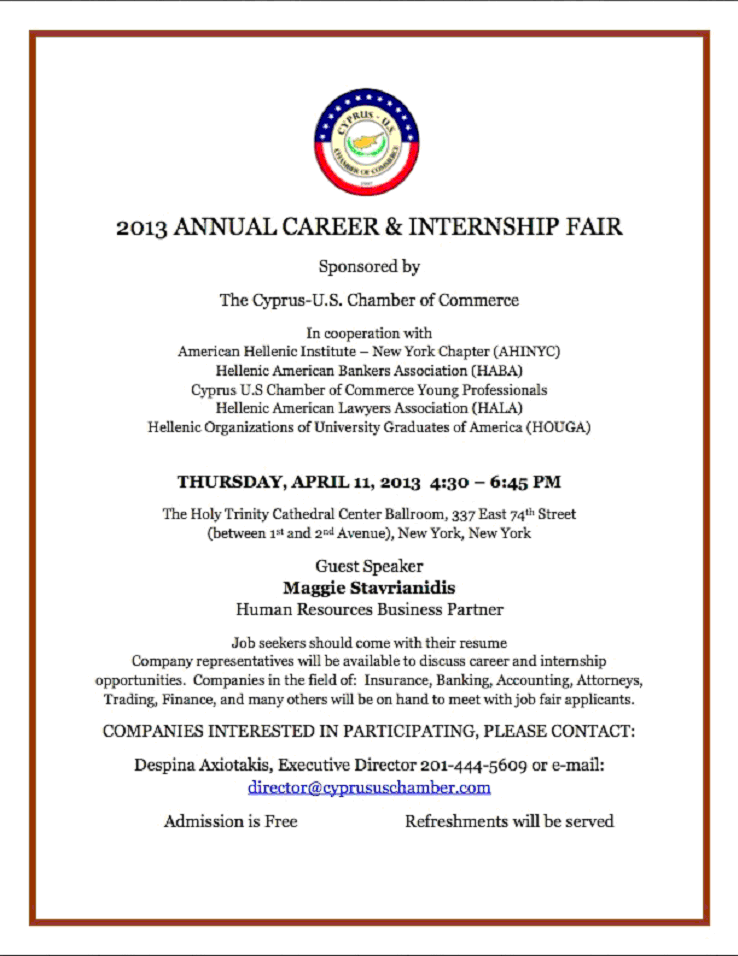
In the interest of members and readers of the Bulletin we relay the following Announcement of the Cyprus-U.S. Chamber of Commerce concerning placement opportunities at a Career Fair:
Cyprus – U.S. Chamber of Commerce Career Fair
The Unquenchable Light of 1821 will sparkle again in Fort Lee, NJ this year
HL member Alex Floratos, who is chairing the event, informs us that the Hellenic Civic Club of Fort Lee will be celebrating Greek Independence Day on Saturday , March 23 2013 with participation of a good number of officials holding office in this municipality, in addition to a sizable presence of townspeople. Invited dignitaries include the mayor of Fort Lee, the Superintendent of Schools, the Chief of Police along with a detachment of officers including several of Greek descent, and others. The dignitaries are expected to address the participants for the occasion; in addition, scheduled speakers from the local Greek American community will highlight the meaning and value of the War of Independence, for Greece and for Greeks everywhere. Invocation will be offered by the Dean of the Greek Orthodox Cathedral of St. John the Theologian, in Tenafly, NJ. The event will feature a presentation of traditional Greek dances by teams of Junior and Senior GOYA members, and will be concluded with lunch for hundreds sponsored by 2 banks and over 10 Greek eating establishments in the vicinity of the city. The event will take place at the Recreation Center of Fort Lee, Stillwell Avenue, at 2:00 p.m. We congratulate Mr. Floratos and his colleagues of the Fort Lee Hellenic Civic Club for the thoughtful and meaningful scope and high quality commemorative celebration they organized for the proclamation of the Revolution of 1821 and for the reclaiming by the Hellenes of their inalienable rights to freedom, thus breaking a centuries long and bitter servitude to Ottoman rule. This event and many more like this taking place throughout the country this month attest to the vitality of the Greek ethnic soul and the continuing attachment of the Greek American community to its heritage of Hellenic ideals, for the good of itself as well as of the entire American society.
On-Line Course in Modern Greek Offered Free
In cooperation with the Institute for Language and Speech Processing (ILSP)/
“Athena” Research Center, the Hellenic Link, Inc. is offering as a service to the community a series of Greek language lessons on its Web site: http://www.helleniclink.org ( on a 24/7 schedule)
On the home page of the site, upper left corner, click on “Learning Greek,”
to be introduced to a series of fifteen lessons of the filoglossia+ courseware.
Please inform anyone who would be interested in learning Greek of this service.
THE HELLENIC LINK, Inc.
A NON PROFIT CULTURAL AND SCIENTIFIC ASSOCIATION
OF HELLENES AND PHILHELLENES
INCORPORATED IN DELAWARE
Suite No. 278, 38-11 Ditmars Blvd, Astoria, New York 11105
Email: info@helleniclink.org
Contact Telephone: (718) 217-0430
Website created by Avekta Productions Inc., New York , NY