4. Modular Teaching

Posted by: Editors  :  Category: News & Articles

Modular Teaching of Hellenic Cultural Themes:  The Crucial Link Connecting Content and Pedagogy 1

by

Constantine G. Hatzidimitriou, PhD
St. Johns University, NY & NYC Dept. of Education

First of all, I must thank the Conference organizers, AFGLC and my colleagues at Hellenic Link, Inc., for inviting me and encouraging me to develop and to present this paper.  In the time I have I will attempt to accomplish three objectives: (1) present a brief overview of the evolution of the teaching of Hellenic Studies in the United States at the elementary, secondary, and tertiary education levels in both private and public institutions, with particular emphasis on developments during the last forty years; (2)   attempt to demonstrate that a lack of alignment has resulted in a systemic failure to link the content of Hellenic Studies to major themes and subject matter in the American educational mainstream, especially at the level of public elementary and secondary schools; and,  (3)  propose that the way to reverse this marginalization and decline is to institute a systemic modular approach to the core subjects of Hellenism utilizing solid links between academic specialists and the sectors of the elementary and secondary private and public school systems, and provide a sample of what these modular teaching resources could look like.

Part One:

The ideals, language and history of Hellenism have had a place in American public education since the nineteenth century.  Although with the move towards more practical and career oriented subjects in the early twentieth century the classical tradition became de-emphasized — knowledge of the classics, broadly defined — has remained part of the curriculum and continues to represent an opportunity for us.[i] With one notable exception, to which I will shortly refer, the history, language and culture of Byzantium and Modern Greece have never gained a place in the public schools, and have only been brought forth on the strength of the efforts of individual teachers and local community interests.  In fact, recently a gifted schoolteacher from New York created something of a sensation through a series of podcasts on the “lost” legacy of Byzantium in the West.[ii] The same is true of Greek-American studies which largely does not exist within the multicultural and immigrant subject matter public schools study, and is still rare within ethnic studies programs in colleges and universities.[iii]

Three events in the late 1960s occurred together to present the Greek community with an unprecedented opportunity with regard to the public school system and American higher education institutions.  The first was the passage of the Immigration Act of 1965 that enabled a new wave of Greek immigration; the second was the Bilingual Education Act and related Supreme Court decision in 1974; and the third was the creation of the Modern Greek Studies Association in 1968.[iv] The first two events meant that for the first time, Greek language and culture received massive amounts of federal and state aid, and was legitimized within the bilingual/multicultural educational establishment that was created throughout the nation.

In New York City, the Greek-American communities of  Washington Heights,  Bayridge, Brooklyn, and especially LIC/Astoria, hired Greek bilingual teachers and counselors and received funding to create curricula and resources that could meet the needs of newly arrived Greek immigrant students and their families.  Greek-American School Board members were elected, and many Greek-American educators were hired and found support for the promotion of Greek studies from within the public school bureaucracy.  In fact, utilizing these funds, a full-time resource position in Greek bilingual education was created at the Central NYC Dept. of Education whose sole purpose was to maintain Greek educational resources and assist teachers and others in using them.  There were even some short-lived Deputy Superintendents of Greek origin, although no Greek-American made it to the highest levels of the system in NYC — unlike in Chicago.[v]

By the 1980s, Greek holidays were celebrated in public schools in many places in NYC and elsewhere, as well as officially recognized by the teachers union and educational establishment.[vi] In fact, public sector Title VII funding enabled the creation of so-called Regional Curriculum Resource Disseminated Centers, which included Greek language and cultural materials among their offerings.[vii] These Greek educational materials were created by grants to individuals and institutions that presumably had the expertise to write them, and funding was provided to colleges and universities in order for them to provide technical assistance and sponsor research, including doctoral dissertations in these areas.  One of these institutions was the Florida State University which received large grants and produced the largest number of doctoral dissertations in the nation related to Greek Bilingual Education under the supervision of Dr. Byron C. Massialas.[viii]

During this period, professional public school educators associations, such as the Hellenic Educators Association in NYC and its counterparts in Chicago and elsewhere, were established.[ix] At the same time, because of the increase in Greek immigration in the 1960s and 1970s, the Greek Orthodox Archdiocese increased the number of Greek-American day and afternoon Schools throughout the U.S., especially in large urban centers, and attempted to infuse them with new resources.  For example, St. Demetrius, the Greek American Day School in Astoria, New York, increased its grade levels to high school and the New York and Illinois State Education Departments began to award high school graduation credit for Modern Greek through Regents exams.[x]

While all of this Greek education-related activity was taking place in the public and private sectors of the U.S. Educational system, similar developments were occurring in colleges and universities.  The Modern Greek Studies Association (MGSA) was founded in 1968 and listed its original purpose as an:

“American-based, non-profit, tax-exempt organization of scholars, students and other interested persons, established for the purpose of promoting modern Greek studies, particularly in the United States and Canada, but also wherever else interest exists and support is needed…. The Association sponsors symposia and seminars devoted to Modern Greek subjects: language, literature, history, the social sciences, and the fine arts.  It issues and supports publications in the areas of its interest.  It also serves as a center for information on programs and activities in the field of Byzantine and Modern Greek studies.”[xi]

Although the statement above does not make it absolutely clear, the Association was and has been almost exclusively concerned with Modern Greek Studies at the tertiary level, and has evolved into “THE” professional organization for academics in the field in the U.S. and Canada.  Indeed, its symposia and conferences have established a high professional standard for the field, and its journal has published significant research on virtually all aspects of Modern Greek Studies. An examination, however, of its publications to 2008, does not indicate any significant involvement in Modern Greek Studies, broadly defined, at any level other than the university.  The only exception is the occasional article in its journal of Modern Greek Studies which sometimes refers to or concerns other educational levels as part of a specialized study.[xii] What is noteworthy is that, although the MGSA mission statement indicates that it serves as an information and communication center for the study of modern Hellenism — which presumably includes all sectors of the educational system and the community, it does not appear to have made any significant contributions outside of college and university settings.   This situation is both fortunate and unfortunate, since from a practical point of view, this means that: on the one hand, educators and students outside of the “Academy” have not had access to or benefited from the progress that has been made in MGS during the last thirty years, consequently, the content of instructional materials at public and private school levels has not been guided by the increased expertise of scholars in these fields that have become more prevalent in U.S. institutions;  on the other hand, these educators have also been shielded from some revisionist MGSA-supported viewpoints, based on new theoretical perspectives borrowed from anthropology and other social sciences, that have “deconstructed” much of what they still take for granted with regard to Hellenic identity, continuity with antiquity, and cherished historical “facts” concerning  Hellenism.

Over the years, the MGSA has received grants from American-, Greek-American-, and Greek government-related sources for its activities, and has grown into an important academic association with a solid presence on the internet as well.[xiii] Its members dominate the training of young scholars in the field, and through undergraduate programs assists in shaping what Hellenism means to younger generations who care enough to be seriously interested.

The aims of the American Foundation for Greek Language and Culture, the sponsor of this Forum/Conference at the University of South Florida, are similar to those of the MGSA, since AFGLC also places its emphasis on the tertiary level.  Clearly, however, as the list of presenters indicates — with a few notable exceptions, the Foundation and its conference is not dominated by content area specialists in the fields of Byzantine and Modern Greek Studies.   In fact, the symbolism used on the Conference Program and the structure of many of the panels is quite different from MGSA conferences in recent decades, and places emphasis more on school levels below the tertiary, in pedagogy and the teaching of Modern Greek, an innovation for which I offer my congratulations.

What I have not examined in any detail is the eternal and fruitless debate over the importance of teaching the Greek language as opposed to Hellenic culture, broadly defined. This subject has been the topic of numerous studies and newspaper columns, and is at the core of what the Greek-American secular and religious communities consider a crisis on preserving [Greek] identity in the United States.[xiv] Suffice it to say, [that] Modern Greek language study and acquisition alone has not proven to be the road to ethnic survival — as the decline in church-related Greek language programs shows– and that language acquisition must be coupled with appropriate and relevant cultural content in order to be effective.   This is one reason I believe that cultural modules are crucial for success.

Having provided a brief historical overview of the development of Greek studies Education in the U.S., I will now turn to part two.

Part Two:

What is the result of these more than twenty years of public and private investment in Hellenic Education at the elementary, secondary and higher education levels of the U.S. educational system?  The bitter truth is that no permanent foundation was laid and no solid bridges to mainstream public education were created.  In the 1990s, as Greek immigration waned and Greek-American communities became more affluent and more assimilated, the public school legal mandates in bilingual education no longer applied to Greek language or cultural studies.   What had been created through public- and Church-affiliated schools — even though largely uniformed by scholars in MGS, was not built upon and collapsed like a “house of cards.”   By 2001, retirements and re-organizations had largely wiped out Greek-American influence in the NYC and Chicago public schools.  At present, even in Astoria, Queens, Modern Greek is rarely taught in public schools, and related subject and cultural activities are virtually non-existent.  A notable exception is the fine Greek language program at the Bronx High School of Science — which is an example of individual initiative and external funding, not  the efforts of the past.[xv] As the Director of Social Studies Education for a large portion of the NYC public schools in Queens, I can attest to the fact that we receive no competitions, materials, or resources of any kind related to Hellenism.  Even the Greek bilingual educational resources that were created in the past, both in NYC and nationally, have largely disappeared.

The situation in terms of the number of Greek Orthodox Archdiocese affiliated day and afternoon schools and their curriculum resources does not fare better.  In fact, recognizing the looming crisis, the Archdiocese sponsored a task force to study the problem of Greek language schools, which issued a report in 1999.  More recently, the Archdiocese has increasingly turned to foreign assistance for materials development and teacher training from Greece through the Paideia Project of the University of Crete and SAE.  Yet, despite these efforts, Archdiocese- related schools and programs continue to lack a uniform curriculum in Hellenic studies and high quality language and cultural resources.[xvi] Additionally, new technology-based materials for Greek language and Hellenic cultural instruction also remain almost completely unknown.

At the tertiary level, generous endowments of private and public funds, and the increasing acceptance of Modern Greek language and culture as legitimate fields of study, have resulted in more stability and a significant growth in programs offered.   In December 1971, the MGSA issued a report based on a survey it conducted on “The State of Modern Greek Studies in North America,” which indicated that twenty-eight institutions in the U.S. and Canada offered courses on Modern Greek language or were planning to do so.  It is interesting to note that thirty-seven years later, the MGSA reported to its membership that a survey conducted between 2004 and 2007 indicated that by the end of the 2007-2008 academic year, twenty-eight institutions reported having Modern Greek Studies Programs, with twenty-six offering courses in first-year Modern Greek language.  While there is no question that the range and extent of courses being offered in Modern Greek language and culture have greatly increased, it would also appear that MGS have not become more widespread within American higher education since 1971.  In fact, it appears that some institutions which offered Modern Greek in the 1970s no longer do so, while approximately half of those listed in 1971 still do.[xvii]

I believe that we would have had a very different result if the extensive resources and expertise that was applied to the study and teaching of Modern Greek language and culture during the last several decades had been implemented and linked together at all levels within the public and private U.S. educational systems.  Furthermore, I also think that opportunities to link the Hellenic subject matter to topics within the required American curriculum and state/national standards of public and private grade K-12 schools would have made MGS more relevant to general education, and help recruit both Greek-Americans and philhellenes to the more challenging programs offered by colleges and universities.  These links would have also improved the quality and range of the instructional materials created in both public and private schools by taking advantage of the content knowledge of scholars of Hellenism and specialists in pedagogy, curriculum/staff development and presentation, which would have had a dramatic impact upon the quality of instruction and student motivation.

Others at this conference will deal with methods and ideas concerning the teaching of Modern Greek.  I will limit my remarks to one example related to Modern Greek history which draws upon my academic training and expertise.[xviii] It is to this subject that I will now turn in part three of this presentation.

Part Three:

In order to be effective, the Greek related material must be integrated into the existing curriculum and meet mandated local and national standards.   Public school teachers do not have time for exotic additions that do not relate to standardized assessments.   What is presented below is a draft to give an idea of what I mean.   Obviously, it needs to be expanded upon, refined and linked to technology based resources.   Follow-up project-based activities could also be added, as well as pod-casts, and differentiated activities involving role-play and debates.   The draft modular guide on “America and the Greek Revolution” relates to seventh grade middle school American history subject matter and links the content of the revolution of 1821 to major themes in U.S. history, such as religious freedom, individual rights, slavery, and nineteenth century American foreign policy.  It utilizes the same pedagogical approaches used for mainstream social studies content utilizing primary sources, higher order thinking skills, “big ideas,” curriculum mapping, and differentiating instruction.  At the same time, its content is based upon the latest tertiary-level scholarship in Modern Greek Studies and is informed by scientifically validated research.

Teachers Notes for American History Foreign Policy Module appropriate for 7th or 9th Grades

DRAFT COPY by Dr. Constantine G. Hatzidimitriou, February 2010

Relationship to New York State Social Studies Thematic Strands:

VI:  Power, Authority, and Governance –The complex purposes and features of individuals and groups with respect to issues of power and government.

IX: Global Connections – The critical importance of knowledge and awareness of politics, economics, geography, and culture on a global scale.

Grade 7 Unit 3:  A New Nation

Essential Question:  How did the new nation respond to independence?   Farewell Address.  Freedom of Religion: Independence and Revolution from Slavery.

Focus Question:  How did Washington’s Farewell Address Influence Subsequent American Foreign Policy?

National History Standards Met: Chronological Thinking; Historical Comprehension; historical Analysis and Interpretation; Historical Research Capabilities; Historical Issues –Analysis and Decision Making.

Literacy and Higher Order Skills Connection: Interpretation of documents — multiple perspectives, Document-Based Questions (DBQ).

Background Information:  Two of the most important documents which have influenced American Foreign Policy are President George Washington’s Farewell Address (1796) and President James Monroe’s Annual Message to Congress (1823).  This resource module offers an opportunity for students to explore the issues involved in applying the principles embodied in these historical documents to a case study of a European conflict:  the revolt of the Greeks against the Ottoman Empire in 1821, and their request for American aid and intervention.  The analysis of the case study of Greece should then be applied to others.

Materials Needed:  maps, audio-visual materials, artifacts and other hands-on materials.

Document A:  Washington’s Farewell Address

Document B: The Greek Revolution of 1821 and American Neutrality

Document C:  The Monroe Doctrine

Document D:  Compromise and American Neutrality

Student Activity: Divide the students into differentiated groups depending on their literacy levels and background in American history.  Distribute the Documents to each group and ask them to decide upon a group leader who will be the spokesperson for their group.  Review any vocabulary and historical background that you feel is appropriate for this activity.  Decide on how much time you will give each group for the consideration of the issues posed in each document.  You may wish to return to each one to reinforce the learning points at the start of working on another document.

Document Discussion Questions:

Document A:  Washington’s Farewell Address:

1.      What is the historical context of this document?  Who wrote it and why?

2.      What is his advice with regard to the nation concerning foreign entanglements?

3.      Does he advocate a total non-involvement in foreign affairs or does he qualify his viewpoint?

4.      How does his advice impact foreign commercial relations and American economic interests?

5.      Why does he give the advice to the nation that he advocates?

6.      Do you think his advice has been beneficial to the United States or has it been negative?

7.      Can and should Washington’s ideas be applied to American foreign policy today?

Document B: The Case of the Greek Revolution of  1821

1.       Who are the Greeks and why are they revolting against the Ottoman Empire?  Where are they located?

2.      Who is sending this document to the United States and for what reason?  How do you think it was circulated?

3.      Why do the Greeks think that the American people should aid them in their struggle?  What do they think they have in common?

4.      What advantages for the United States do you think the writers of this document expect might be as result of aid?

5.      How does former President Jefferson react to the appeal of the Greeks for aid?

6.      How do these documents relate to the advice given in Washington’s Farewell Address?

7.      What do you think happened?  Do you think the U.S. aided the Greeks?  Should they have been sent aid?  What other nations were asking for aid from America at this time?

Document C:  The Monroe Doctrine

1.       What is the historical context of this document, who wrote it, who is the audience,  and why was it written?   What part of the world does it concern?

2.      What is President Monroe adding to the ideas concerning American foreign policy contained in Washington’s Farewell address?

3.      Who is Monroe trying to protect in this address?  Who is he concerned about?

4.      Do you think the United States should have made a declaration like this at that time?

5.      Why does he think it was in America’s interest to announce this policy or doctrine to the world?   What could have been the result?

6.      Has this addition to American foreign policy been applied beyond 1823?  Do you think it has had a positive or negative effect?  Is it still applicable today?

7.      Why does President Monroe refer to the Greeks as part of his message to Congress?  Does he advocate sending aid?  How does what he has to say relate to the previous two documents.

Document D:  Compromise on American Neutrality

1.       What is the context of the document by President Madison and why do you think he wrote it?  Who was the audience?

2.      How does it relate to Washington’s Farewell Address and the Monroe Doctrine?

3.      What is a frigate and why does President Madison suggest the American government send another one to the Greeks?

4.      Why did he not think sending frigates to help the Greeks violated the principles of American neutrality?

5.      Do you think what President Madison advocated was popular at the time?  Do you think it was a good idea?  How do you think the Ottoman Turks reacted?

6.      Does America send military aid to foreign nations today?  Is this considered a positive aspect of American foreign policy?

7.      Why do you think the Congress is sending instructions to Commodore Rogers concerning aid being sent to Greece from New York City?   Is this sending of this aid a violation of American neutrality?

8.      Why do you think the American aid ship might need protection?  Do you think sending humanitarian and military aid helps or hinders American foreign relations and commerce?

All of the documents concerning Greece are reproduced from:

Founded on Freedom and Virtue: Documents Illustrating The Impact in the United States of the Greek War of Independence 1821-1829 edited by Constantine G. Hatzidimitriou,  (New York, Aristide D. Caratzas Publisher: 2002).

DOCUMENT A

Washington’s Farewell Address 1796

Washington’s Farewell Address was the message to the American people published by outgoing President George Washington on September 17, 1796. Washington wrote it during the height of a divisive Presidential campaign. In it he outlined three principles that he believed the new nation should follow in public affairs. First, sectional antagonisms should be put to rest. Second, “the baneful effects of the spirit of party” should be muted because they threatened liberty by subordinating people to demagogic leaders and hampering the ability of the President to promote the national interest. Third, U.S. diplomacy should “steer clear of permanent alliances” and “trust to temporary alliances for extraordinary emergencies.”

The address was controversial. The United States did follow one piece of his advice: it did not enter into permanent military alliances with other nations until the end of World War II.

1796

Friends and Citizens:

….The great rule of conduct for us in regard to foreign nations is in extending our commercial relations, to have with them as little political connection as possible. So far as we have already formed engagements, let them be fulfilled with perfect good faith. Here let us stop. Europe has a set of primary interests which to us have none; or a very remote relation. Hence she must be engaged in frequent controversies, the causes of which are essentially foreign to our concerns. Hence, therefore, it must be unwise in us to implicate ourselves by artificial ties in the ordinary vicissitudes of her politics, or the ordinary combinations and collisions of her friendships or enmities…..

…It is our true policy to steer clear of permanent alliances with any portion of the foreign world; so far, I mean, as we are now at liberty to do it; for let me not be understood as capable of patronizing infidelity to existing engagements. I hold the maxim no less applicable to public than to private affairs, that honesty is always the best policy. I repeat it, therefore, let those engagements be observed in their genuine sense. But, in my opinion, it is unnecessary and would be unwise to extend them…..

Taking care always to keep ourselves by suitable establishments on a respectable defensive posture, we may safely trust to temporary alliances for extraordinary emergencies.

In offering to you, my countrymen, these counsels of an old and affectionate friend, I dare not hope they will make the strong and lasting impression I could wish; that they will control the usual current of the passions, or prevent our nation from running the course which has hitherto marked the destiny of nations………

Document B

The Greek Revolution of 1821 and American Neutrality: A Test Case

Between 1821 and 1830 thousands of people throughout the United States became involved in expressions of sympathy and raised millions of dollars in aid to assist the Greeks in the their revolutionary struggle to win religious and political freedom from the Ottoman Empire.   Newspapers called the phenomenon “Greek Fire” and even African Americans who themselves were not free contributed to the common cause.   This public outcry brought enormous pressure on the U.S. government to intervene in a foreign conflict. Read the documents below and consider how they relate to Washington’s Farewell Address.

May 25, 1821 –Greek Appeal for Aid by Provisional Senate:

To the citizens of the United States of America: Having formed the resolution to live or die for freedom, we are drawn towards you by a just sympathy; since it is in your land that Liberty has fixed her abode, and by you that she is prized as by our fathers.  Hence, in invoking her name, we invoke yours at the same time, trusting that in imitating you, we shall imitate our ancestors, and be thought worthy of them if we succeed in resembling you.

Though separated from you by mighty oceans, your character brings you near us…..  It is for you, citizens of America, to crown this glory, in aiding us to purge Greece from the barbarians, who for four hundred years have polluted the soil.  It is surely worthy of you to repay the obligations of civilized nations, and to banish ignorance and barbarism from the country of freedom and the arts.  You will not assuredly imitate the culpable indifference or rather the long ingratitude of some of the Europeans.  No, the fellow citizens of Penn, of Washington, and of Franklin, will not refuse their aid…

…Greece will furnish you advantages, which you can in vain seek from her ignorant and cruel tyrants; and the bonds of gratitude and fraternity will forever unite the Greeks and the Americans.  Our interests are of a nature more and more to cement an alliance founded on freedom and virtue.

Monticello, October 31, 1823—Response by Thomas Jefferson:

….No people sympathize more feelingly than ours with the sufferings of your countrymen, none offer more sincere and ardent prayers to heaven for their success.  And nothing indeed but the fundamental principle of our government, never to entangle us with the broils of Europe, could restrain our generous youth from taking some part in this holy cause.  Possessing ourselves the combined blessings of liberty and order, we wish the same to other countries, and to none more than yours, which first of civilized nations, presented examples of what man should be…


DOCUMENT C

James Monroe, “The Monroe Doctrine” (1823)

On December 2, 1823 in his annual message to Congress, President Monroe issued the Monroe Doctrine a cornerstone of U.S. foreign policy during the 19th century. He proclaimed the Americas should be free from future European colonization and free from European interference in sovereign countries’ affairs.  As you read, consider the relationship that Monroe sought to establish between the United States, Europe and the continuing Greek revolution.  And, consider the relationship Monroe sought to establish between the United States and the nations of Latin America, many of which had recently declared their independence from Spain. Although it is Monroe’s most famous contribution to history, the speech was written by Secretary of State John Quincy Adams who designed the doctrine in cooperation with Britain

The American continents, by the free and independent condition which they have assumed and maintain, are henceforth not to be considered as subjects for future colonization by any European powers…. In the wars of the European powers in matters relating to themselves we have never taken any part, nor does it comport with our policy so to do….  With the movements in this hemisphere we are of necessity more immediately connected, and by causes which must be obvious to all enlightened and impartial observers…  We owe it, therefore, to candor and to the amicable relations existing between the United States and those powers to declare that we should consider any attempt on their part to extend their system to any portion of this hemisphere as dangerous to our peace and safety.  With the existing colonies or dependencies of any European power we have not interfered and we shall not interfere.  But with the Governments who have declared their independence and maintained it, and whose independence we have, on great consideration and on just principles, acknowledged, we could not view any interposition for the purpose of oppressing them, or controlling in any other manner their destiny, by any European power in any other light than is the manifestation of an unfriendly disposition toward the United States….

The late events in Spain and Portugal show that Europe is still unsettled….  It is impossible that the allied powers should extend their political system to any portion of either [North or South American] continent without endangering our peace and happiness; nor can anyone believe that our southern brethren, if left to themselves, would adopt it of their own accord.  It is equally impossible, therefore, that we should behold such interposition in any form with indifference…. It is still the true policy of the United States to leave the parties [of Latin America] to themselves, in the hope that other powers will pursue the same course….

…A strong hope has been long entertained , founded on the heroic struggle of the Greeks that they would succeed in their contest, and resume their equal status among the nations of the earth.  It is believed that the whole civilized world takes a deep interest in their welfare.  Although no power has declared in their favor, yet none, according to our information, has taken part against them….  There is good cause to believe that their enemy has lost for ever all dominion over them; that Greece will become and independent nation.  That she may obtain that rank, is the object of our most ardent wishes…

DOCUMENT D

A Compromise on American Neutrality based on Popular Pressure and Common Interest

As you read the two documents below, consider how the President and the U.S. government found a way to aid the struggling Greeks and involve itself in a European conflict without formally compromising its policy of neutrality and non-alignment.

President James Madison on the Greek Cause: New York Enquirer-October 12, 1826: excerpted from a letter to the editor

…There is probably no severer duty we can impose upon ourselves as a nation, than to take care of ourselves against an impetuosity of feeling—against a hectic desire to mingle in every contest having freedom for its object.  This feeling is natural—is honorable; but its loose gratification is dangerous.  “Charity begins at home” is a good proverb.  It may be carried too far individually, but not in a national point of view.  Our feelings, our interests, our anxieties, our desires were all with South America in her contest with Spain, yet we were prudent and correct in maintaining our neutral position, which probably saved us from an European war.  How can we, in justice to South America, and in accordance with the settled principles of our government, come out openly in favor of the Greeks and form an alliance with that crude government.

But there may be something done for the Greeks without compromitting this neutrality; and here let it be understood, that we have no fears from Turkey, or from any other European power, should we take sides with the Greeks.   We have to fear the effect of surrendering a principle intimately connected with our own safety and welfare: still we can do something beneficial to the cause, and yet not compromit the government.  A sum of money was sent to the United States to build two frigates for the Greeks.  Owing to the mismanagement of the agents, one of the ships was sold to the United States government …to enable the other frigate to sail.  Now, it is proposed …to give the other frigate to the Greeks.  To this proposition there is no objection, excepting that the act is manifestly a violation of our neutrality.  But there is another, and it strikes us, a better mode of reaching the point.  Let the frigate be fitted for sea, and sent to the Greek government, taking the obligation to the government to repay to the United States the amount of her cost when in funds.  This would be credit sale; an act of justice….


Instructions to Commodore Rogers, U.S. Mediterranean Naval Squadron, Washington, March 3, 1827

Dear Sir:  The benevolent citizens of New York, hearing of the sufferings of their fellow men and fellow Christians in Greece for want of food and clothing have generously fitted out a vessel loaded with articles for their relief.  She is (with all her cargo) the property of American citizens, consigned to Messrs. Howe and Jarvis, American citizens in Greece.  A confident assurance is felt, that should the vessel fall in with the squadron under your command, you will extend to her all the protection which the rules of the service and the neutral relations of the country permit.

U. S. House of Representatives


[i] See the following surveys:  Meyer Reinhold,  The Classick Pages: Classical Reading of Eighteenth Century Americans (University Park, PA: Pennsylvania State University Press,:1975);  Classica Americana: The Greek and Roman Heritage in the United States (Wayne State University Press: 1984); Carl J. Richard,  The Founders and the Classics: Greece, Rome and the American Enlightenment (Harvard University Press: 1994); and Allan Bloom, The Closing of the American Mind (NY, Simon and Schuster: 1987);  James Atlas, Battle of the Books: The Curriculum Debate in America ( NY, Norton and Company: 1990); and E. D. Hirch, jr., Cultural Literacy: What  Every American Needs to Know (Boston, Houghton Mifflin Company: 1987).

[ii] Lars Brownworth, Lost to the West: The Forgotten Byzantine Empire that Rescued Western Civilization (Crown Publishing: NY 2009); see also http://www.12byzantinerulers.com.


[iii] See Charles C. Moskos,  “ Greek American Studies,”  in  Reading Greek America: Studies in the Experience of Greeks in the United States edited by Spyros D. Orfanos, ( NY, Pella Publishing: 2002)  23-62.; and his earlier overview with the same title in The Greek American Community in Transition ed., by Harry J. Psomiades and Alice Scourby (NY., Pella Publishing:1982) 17-64;  Alice Scourby, “Ethnicity at the Crossroads: The Case of Greek America,”  in Journal of the Hellenic Diaspora (JHD) (20.1, 1994)  special  issue on “Rethinking Greek America” edited by Dan Georgakas, 123-33;  see also the comments of Dan Georgakas and Charles  Moskos in New Directions in Greek American Studies (NY, Pella Publishing: 1991) 9-15; and George A. Kourvataris, “The Futuristics of Greek America,”  in Orfanos, ed., Reading Greek America 145-166.  The issues are also discussed in A Hellenic Education Plan For America (NY., Hellenic Link: 2005).


[iv] See the overview by Vivian Anemoyanis, “Greek Bilingual Education in Historical Perspective,” in Psomiades-Scourby eds., Greek Community in Transition 171-180; and S. P. Orfanos, et. al., eds. Education and Greek Americans: Processes and Prospects (N.Y., Pella Publishing: 1987).  The history of the Modern Greek Studies Association (MGSA) remains to be written—see the comments of an early member, George Giannaris, in Giorgos Giannares,  Politistikoi antagonismoi  kai Ellenismos [Cultural Conflicts and Hellenism] Athens-Komotini, Ekodseis Sakkkoula: 2000)  351-63.


[v] See the article by Vivian Anemoyanis cited above.  She was the hired as the Coordinator of Bilingual Education for NYC Dept. of Education Community School District 30- Queens which included communities such as Astoria where large numbers of Greek immigrants settled.  What transpired within the NYC Dept. of Education and nationally concerning Greek Bilingual Education remains little studied with the exception of some doctoral dissertations (see below).  The archives for such a study are rapidly disappearing including those of the NYC Dept. of Education’s Bilingual Education Unit.  For Community School District 30—the School Board Minutes and associated are presently housed at the Superintendent’s Office at the NYC Dept of Education Support Center at Queens Plaza in Long Island City.  One can also piece the story together through a careful study of articles and surveys that appeared in the Greek American newspapers of the time in NYC and elsewhere.  For Chicago, see:  Andy Kopan, Education and Greek Immigrants in Chicago, 1892-1973, unpublished Dissertation, University of Chicago, 1973; and the dissertation cited below by Anthony S. Xydis.


[vi] For example, see:  Greek Heritage and Culture Week Resource Unit prepared by John G. Siolas with the assistance of Steve Papadopoulos (New York City Public Schools Office of Bilingual Education Center for Curriculum Development: 1983).


[vii] For example:  The Hellenic Heritage Series by Constantine Georgiou, Ph.D., (Northeast Center for Curriculum Development, Community School District 7, Bronx, New York: n.d., circa early 1980s?).


[viii] George Flouris, “The Self-concept and Cross-cultural Awareness of  Greek American Students Enrolled in the Monolingual and Bilingual Schools,” unpub. Diss. Florida State University, 1978;  John Spiridakis, “The Effects of Greek Cultural Units Drawn from the Popular Arts on Greek-American Students’ Attitudes Toward and Knowledge of the Greek Culture,”  unpub. Diss. Florida State University, 1978; A. Papadopoulos, “A Comparative Study of Attitudes of Alienation Among Greek-American Children Attending Monolingual and Bilingual Schools in New York City,” Florida State University: 1978; the production of doctorates of this type continued into the 1990’s—for example see Anthony S. Xidis, “The Impact of Greek Bilingual Programs on the Academic Performance, Language Preservation and Ethnicity of Greek-American Students: A Case Study in Chicago,” unpub. Diss. Florida State University: 1993).   See also the comments of Byron C. Massialas, “The Education of Hellenes in America: From Melting Pot to Cultural Pluralism,” in The AHEPAN, vol. LVIII, no. 5, (Washington D.C.: 1984).   The most comprehensive bibliographic listing of dissertations and publications related to Greek-American studies has been published by Stavros K. Frangos and Alexandros K. Kyrou, “Diaspora Studies: Hellenic Diaspora,” in Stratos E. Constantinidis ed., Greece in Modern Times: An Annotated Bibliography of Works Published in English in Twenty-two Academic Disciplines During the Twentieth Century, volume I, (Lanham, Maryland, Scarecrow Press: 2000) 355-78.


[ix] See the bylaws and newsletters of the NYC Hellenic-American Educators Association which is an affiliate of the United Federation of Teachers Union in NYC.


[x] Emmanuel Hatziemmanuel, “Hellenic Orthodox Education in America,” in Psomiades-Scourby, eds.  The Greek Community in Transition,  181-90; Constantine G. Hatzidimitriou, “Church -Community Relations in the United States,”  in Christos P. Ioannides, ed.,  Greeks in English Speaking Countries: Culture, Identity, Politics (N.Y., A.D. Caratzas: 1997);  Spyros D. Orfanos and Sam J. Tsemberis, “A Needs Assessment of Greek American Schools,”  in Orfanos, ed.,  Reading  Greek America, 193-208 and the article on Greek in New York in the same volume (pp. 169-191).  See also the various task forces and conference proceedings cited below concerning Greek Parochial schools and the Archdiocese.  Once again, information in the Plan issued by Hellenic Link is also relevant.


[xi] Reproduced from the MGSA Bulletin, volume VIII, No. 1, September 1976, Princeton, N.J., page 10. Over the years, there have been some slight changes to its mission statement—for example, the 2008 issue of the MGSA Bulletin, vol. XL page 3, adds under Goals and Activities: “Interdisciplinary in orientation, it seeks to stimulate the discovery and diffusion of knowledge about the language, literature, arts, history, politics, economy and society of modern Greece and the Diaspora.  MGSA defines its scope broadly to include not only post-independence Greece but also the period of Ottoman rule and the later Byzantine Empire, as well as aspects of early, Byzantine, Hellenistic, and Classical times that have a bearing on the modern period.

MGSA’s activities since its foundation have been extensive.  It has convened international symposia and summer seminars, has issued periodical publications, and has produced a number of significant volumes on Greek history, literature, and society.  It also serves as an information and communications center for all persons seriously interested in the study of modern Hellenism.”


[xii] The Journal of Modern Greek Studies replaced the original joint publication entitled Byzantine and Modern Greek Studies.   The MGSA routinely publishes meeting minutes and reports on its activities in its Bulletin.


[xiii] Financial reports on grants and the Association’s budgets have been issued to members through its Bulletin over the years.


[xiv] Many of the previous publications concerning Greek American Studies concern the language issue and the subject of teaching Modern Greek.  For a conference publication that was exclusively devoted to this subject, see:  Anne Farmakides, et al., The Teaching of Modern Greek in the English Speaking World: A Review of the Discipline, Evolution and Teaching Approaches (Brookline, MA:  Hellenic College Press: 1984; and for a Greek university perspective see:  Michales Damanakes, Paideia Omogenon [Education of Greeks Abroad]  (Rethymno, University of Crete: 1999).


[xv] Constantine G. Hatzidimitriou, “The Greek American Community in New York,” in Kenneth T. Jackson, ed., The Encyclopedia of New York City (New Haven, Yale University Press: 1995) 503-4; new edition with updated article is forthcoming.


[xvi] The Future of the Greek Language and Culture in the United States: Survival in the Diaspora (A Report from the Archbishop’s Commission on Greek Language and Hellenic Culture,  New York, Greek Orthodox Archdiocese of America: 1999).


[xvii] MGSA Bulletin volume 3—No. 2  December 1971 pp. 1, 3-5;  MGSA Bulletin volume XL 2008 page 46.   The MGSA website indicates a few more institutions than those listed in their bulletin which offer Modern Greek; and it must be noted that the establishment of Centers in institutions such as at Queens College/CUNY, Michigan, Harvard, Princeton  and others are real achievements, although their long-term longevity remains to be seen.  Each MGSA Bulletin contains a report on the  current major  MGS programs—a study of all of these reports would be quite illuminating—and give a more precise idea of the new and continuing programs over the years.  I have also not been able to compare the levels of MGSA membership over time.  These numbers would also be a rough gage of expansion, stability or decline.


[xviii] See Constantine G. Hatzidimitriou, ed., Founded on Freedom and Virtue: Documents Illustrating The Impact in the United States of the Greek War of Independence 1821-1829 (Aristide D. Caratzas, New York: 2002).   Another example could relate Byzantine history in connection with Global Studies courses at the High School Level and link sources connected to the introduction of silk into the West and the extensive trade conducted in the East by Byzantine merchants long before Marco Polo.  One should also note the excellent Teachers Resource Guide produced by the Pontian Society of Chicago which puts historical material into the public schools concerning the Asia Minor Catastrophe and Genocide.


———————————————–

1 Paper presented at the 15th Annual Educational Event AFGLC-ICHS Forum/Conference, University of South Florida, Tampa, FL & St. Petersburg

College, Tarpon Springs, FL, February 19-20, 2010.

A contribution from the Advisory Council on Hellenic Education of the Hellenic Link, Inc., New York.
5. Hellenic Paideia

Posted by: Editors  :  Category: News & Articles

HELLENIC PAIDEIA: COLLEGE LEVEL EDUCATION FOR HIGH SCHOOL STUDENTS1

Dean C. Lomis, Ph.D.
Emeritus Director, International Center
University of Delaware, Newark, DE

Prologue

When asked how much educated men were superior to uneducated, Aristotle replied: “As much as the living are to the dead.”
Euripides advocated: “Who so neglects learning in his youth, loses the past and is dead for the future.”
Diogenes emphasized that “Only the educated are free.”
The ancient Greek poet Pindar advised: “That which is silent dies.”
Benjamin Franklin promoted that “The good education of youth has been esteemed by wise men in all ages as the surest foundation of happiness.”
The famous educator Maria Montessori maintained that “The unknown that can help humanity is that which is hidden in a child.”
And, recently — now-retired — Pennsylvania Supreme Court Justice Nicholas Papadakos remarked: “The Greek American is doing away with the Greek language, heritage and culture in one generation, which the Turks could not do in Greece over 400 years of occupation, intimidation and extermination.”

Introduction

The concern that we are losing our youth from our Hellenic heritage and culture is now a major reality.  Unlike yesteryear, the vast majority of Greek American youth today falls in the negative with regard to Greek heritage and culture.  Young Greek Americans may certainly identify as being “Greek,” but if asked what this means, the vast majority would not be able to explain.  Just like being “American” is not only hot dog and apple pie, baseball and coca-cola, likewise being Greek is not only feta and souvlaki, baklava and syrtaki.

Currently, the second and third, and even fourth, generations of Greek Americans who comprehend the dilemma, but who desire to maintain and improve Hellenism for their offspring, find themselves at a loss on what to do.  Some try to bring preschool children together to watch Greek video tapes and listen to Greek children’s songs; some make a valiant effort to speak some Greek at home; some establish nurseries at their Hellenic community center; and, some are considering other initiatives. All these efforts or considerations certainly deserve commendation.  However, unless some serious national program is developed so that the emphasis will be united and extended, all the aforementioned – as well-meaning and as good as they may be – they will only be “band-aid” approaches.

The Issue

Our Hellenic American communities are experiencing serious difficulties with upper high school and college-level Greek Americans attending church, maintaining their Greek language and their Hellenic heritage and culture, and remaining in the community, including marriage, after completion of their formal education.  Since times have indeed changed, it is no longer necessary to “Americanize” a “Greek immigrant community.”  AHEPA did a masterful job on this – perhaps even too good – for, as our then-Senator of Delaware and now our nation’s Vice President – a strong philhellene – has said: “Stop trying to be ‘super-Americans’.”  Rather, the task now is to “[re]Hellenize” an “American society of Greek descent.”

The Need

Considering the present situation both a challenge and an opportunity, a need is clearly apparent for innovative and creative ideas to provide new approaches of relevance to the interest of the young, beyond the well-meaning but “band-aid” attempts.  In our increasingly interdependent world, the maintenance of the language, religion, heritage and culture of our forefathers is paramount to the continuity of our communities and to the best interests of our country, the United States of America, in bilateral terms with the country of our ancestry, Greece.  The events of September 11, 2001 certainly attest to this when some 3,000 victims from several countries, the most from the United States, including Greek Americans and Helladic Greeks and a Cypriot, perished in that dastardly terrorist attack.

There is dire need, therefore, for our young to learn and maintain the Greek heritage and culture for their own “quality of life,” and in promoting the continuity of the Hellenic spirit upon which our Founding Fathers developed and established this “empire of reason” based on the “age of reason” of the classical Greeks.

The Objective

The objective of the plan for “Hellenic Paideia” I present today is at least six-fold: to the benefit of our future generations and their families; to our Greek Orthodox Church; to our Hellenic communities; to the organizations which might decide to support it; to this, the University of South Florida, if it accepts the challenge and the opportunity to promote it; and, to our ancestral land of Greece.

The Benefit

The benefits of this proposal are perhaps endless; for the young: the opportunity to begin their higher education at an earlier age, thereby developing an earlier reality of the need and understanding of higher education; for the parents: the satisfaction that a “structured” national program is operating, which also provides substantial college-education financial savings; for our Greek Orthodox Church: the providing of needed services which, in turn, receive greater youth attendance; for our Hellenic communities: greater participation and involvement; for our organizations: relevance; for our Greek afternoon or evening schools: meaningfulness as preparatory for advanced study; for the University of South Florida Hellenic Studies Program: the opportunity to lead the effort and become the focal center of our youth’s Hellenic education; and, for Greece: renewed and stronger bonds.  Let us not fool ourselves.  Young Greek Americans do not share bonds with young Helladic Greeks.  A very good example is our college campuses.  Very few Greek American students socialize with students from Greece.  Even among themselves, Greek Americans do not make sustained effort from day one on campus – as in the past – to meet other Greek students from the U.S. or Greece.  Meetings are usually accidental and usually not durable.

The Procedure

A.    Structure
1.    As an accredited tertiary institution, the University of South Florida with its successful Hellenic Studies Program be supported in developing and administering a nationwide college level program of Hellenic studies for high school students and others who may wish to enroll.
a.    Under the guidance of the University’s Program, each and every Hellenic community across our nation establish an extension program to offer a uniform curriculum of Hellenic studies college-level program for high school students.
b.     Each community, under the supervision of its parish council, recruit teaching faculty from among its parishioners and from local colleges and universities, who meet the criteria of the South Florida’s guidelines, to be offered adjunct professorial positions with the University of South Florida Hellenic Studies Program.
c.    The extension curriculum should be as follows, based on high school academic terms but for college credit.

Freshman Year

Fall semester: Elementary Modern Greek I (3 college credits): This course should be very elementary, to some extent a review for those with Greek afternoon/evening school background.  It should teach grammatical structure in the manner foreign languages are taught at U.S. colleges and universities.  Included should be information on how the Greek language has influenced the West and the English language, beginning by showing that of the 26 letters of the English alphabet 16 are derived directly from the Greek, in capital form.
Spring semester: Elementary Modern Greek II (3 college credits): Continuing from the first term, students should be able to construct simple sentences, begin to read ably, and start conversing at a comfortable level.  Included should be information on how much the Greek language has influenced the English language, as students begin to recognize the English words derived from Greek.

Sophomore Year

Fall semester: Intermediate Modern Greek I (3 college credits): This course is to expand on the grammar, moving into syntax structure, and showing that of the 166, 724 words in The Webster International Dictionary, 41,214 (25%) are Greek in origin; and, that if the words with Greek prefixes and suffixes are added, the percentage rises considerably, and if the Latin words derived from Greek are also added,the percentage rises significantly.
Spring semester: Intermediate Modern Greek II (3 college credits): This course is to solidify the working knowledge of the language, and show students that comprehending Greek strengthens their English.

Junior Year

Fall semester: History of Ancient Greece (3 college credits): This course is to offer students knowledge not only on the heroic exploits, but more so on the significance of ancient Greece.  This should solidify their knowledge that the story-like [paramythenioi] characters they heard in passing at Greek afternoon schools or at home, or to some minor extent in their American middle school classes, were indeed real, and the precursors of our own American democracy.  In addition, they would learn the importance of the wars and victories over the Persians in preparing and protecting the birth of Western Civilization.

Spring semester: History of Modern Greece (3 college credits): This course is to show the significance of Byzantium in the continuity of Hellenism, attaining new levels of intellectual and humanistic achievements, becoming the guiding light of Western Civilization through the Dark Ages.  The course will include how the Greeks maintained their Greek spirit and identity during the course of 400 years of Tourkokratia, and the importance of the Greek Revolution and Independence.  It will also cover the significant Greek role in the global perspective through its preservation of Western Civilization by its heroic stand in World War II, and conclude with its present-day relevance as a member of the European Union and as the economic leader of the Balkans.

Senior Year

Fall semester: The American Hellenic Society (3 college credits): This course is to offer insights of the Greek American experience throughout the centuries from the discovery of America to the present.  Students should be both fascinated and excited to learn that from the time of Columbus the Greek human element was present in the New World; that the first Greek settlement was in St. Augustine, Florida; that Americans went to Greece and fought in the War of Greek Independence because they felt so strongly about  Greece; that in the development of America Greeks played significant roles from workers building the transcontinental railroad to being professors at esteemed academic institutions; that Greek Americans have had enormous successes in business, government, and in research institutes; that Greek Americans have held high positions of responsibility, like the Greek American Commandant of the U.S. Naval Academy in the second half of the 19th Century; that the first Greek American (and Greece-born at that) U.S. Congressman came from Wisconsin in the third quarter of the 19th Century; that the United States organized the Greek-American Battalion which eventually fought gallantly and was highly decorated by the French government for its valiant contribution during World War II in France; that U.S. Major General Gus Pagonis, when ordered by General Colin Powell to develop a supply plan for Desert Shield in Iraq in 1990, he applied — with modifications for present-day requirements – the plan Alexander the Great developed for his march through Asia; and so much more.  They might even learn that after the dastardly Turkish invasion of Cyprus, when our U.S. policy-makers were not responding because there was not much outcry from an otherwise unaware American public, the Greek restaurateurs in downtown Chicago shutdown their restaurants one Monday noon, to the confusion of the public, which was educated that day outside the closed restaurants, in turn compelling their then-Senator Charles Percy ultimately to support the Greek cause in Washington.
Spring semester: Orthodoxy in the Americas (3 college credits): Not to be taught as evangelical, this course should inform of the background of Orthodoxy as a religion but in the sociological sense, and explain how it is conducted in Diaspora, and how it is associated with Greece and with the Ecumenical Patriarchate in Constantinople.

Post-High School/Pre-College Summer

The Hellenic Studies Program of the University of South Florida make arrangements with the Aristotelian University of Thessaloniki, or another high-level academic institution in Greece,  for a six-week, two-course summer program, granting 6 college credits, for Introduction to Classical Greek (3 college credits), and Advanced Modern Greek (3 college credits).
Introduction to Classical Greek may be offered 8:00 – 9:30 a.m. and Advanced Modern Greek may be offered 9:30 – 11:00 a.m., daily.  The latter should be followed by an internship experience, with each student assigned from 11:30 a.m. to 2:00 p.m. to a local store to be exposed to direct conversation with the people.  On weekends, the program should include visits to museums, archaeological sites and other points of pedagogical importance, while weekend evenings be  spent frequenting local tavernas and other community functions for the social acquaintance of the participants.

Curriculum Distribution

1)    The four semesters of elementary and Modern Greek satisfy the two-year, twelve-credit foreign language requirement of any college or university.
2)    The two semesters of history satisfy the one-year, six-credit social science requirement of any college or university.
3)    The two semesters of community life and Orthodoxy (not in religious sense) satisfy the one-year, six-credit humanities requirement of any college or university.
4)    The two summer-study-in-Greece courses satisfy group or elective requirements of any college or university.

Adjunct Faculty Recruitment

1)    Each community recruit potential faculty for adjunct appointment, upon approval by the University of South Florida Hellenic Studies Program.
2)    With regard to faculty for Modern Greek language instruction, each community has individuals well-educated in Greece who can teach college-level elementary and intermediate Modern Greek, under existing or to-be-developed guidelines of the South Florida’s Hellenic Studies Program.
3)    For Ancient Greek History, a professor of Greek History from a  local college or university should be recruited.  Most colleges and universities offer at least one course of Ancient Greek History.
4)    For Modern Greek History, reliance should be placed on Greece-educated persons who meet South Florida’s Hellenic Studies Program requirements, and who will teach in accordance with the Program’s existing or new guidelines.
5)    The American Hellenic Society course may be taught by a Greek American professor or teacher who meets the requirements of the University of South Florida Hellenic Studies Program, and in accordance with its guidelines.  To prepare selected faculty to teach this course – and perhaps others, the University’s Hellenic Studies Program may conduct a one-to-two-week intensive preparatory summer course on the campus and/or in a suitable facility in Greece.
6)    The course on Orthodoxy in the Americas may be taught by the local priest or a qualified lay person, at the approval of South Florida’s Hellenic Studies Program.
7)    The post-high school/pre-college summer study in Greece should be considered as an ordinary “study abroad program,” with six college credits credited directly to each attending student’s academic file at the University of South Florida.

Tuition and expenses

1)    Tuition may be assessed per course at the beginning of each term, the amount to be determined by the University.
2)    In addition to payment to adjunct faculty, a percentage to be determined should be provided to the local parish for expenses of holding classes on its premises.

College Credit

·    All courses should be accumulated as “college credits” toward a degree from the University of South Florida.  High school graduates who have attended the University’s Hellenic Studies Program and decide to continue their studies at the University of South Florida will be entering with thirty (30) credits, the equivalent of one year of tertiary education.
·    High school graduates, who desire to attend another tertiary institution, should be able to apply for transfer transcript of their accumulated academic credits.

Success

The success of this proposal depends on the ‘structure’ and administration determined by the Hellenic Studies Program of the University of South Florida, and by the benefits of the concept explained to the Hellenic communities across our nation for participation.

Results

The successful implementation and operation of this proposed plan should have illimitable positive results.  For one, the plan should create long-lasting enthusiasm at least to most members of the Greek Orthodox communities.  Second, it should provide for the general education in the Greek language, heritage and culture, and deepen knowledge of our Hellenic heritage and Orthodox religion.  Third, it should create renewed interest, participation, and advocacy for and of our culture, heritage, community, and faith.  Fourth, it should be of considerable financial help in these times of high educational costs.  Fifth, it could shorten tertiary education by one year, a financial saving in itself.  Sixth, it should provide a new impetus to our American Hellenic society, proving the significance and importance of its existence.  Seventh, it should better equip our youth to enter our now expanding multicultural and interdependent world.  Eighth, it should prepare our young to be better educated individuals because of the benefits that better education provides.  Ninth, no matter what the ultimate major field of study, it should provide each student completing the thirty-credit curriculum with a minor in Hellenic studies.  And last, but certainly not least, it should make elementary-grade Greek afternoon and evening schools more relevant as preparatory for the Hellenic studies college-level program while in high school.  A highly valuable added advantage will be the newly-developed bonds that young Greek Americans will establish with the country of their ancestry, knowing and feeling their Hellenism.

The Purpose

The purpose of this proposal is to consider the needs and determine relevant solutions to the issue of paideia confronting our American Hellenic Society, in conjunction with the Hellenic Studies Program of the University of South Florida.  Implementing this or a similar proposal should make the University’s Hellenic Studies Program even more relevant in providing expanded educational services to the American Hellenic communities, as they work, together, for the preservation and maintenance of our Greek heritage and culture.  Eventually it could, and should, become the educational guiding light of our ethnicity.

Conclusion

The proposed plan will require the particular attention every Hellenic community in America.  It is strongly recommended than when finalized to the satisfaction of the best professional judgment of the Hellenic Studies Program of the University of South Florida — if the proposal is adopted, it be released to all American Hellenic press and information media for wide coverage.

Epilogue

Aristotle advocated that “the fate of empires rests on the education of youth.”  I think you agree with me that the fate of the Empire of Hellenism rests on the education of our young Hellenes.  Therefore, in closing I want to do like a coach who gives to his players his final inspiration before the kickoff, tipoff, or first pitch, for the task ahead may be difficult but the objective is noble.  I wish to recite three stanzas of George Veritis’ poem: “Kourayio,” as it was provided fairly recently to me in Wilmington, Delaware by one of our retired clergy, Father George Giannaris:

Τόν πύργο χτίζουμε όλοι αντάμα,
καί στό Χριστό κάνουμε τάμα
κανένας μας νά μή σταθή,
ώσπου η δουλιά μας νά τελειώση,
στό βράχο ο πύργος νά ριζώση
κι’ ίσα μέ τ’ άστρα νά υψωθή!

Άλλοι αγκωνάρια πελεκάνε,
κι’ άλλοι τ’ ασβέστι κουβαλάνε
καί φτιάνουνε πηλό απ’ τή γή.
Καθείς τόν κόπο του θά βάλη,
κι’ είναι μικροί κι’ είναι μεγάλοι
κι’ άλλοι μαστόροι, άλλοι ‘πουργοί.

Τόν πύργο χτίζουμε όλοι αντάμα,
κουράγιο, αδέλφια, γιά τό τάμα
πούχομε κάνει στό Χριστό.
Όλοι μέ κέφι άς εργαστούμε,
καί μέ χαρά άς αγωνιστούμε
γιά νά τό κάνουμε σωστό!

————————————
1     A contribution from the Advisory Council on Hellenic Education of the Hellenic  Link, Inc.

Athens Evolution in Antiquity

Posted by: Editors  :  Category: News & Articles

The Urban Planning of Athens in Antiquity

(An Informative PowerPoint Presentation)


Click the photo above to watch the presentation.

To download this PowerPoint presentation, click on the picture above.


Dr. Simopoulos Lecture

Posted by: Editors  :  Category: News & Articles


Artemis Simopoulos Lecture

The Mediterranean Diets: What is so Special about the Diet of Greece?

The Scientific Evidence 1

By  Artemis Simopoulos, M.D.

President, The Center for Genetics, Nutrition and Health, Washington, D.C.

Summary

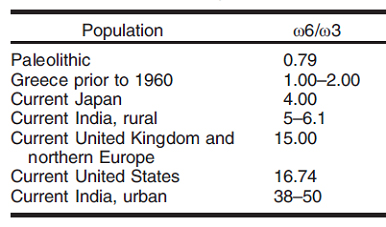
The health of the individual and the population in general is the result of interactions between genetics and a number of environmental factors. Nutrition is an environmental factor of major importance. Our genetic profile has not changed over the past 10,000 y, whereas major changes have taken place in our food supply, energy expenditure and physical activity. Today industrialized societies are characterized by the following: 1) an increase in energy intake and decrease in energy expenditure; 2) an increase in saturated fat, (n-6) fatty acids and trans fatty acids and a decrease in (n-3) fatty acid intake; 3) a decrease in complex carbohydrates and fiber intake; 4) an increase in cereal grains, and a decrease in fruit and vegetable intake; and 5) a decrease in protein, antioxidant and calcium intake. Furthermore, the ratio of (n-6) to (n-3) fatty acids is 16.74:1, whereas during evolution it was 2–1:1 (Table 1, Fig. 1).

Recent investigations of the dietary patterns and health status of the countries surrounding the Mediterranean basin clearly indicate major differences among them in both dietary intake and health status. Therefore, the term “Mediterranean diet” is a misnomer. There is not just one Mediterranean diet but in fact many Mediterranean diets, which is not surprising because the countries along the Mediterranean basin have different religions, economic and cultural traditions and diets. Diets are influenced by religious habits, that is, Muslims do not eat pork or drink wine and other alcoholic drinks, whereas Greek Orthodox populations usually do not eat meat on Wednesdays and Fridays particularly during Lent but drink wine, and so on. Although Greece and the Mediterranean countries are usually considered to be areas of medium-high death rates (14.0 –18.0 per 1000 inhabitants), death rates on the island of Crete have been below this level continuously since before 1930. No other area in the Mediterranean basin has had as low a death rate as Crete, according to data compiled by the United Nations in their demographic yearbook for 1948. It was 11.3–13.7 per 1000 inhabitants before World War II and ~10.6 in 1946–1948. Cancer and heart disease caused almost three times as many deaths proportionally in the United States as in Crete. The diet of Crete represents the traditional diet of Greece before 1960. The Seven Countries Study was the first to establish credible data on cardiovascular disease prevalence rates in contrasting populations (United States, Finland, The Netherlands, Italy, former Yugoslavia, Japan and Greece), with differences found on the order of 5- to 10-fold in coronary heart disease. In 1958, the field work started in Dalmatia in the former Yugoslavia.


SimopoulosChart

Table 1. Omega-6:Omega-3 Ratios in Various

Populations


From the inception of the research program, an important focus was on the diet and its possible relationship to the etiology of coronary heart disease. The 5-y follow-up found favorable all-cause death rates in Greece, Japan and Italy compared with the other areas, as well as a lower incidence rate of coronary disease. The Seven Countries Study was designed to investigate relationships between diet and cardiovascular disease, primarily described in terms of the fatty acid composition of the diet.

The presentation will focus on the characteristics of the traditional diet of Greece before 1960 as exemplified by the diet of Crete. The diet of Crete or the traditional diet of Greece resembles the Paleolithic diet in terms of fiber, antioxidants, saturated fat, monounsaturated fat and the ratio of (n-6) to (n-3) fatty acids (Table 1). The Lyon Heart Study and subsequently the study of Singh et al. support the importance of having a diet consistent with human evolution. Western diets today deviate from the Paleolithic diet and are associated with high rates of cardiovascular disease, diabetes, obesity, cancer and mental health.

SimopoulosChart2

FIGURE 1 Hypothetical scheme of fat, fatty acid (n-6, n-3, trans and total) intake (as percentage of energy from fat) and intake of vitamins E and C (mg/d). Data were extrapolated from cross-sectional analyses of contemporary hunter-gatherer populations and from longitudinal observations and their putative changes during the preceding 100 y

Implementation of the diet of Crete

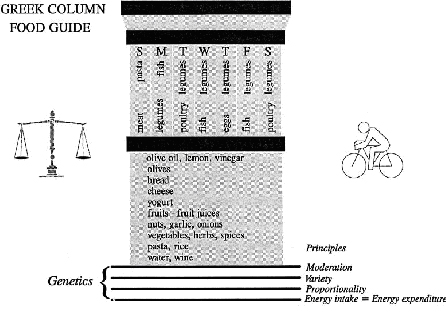
The Lyon Heart Study clearly showed that the diet of Crete can be adhered to over a period of 5 y. Figure 2 is the Greek Column Food Guide based on the diet of Crete. The visualization of this food guide in the form of a Greek column includes the concepts of genetic variation and nutrition and a balanced energy intake and energy expenditure; it is based on foods, not food groups. Although it excludes certain foods made with hydrogenated oils, it does not restrict the intake of naturally occurring foods. It also takes into consideration moderation, variety and proportionality.

SimopoulosChart3

FIGURE 2 The Greek column food guide. The guide is based on genetic individuality; the principals of

moderation, variety, proportionality, and equality of energy intake with energy expenditure


Studies on the Paleolithic diet suggest that (n-3) fatty acids were present in practically all foods that humans ate and in equal amounts with (n-6) fatty acids. The depletion of the (n-3) fatty acids in Western diets is the result of agribusiness, modern agriculture and aquaculture. The high ratio of (n-6) to (n-3) fatty acids (16.74:1 instead of 1:1) is the result of excessive production of vegetable oils and the indiscriminate recommendation to substitute saturated fat and butter with oils high in (n-6) fatty acids to lower serum cholesterol levels without taking into consideration their adverse effect on overall human metabolism.

The results of the Seven Countries Studies and the Lyon Heart Study based on a modified diet of Crete indicate that a Paleolithic-type diet such as the traditional Greek diet balanced in (n-6) and (n-3) fatty acids and rich in vitamins C and E (fruits and vegetables) is associated with decreased rates of heart disease and cancer more so than any other diet or drug intervention.      What appears to be so special about the Greek diet relative to the other Mediterranean diets is the content of bioprotective nutrients, specifically the following: 1) a more balanced intake of EFA from vegetable, animal and marine sources; a ratio of (n-6) to (n-3) fatty acids of ;2:1 instead of the 15:1 in Western and Northern Europe and 16.74:1 in the United States; and 2) a diet rich in antioxidants, i.e., high amounts of vitamin C, vitamin E, b-carotene, glutathione, resveratrol, selenium, phytoestrogens, folate, and other phytochemicals from green leafy vegetables; phenolic compounds from wine and olive oil; high intakes of tomatoes, onions, garlic and herbs, especially oregano, mint, rosemary, parsley and dill, which contain lycopene, allyl thiosulfinates, salicylates, carotenoids, indoles, monoterpenes, polyphenols, flavonoids and other phytochemicals used in cooking vegetables, meat and fish.

Such a dietary pattern has been shown to be beneficial to health because it is associated with a reduced risk of cardiovascular disease and cancer.

TABLE 2

The seven dietary guidelines of the Omega Diet

SimopoulosChart4

——————————————————-

1 Lecture delivered at the 10th

Dr. Demetrios Flessas Annual Commemorative Event

of the Hellenic Link, Ink. And the Hellenic Medical Society of New York, Archdiocesan Cathedral Cultural Center, April 15, 2010 at 7:00 p.m.

To view the PowerPoint presentation, entitled “Nutritive Basis of Positive Health,” employed by Dr. Simpopoulos at the above-referred lecture, 

click HERE.


Western Thrace (Article)

Posted by: ADMIN  :  Category: News & Articles


Western Thrace: is Eastern Neighbor’s Goal a Westward “Lebensraum” Expansion?

ΕΝΑΣ ΥΠΟΥΛΟΣ ΚΙΝΔΥΝΟΣ ΑΠΩΛΕΙΑΣ ΤΗΣ θΡΑΚΗΣ (1)

1.  Ή Θράκη, ώς γεωγραφικός δρος περιλαμβάνει τή σημερινή Νότια Βουλγαρία, (τήν άλλοτε Άνατολική Ρουμελία 35.000 τ. χλμ.), τήν Άνατολική Θράκη (34.615 τ. χλμ.) πού άνήκει στήν Τουρκία καί κάθε μία έχει εκταση μιάμισυ φορά τήν Πελοπόννησο (21.643 τ. χλμ.) καί τή Δυτική Θράκη (8.580 τ. χλμ.) πού άνήκει στήν ‘Ελλάδα καί εχει εκταση περίπου όσο ή Κρήτη (8.300 τ. χλμ.),
Μέ τή λήξη τών Βαλκανικών πολέμων, ή Δυτική Θράκη περιήλθε στή Βουλγαρία δυνάμει της Έλληνοβουλγαρικής Συνθήκης τού Βουκουρεστίου (28.7/10.8.1913), της Τουρκοβουλγαρικής Συνθήκης της Κωνσταντινουπόλεως (17 Σεπτ. 1913) καί της Τουρκοβουλγαρικής Συμβάσεως της Σόφιας (1915)(1). Τό τέλος τού Α’ Παγκοσμίου πολέμου βρήκε τήν Βουλγαρία στό πλευρό των ήττημένων καί μέ τή Συνθήκη Ειρήνης τού Νεϊγύ (14/ 27.11.1919), πού κυρώθηκε μέ τόν Ν. 2433/23.7.1920, ή Δυτική Θράκη περιήλθε άπό τή Βουλγαρία στήν Έλλάδα.
2. Ή Τουρκία δέν άνέχθηκε τήν απώλεια τών Εύρωπαϊκών έδαφών της άλλοτε ‘Οθωμανική; αύτοκρατορίας. Γι’ αύτό, μετά τήν Μικρασιατική καταστροφή το  1922, στή Λωζάννη ό έκπρόσωπος της νικήτριας Τουρκίας ‘1σμέτ πασάς Ινονού ζήτησε τήν έπάνοδο στα σύνορα τού 1913 καί δημοψήφισμα γιά τή Δυτική Θράκη. ‘Ωςέπιχείρημα έπικαλέσθηκε ότι ή Τουρκοβουλγαρική Σύμβαση της Σόφιας τού 1915 δέν είχε έπικυρωθεί άπό τόν Σουλτάνο. ‘Επί πλέον. ζήτησε τή Σαμοθράκη πρός έξασφάλιση τών Στενών τού ‘Ελλησπόντου.
Ό Ίνονού άκολουθούσε τήν διακήρυξη τού Έθνικού Συμβολαίου τού Κεμάλ, τό 1920, στή Σεβάστεια: «Σκοπός μας είναι ή Δυτική θράκη νά παραμείνει στά τουρκικά χέρια ώς ένιαίο σύνολο καί σέ κατάλληλο χρόνο καί εύκαιρία νά ένωθεί μέ τήν Μητέρα πατρίδα. Έμείς δέν μπορούμε νά δεχθούμε τήν άπαλλοτρίωση τού Τουρκικού αύτού τμήματος. οι άδελφοί μας τής Δυτικής Θράκης σέ πρώτο βήμα πρέπει νά άγωνισθούν γιά νά κερδίσουν τήν άνεξαρτησία καί τήν αύτονομία τής Δυτικής Θράκης»(2).
Ό άντιπρόσωπος της ήττημένης ‘Ελλάδος Έλευθέριος Βενιζέλος προέβαλε τό γεγονός, ότι οΙ Τούρκοι παραιτήθηκαν άπό τή Δυτική Θράκη μέ τή Συν-

(1) Βλ. Ν. Σοϊλεντάκη, Ιστορία του Θρακικοϊί Έλληνισµου, τόµο Β’ (εκδ. Παπαζήση, 2004) σελ. 65-68.
(2) Π. Χιδίρογλου, χαρακτηριστικά γνωρίσµατα της Τουρκικης διπλωµατικης συµπεριφορας έναντι της Έλλάδος, 1994, σελ. 28, σηµ. 1, µέ παραποµπή στίς έφηµερίδες Bati Trakya 166/1981 σελ. 3-4 καί Yeni Bati Trakya Dergessi, 24/1985, σελ. 31.
ΑΚΤιΝΕΣ. ΙΑΝΟΥΑΡΙΟΣ 2010

10

———————————————————————————————————

‘θήκη τού Βουκουρεστίου καί δτι κατά τόν Α’ Παγκόσµιο Πόλεµο παραχώρησαν τίς περιοχές Διδυµοτείχου καί Κάραγατς στή Βουλγαρία έξ ίδίας πρωτοβουλίας, ϋστερα άπό διαπραγµατεύσεις. ‘Ως πρός τό δηµοψήφισµα, άντέτεινε ότι ή άναλογία Τούρκων καί Έλλήνων είναι ήδη ένα πρός δύο. ‘Όπως χαρακτηριστικά εϊπε: «Ή εκτασις αύτής τής περιοχής ρυθµίσθηκε άπό τή Συνθήκη τού Νεϊγύ, µέ τήν όποία ή κυβέρνηση τής :Α γκύρας δέν ε[χε καµία σχέση, διότι πρό τού πολέµου ή περιοχή αύτή έκχωρήθηκε άπό τήν Τουρκία έξ ιδίας πρωτοβουλίας κατά τόν πόλεµον, ύστερα άπό διαπραγµατεύσεις µέ τήν Βουλγαρία, καί όχι ύπό τήν πίεση στρατιωτικών έπιχειρήσεων, είτε µιάς ήττας στό πεδίο τού πολέµου».
Στό έπιχείρηµα τού ‘Ισµέτ πασά ‘Ινονού ότι ή Δυτική ‘θράκη ήταν άπαραίτητη στήν Τουρκία γιά τήν στρατιωτική άσφάλεια της Άνατολικης Θράκης, ό Βενιζέλος αντέτεινε ότι ήταν άστήρικτο, άλλά καί µέ τήν ϊδια λογική ‘θά έπρεπε στή συνέχεια νά δοθεϊ στήν Τουρκία ή Άνατολική Μακεδονία γιά νά έξασφαλισθεϊ ή Δυτική Θράκη καί στή συνέχεια ή Κεντρική Μακεδονία γιά άσφάλεια τής Άνατολικής, ώσπου νά φθάσουµε στή ‘θάλασσα. Καί κατέληξε λέγοντας: «Ή Έλλάς έπλήρωσε ήδη γιά τά λάθη της καί δέν είναι δυνατόν νά τής ζητηθεί τίποτε περισσότερο».
Νά σηµειωθεϊ ότι ή Τουρκική άντιπροσωπεία άξίωσε νά καταχωρηθοϋν στο 240 πρακτικό, έπί λέξει τά έξης: «’Ο ‘Ισµέτ πασάς έδήλωσεν έπανειληµένως ότι, ή Κυβέρνησις τής Μεγάλης Έθνικής Συνελεύσεως τής Τουρκίας ούδεµίαν έχει βλέψιν  έπί τών έδαφών τής παλαιάς Τουρκικής Αύτοκρατορίας, τά όποία παρέµειναν έκτός τών συνόρων τής Τουρκίας. Τό σηµερινόν Τουρκικόν Κράτος συγκαταλέγεται µεταξύ τών κρατών έκείνων, τά όποία έπιθυµούν όλως lδιαιτέρως νά περιορίσουν τήν εξουσίαν των είς τό ίδιον αύτών εδαφος … »(3). Κατά τή διάρκεια των διαπραγµατεύσεων στή Λ ωζάννη , ύπογράφηκε στίς 30 ‘Ιανουαρίου  1923, ή ‘Ελληνοτουρκική Σύµβαση περί ύποχρεωτικης άνταλλαγης των πληθυσµών µεταξύ Έλλάδος καί Τουρκίας. ‘Από τήν άνταλλαγή έξαιρέ’θηκαν δπως ρητως άναγράφεται, κατόπι ν τουρκικης επιµονής «οί Μουσουλµανοι» στό θρήσκευµα της Δυτικής Θράκης άλλά “Ελληνες ύπήκοοι, καί οί έγκατεστηµένοι στήν Κωνσταντ ι νούπολη  “Ελλ ηνες (Ρωµιοί). (4)
3. Κατά τήν τελευταία άπογραφή πού έχουµε καί εθνολογικά στοιχεία, στή Θράκη τό 1991, διαβιοϋσαν στόν νοµό Ξάν’θης 47.000 Όρθόδοξοι καί 42.000 Μουσουλµάνοι, έκ των όποίων 23.000 Ποµάκοι, 9.000 Αθίγγανοι καί 10.000 Τουρκογενείς (Τουρκόφωνοι). Στόν νοµό Ροδόπης 42.000 Όρθόδοξοι, 62.000 Μουσουλµάνοι έκ των όποίων 11.000 Ποµάκοι, 42.000 Τουρκογενείς καί 9.000 Άθίγγανοι. Στόν νοµό Εβρου 142.000 Όρθόδοξοι, 10.000 Μουσουλµάνοι έκ των όποιων 2.000 Ποµάκοι, 2.000 Τουρκογενείς καί 6.000 ‘Αθίγγανοι. Κατά τήν άπογραφή τού 2001, ό πληθυσµός στόν νοµό Ξάνθης άνήλθε στούς 101.045 κατοίκους, στό νοµό Ροδόπης 110.828 κατοίκους καί στόν νοµό ‘Έβρου 149.354. Στοιχεία ώς πρός τήν έθνολογική σύνθεση δέν ύπάρχουν, διότι δέν περιελήφθη σχετικό έρωτηματολόγιο.

(3) Ν. Σοϊλεντάκη, άνωτ, σελ. 150-154.
(4) Ν. Σοϊλεντάκη, ανωτ., σελ. 155-1574.

ΑΚΤΙΝΕΣ. ΙΑΝΟΥΑΡΙΟΣ 2010

11

———————————————————————————————————————

4.  Ή Τουρκία, έχουσα μακρόπνοη στρατηγική καί μεγάλη ύπομονή «λησμόνησε» τή δήλωση τού ‘Ισμέτ πασά Ί νονού καί τίς ύποχρεώσεις της έναντι της ‘Ελλάδος άπό τή Συνθήκη Είρήνης της Λωζάννης (5), άλλά δέν λησμόνησε ποτέ τήν ύποθήκη τού Κεμάλ γιά τή Δυτική Θράκη καί τούς Μουσουλμάνους κατοίκους της. Τόν Μάιο 1965, όταν διεξήγοντο μυστικές συνομιλίες στό Λονδίνο γιά τό Κυπριακό ζήτημα, ό Τούρκος ύπουργός ‘Εξωτερικών ‘Ισίκ ζήτησε άπό τόν ‘Έλληνα συνομιλητή του πρέσβη Σγουρδαίο, ώς άντάλλαγμα γιά τήν “Ενωση της Κύπρου μέ τήν ‘Ελλάδα, νά έκχωρηθεί στήν Τουρκία ή περιοχή τού νομού “Εβρου, πού έκτείνεται άπό τό Διδυμότειχο ως τά βουλγαρικά σύνορα. Οί ΗΠΑ κατέστησαν γνωστό στήν ‘Ελλάδα, ότι ή άνωτέρω τουρκική έδαφική διεκδίκηση είναι έξαιρετικά περιορισμένη καί έξισορροπείται μέ τό παραπάνω χάρη στά πλεονεκτήματα πού θά κέρδιζε ή ‘Ελλάδα ένσωματώνοντας τήν Κύπρο (6).
Τόν Φεβρουάριο τού 1988, ό καθηγητής Άρμάογλου είπε σέ συνέδριο: «Μόνο µέ τήν ένταξη τής Δυτικής Θράκης έντός τών όρίων τή τουρκικής έπικράτειας θά µπορέσει ή Τουρκία νά άποκτήσει ένα σταθερό στοιχείο άσφά- λειας στή Βαλκανική>(7) καί ό πρωθυπουργός της Τουρκίας ‘Οζάλ τό 1990 έδήλωσε, ότι τά φυσικά σύνορα της ‘Ελλάδος βρίσκονται στόν “Ολυμπο, διότι ή κοιτίδα των ‘Ελλήνων βρίσκεται νοτίως αύτοϋ. Στίς 22.11.1992 ό πρωθυπουργός Ντεμιρέλ δήλωσε, ότι ένδιαφέρεται καί θά προστατεύσει τούς «τουρκικής καταγωγής» πληθυσμού; τής Δυτικης Θράκης. Ή ‘Ελλάδα άπάντησε: «Δέν ύπάρχουν Τούρκοι στήν Έλλάδα(8). Δήλωση που θυμίζει την κατά
το παρελθόν έπαναλαμβανόμενη δήλωση «Γιά τήν Έλλάδα δέν ύφίσταται Μακεδονικό ζήτηµα». Τά άποτελέσματα αύτής τής τακτικης είναι γνωστά καί πικρά. Άλλά, καί σέ επίσημα κείμενα διατυπώνεται ή άποψη, «… τήν άπώλεια τών νησιών οπως ή Μυτιλήνη καί ή Χίος, πού βρίσκονται µπροστά στίς θαλάσσιες πύλες ηίς Πατρίδας Τουρκίας καί έντός άποστάσεως µιας βολίδας άπό τή Μ. Ασία, τό τουρκικό έθνος σέ καµιά περίπτωση καί µέ κανlένα τρόπο δέν
θά µπορέσει νά άνεχθεί … » (9).
Άπό τό  1953, ή Τουρκία έπεδίωξε νά ιδιοποιηθεί όλους τούς Μουσουλμάνους τής Δυτικής Θράκης ώς τουρκογενείς καί νά μετατρέψει τήν μουσουλμανική μειονότητα σέ τουρκική. Δηλαδή, τήν κατά τή Συνθήκη Είρήνης τής Λωζάννης θρησκευτική μειονότητα σέ

(5) Βλ. Ν. Σοϊλεντάκη, ανωτ. σελ. 148-157, 168, 186-200, 256-258, 445-460, δπου οΙ τουρκικές παραβιάσεις τiiς Συνθήκης τiiς Λωζάνης.
(6) Βλ. Άρχεια Στέητ Ντηπάρτµεντ, έφημ. Καθηµερινή 27 Αύγούστου 2002, σελ. 13. 

(7) Κ. Βουλουτιάδη, Ή Τουρκική όπειλή στή Δυτική Θράκη, • Θρακικά τόµ. 70ς, 1991-1992 σελ. 206.
(8) Βλ. τίς έφη µερίδες της 29.11.1992 Τ ό Βήµα σελ. Α 22 καί ή Καθηµερινή σελ. 13.
(9) n. Χιδίρογλου, Χαρακτηριστικά γνωρίσµατα τiiς Τουρκικής; διπλωµατικης συµπεριφοράς, σελ. 35.

ΑΚΤΙΝΕΣ. ΙΑΝΟΥΑΡΙΟΣ 2010

12

———————————————————————————————————–

έθνοφυλετική. Ή πολιτική τών έκάστοτε έλληνικών κυβερνήσεων διευκόλυνε άν δέν ύπηρέτησε τήν τουρκική έπιδίωξη. Είδικά, ώς πρός τούς Πομάκους δέν τούς έγκαταλείψαμε, άλλά τούς στείλαμε στήν άγκαλιά της Τουρκίας. Άντιθέτω; εγκαταλείψαμε τούς ‘Έλληνες της Ιμβρου καί της Τενέδου πού ρητώς έξηρέθησαν της άνταλλαγης καί προβλέφθηκε ειδικό καθεστως μέ τή Συνθήκη της Λωζάννης. (10)  Τέλη Μαϊου  2009, ό Τούρκος ύπουργός Έξωτερικών Νταβούτογλου, στή Δαμασκό κατά τήν Σύνοδο τών ‘Υπουργών Έξωτερικών τού όργανισμού ‘Ισλαμικη; Διασκέψεως, κατήγγειλε τήν ‘Ελλάδα, διότι «ή τουρκική μουσουλμανική μειονότητα της Δυτικης Θράκης συναντά σοβαρά προβλήματα στήν άσκηση τών μειονοτικών δικαιωμάτων της», οτι «δέν μπορούν νά έκλέξουν τούς θρησκευτικούς λειτουργούς, νά διοικήσουν τά ίδρύματά τους, νά έκφράσουν τήν έθνική τους ταυτότητα, νά έχουν ίσες εύκαιρίες στήν έκπαίδευση, τήν έργασία ή τήν πολιτική, δτι ή ‘Ελλάδα διορίζει ίμάμηδες καί θρησκευτικούς δασκάλους άπό έπιτροπή άποτελούμενη άπό όρθοδόξους. Τέλος ίσχυρϊσθηκε, οτι δέν έχουν άναγνωρισθεϊ ώς μειονότητα οί μουσουλμάνοι της Ρόδου καί της Κώ (11).
5.    Ή Τουρκία, στήν κατά τά προεκτε-
θέντα έπιδίωξή της, νά έμφανισθεϊ ή θρησκευτική μειονότητα της Δυτική; Θράκης ώς εθνοφυλετική καί συγκεκριμένα ώς Τουρκική, χρησιμοποιώντας ώς δργανά της μουσουλμάνους κατοίκους της περιοχής επέτυχε νά συστήσει σωματείο μέ τόν τίτλο «Τουρκική Ενωση Ξάνθης». Κατόπιν αιτήσεως τού Νομάρχη Ξάνθης, τό Πρωτοδικείο Ξάνθης διέταξε τή διάλυση τού σωματείου μέ άπόφασή του, ή όποία τελικά έπικυρώθηκε μέ τήν ύπ’ άριθμ. 4 τού 2005 άπόφαση της ‘Ολομελείας τού Άρείου Πάγου.
Ή διάλυση τού σωματείου έγινε διότι στό καταστατικό του όρίζεται ότι σκοπός του είναι: «νά συμβάλει εις τήν μεταξύ τών Τούρκων της Δυτικης Θράκης διάδοση τών πνευματικών, κοινωνικών καί θρησκευτικών μεταρρυθμίσεων τών προελθουσών έκ της Τουρκικης μεταπολι τεύσεως», δηλαδή των κεμαλικών μεταρρυθμίσεων. ‘Ο άνωτέρω σκοπός κρίθηκε άπό τά έλληνικά δικαστήρια, ότι άντιβαίνει στή Συνθήκη της Λωζάννης, πού άποτελεϊ νόμο τού Κράτους, διότι έμφανίζεται ότι ύπάρχει έθνική τουρκική μειονότητα καί όχι θρησκευτική καί προωθούνται έντός των όρίων της ‘Ελλάδος πολιτειακοί σκοποί ξένου κράτους καί συγκεκριμένα της Τουρκίας. Μεταξύ δέ τών σκοπών της κεμαλική; μεταρρυθμίσεω; περιλαμβάνεται καί ή προπαρατεθεϊσα διακήρυξη τού Κεμάλ στή Σεβάστεια τό 1920, περί Δυτική; Θράκης, και συνεπώτ; ό σκοπός τού σωματείου Τουρκική “Ενωση Ξάνθη; είναι αντίθετος στή δημόσια τάξη καί τό άρθρο 105 τού ‘Αστικού Κώδικα όρίζει ότι  τό σωματείο διαλύεται άν ό σκοπός τού σωματείου ή ή λειτουργία του είναι παράνομοι ή άντίθετοι στή δημόσια τάξη.
Τό Σωματείο προσέφυγε στό Εύρωπαϊκό Δικαστήριο ‘Ανθρωπίνων Δικαι-

(10) Γιό τή συστηµατική προσπόθεια καταστρατηγήσεως της Συνθήκης της Λωζόνης όπό τήν Τουρκία βλ. Ν. Σοϊλεντάκη, ανωτ. σελ. 190 έφ. καί 445 έφ.
(11) Έφηµ. Τό Παρόν 7.6.2009, .σελ. 2.

13

_________________________________________________________________

ωµάτων, πού έδρεύει στό Στρασβούργο, τό όποίο µέ άπόφασή του στίς 27 Μαρτίου 2008 εκρινε  ότι παρανόμως διελύθη τό σωµατείο διότι ή διάλυσή του «δέν ήταν άναγκαία σέ µία δηµοκρατική κοινωνία». Τό Εύρωπαϊκό Δικαστήριο ‘Ανθρωπίνων Δικαιωµάτων έφθασε στό σηµείο νά περιλάβει σκέψη, άπό προηγούµενη άπόφασή του πού άφοροϋσε φιλοσκοπιανό σωµατείο της Βουλγαρίας, κατά τήν όποία ή διάλυσή του δέν δικαιολογείται «άκόµη κα{ στήν περίπτωση κατά τήν όπο{α µία όµάδα προσώπων άναφέρεται στήν αύτονοµία και ζητεί τήν άπόσχιση ένός τµήµατος τού έδάφους µιας χώρας(12). Στήν έκδοση αύτης της άποφάσεως τού Εύρωπαϊκοϋ Δικαστηρίου ‘Ανθρωπίνων Δικαιωµάτων συµµετέσχον ώς δικαστές ό “Ελληνα; καί ό Κύπριος άντιπρόσωπος, οί όποίοι καί δέν µειοψήφησαν. Σχετικό δέ έλληνικό αϊτηµα νά έκδικασθεί ή ύπόθεση άπό µεγαλύτερη σύνθεση άπορρίφθηκε.
6. Άπό τήν άπόφαση τού Εύρωπαϊκοϋ Δικαστηρίου συνάγεται, δτι έπιτρέπεται ή διάλυση σωµατείου µόνον όταν έµπράκτως (µήπως ένόπλως;) έπιδιώκει τήν αύτονοµία ή τήν απόσχιση ένός τµήµατος της χώρας µας. ‘Όµως, κάθε Κράτος όφείλει νά προνοεί, νά προλαµβάνει καί νά παρεµβαίνει, ώστε νά διασφαλίζει τήν αύ-θυπαρξία του καί νά έξασφαλίζει στούς κατοίκους της συγκεκριµένης χώρας τίς προϋποθέσεις γιά τό ζην καί τό ευ ζην.
Στίς 4 Μαϊού 2009, στόν Δικηγορικό Σύλλογο Ά θηνών καί σέ έκδήλωση της Έταιρείας Διοικητικών Μελετών, µία καθηγήτρια τού Δηµοκριτείου Πανεπιστηµίου µέ στερεά έπιχειρήµατα κατέκρινε τήν άπόφαση. Άπό τή συζήτηση πού ακολούθησε συνήχθη τό συµπέρασµα, ότι ή ύπερασπιστική στάση της Έλλάδος ηταν έλλιπής καί δτι τό Δικαστήριο αγνόησε προηγούµενη άπόφασή του, πού άφοροϋσε στήν Πολωνία, εύνοϊκή των απόψεών µας. Συγκεκριµένα, τό Εύρωπαϊκό Δικαστήριο ‘Ανθρωπίνων Δικαιωµάτων στό παρελθόν δικαίωσε τήν Πολωνία, πού δέν άνεγνώρισε σωµατείο, τού όποιου ό σκοπός ηταν ή άνάπτυξη Σιλεσιανή; έθνικης συνειδήσεως(l3). Ή άπόφαση τού Δικαστηρίου είς βάρος της Έλλάδος, δπως καί κατά της Βουλγαρίας, κατά παραγνώριση της άποφάσεώς του γιά τήν Πολωνία, έπιτρέπει νά σχηµαστίσουµε τήν εντύπωση, δτι ή άπόφασή του, πού κατεδίκασε τήν Έλλάδα γιατί διέλυσε τό σωµατείο Τουρκική Ένωση Ξάνθης, δέν στηρϊχ6ηκε στό Δίκαιο, άλλά έκρι νε µέ πολιτικά ή άλλα κριτήρια, πάντως όχι µέ νοµικά.
‘Εκτεταµένη, λεπτοµερή, έξαιρετικά ένδιαφέρουσα όσο καί άποκαλυπτική κρι τική της Άποφάσεως έγινε άπό τόν κ. Άναστάσιο Μαρίνο, Άντιπρόεδρο τού Σ.Τ.Ε. ε.τ. στο 20 τεύχος της Έπιθεωρήσεως Δηµοσίου Διοικητικού Δικαίου του 2008.
Ν. Π. ΣΟ’Ι’ΛΕΝΤΑΚΗΣ

(12) Άναστ. Μαρίνου, Τουρκική “Ενωση Ξάνθης, Έπιθ. Δηµ. Διοικ. Δικαίου 2008, τευχος 20.

(13) Ή Σιλεσία εΙναι περιοχή πού άνήκει στήν Πολωνίακαί τήν Τσεχία, καί τό µεγαλύτερο τµηµα της πρό του Β’ Παγκοσµίου Πολέµου περιλαµβανόταν στήν Γερµανία. 
 
 ΑΚΤιΝΕΣ. ΙΑΝΟΥΑΡΙΟΣ 2010
14

——————————————————

(1)  Reprinted with permission of the author from AKTINES, 73, 707, January 2010, pp10-14.

Greek to US Standards

Posted by: Editors  :  Category: News & Articles


Aligning Greek Language Teaching with US National Standards” 1

Vasiliki Tsigas-Fotinis, Ph.D. (Caldwell College, Caldwell, NJ)

In order to prepare America for the 21st century, the US Department of Education along with other subject specific professional associations has developed National Standards for subjects taught in public educational institutions. National Standards are voluntarily being employed for each major subject being taught in the USA. These content and curriculum standards are guidelines or goals of what is expected to be taught and learned in their respective field. State and local subject standards generally align with the National Standards for each subject. Standards are a prerequisite for establishing criteria needed for teacher training and certification and for the development of assessments.

“With the help of a three-year grant from the US Department of Education and the National Endowment for the Humanities, an eleven-member task force, representing a variety of languages, levels of instruction, program models, and geographic regions, undertook the task of defining content standards — what students should know and be able to do — in foreign language education. The final document, Standards for Foreign Language Learning: Preparing for the 21st Century, first published in 1996, represents an unprecedented consensus among educators, business leaders, government, and the community on the definition and role of foreign language instruction in American education. This visionary document has been used by teachers, administrators, and curriculum developers at both state and local levels to begin to improve foreign language education in our nation’s schools.”
http://www.actfl.org/i4a/pages/index.cfm?pageid=3392

In 2009, the NEW revised 3rd Edition Standards for Foreign Language Learning in the 21st Century, includes targeted standards for Arabic, Chinese, Classical Languages, French, German, Italian, Japanese, Portuguese, Russian, and Spanish. My question today is, “Should there be national standards for the Greek Language? In addition, should there be national standards for Greek Language teacher training and certification?” “If so, what implications do these questions bring to light?”

Along with the many other notable subjects, NATIONAL STANDARDS FOR FOREIGN LANGUAGE EDUCATION have been developed by the US Department of Education as a Collaborative Project of ACTFL (American Council on the Teaching of Foreign Languages), AATF (American Association of Teachers of French), AATG (American Association of Teachers of German), AATI (American Association of Teachers of Italian), AATSP (American Association of Teachers of Spanish & Portuguese), ACL (American Classical League), ACTR, CLASS and NCJLT-ATJ. [See http://www.actfl.org/i4a/pages/index.cfm?pageid=3392 for actual standards]. The Philosophy Statement of this document sums up its purpose, stating:
Language and communication are at the heart of the human experience. The United States must educate students who are linguistically and culturally equipped to communicate successfully in a pluralistic American society and abroad. This imperative envisions a future in which ALL students will develop and maintain proficiency in English and at least one other language, modern or classical. Children who come to school from non-English backgrounds should also have opportunities to develop further proficiencies in their first language.

I wish the last sentence of this Philosophy Statement was in place when I entered public school only knowing Greek from my immigrant parents. Could you imagine the effect of my school giving me the opportunity to further develop my Greek language proficiencies? What a difference that would have made on me as well as on my English speaking classmates.
As is stated in the above Philosophy Statement, Classical and Modern languages are to be developed and taught. Their usefulness is clear. Greek and Latin languages help students improve their understanding of scientific, medical, legal and mathematical terms and their etymology. Knowledge of these Classical languages will help them do better on Standardized tests because they can figure out words and their meanings. Moreover, the more structured and complex a language is, just like music, more synaptic activity occurs in the brain. Advantages of developing such standards for Hellenic Education effort in North America include the enlargement of the possibility of having the Greek language offered in more public and private schools. When I googled “Why Learn Greek”, I found 13,400,000 results entries, a large majority of these web sites like the one that follows make mention of the importance of understanding the New Testament and other classical works in their original language. In http://www.gsbaptistchurch.com/greek/ under The Greek Language it states:
From 13th Century BC “Linear B” Greek, through the “Classical Greek” of Homer, 8th century, and Plato, 4th century, to the Greek of the Bible, called “Koine Greek” or the common man’s Greek, the language is a marvelous form of language, capable of exact expression and subtle nuances. Christ came when the fullness of time was here (Gal 4:4), and the universal language used to capture and record and preach his arrival and the New Testament he came to offer, was Koine Greek. Every Christian can benefit from the study of this language.

The American Classical League, American Philological Association, and Regional Classical Associations have developed National Standards for Classical Languages (Greek and Latin). [See http://www.aclclassics.org/pdf/standards.pdf] This brings an especially profound set of questions for the Greek community to address. Should we too as a united Greek community join in recognizing these National Standards for Classical Languages? Should we also develop National Standards for the Greek Language? [Modern Greek officially came to be in the 1970’s] And the biggest question of all, who is “we” in the Greek community?

The national standards for foreign language education center around five goals: Communication, Cultures, Connections, Comparisons, and Communities (the 5 C’s of foreign language education). In establishing national standards for the Greek Language, these five Cs need to be answered with research, detail explanations and agreement.

STANDARDS FOR FOREIGN LANGUAGE LEARNING
COMMUNICATION
Communicate in Languages Other Than English
· Standard 1.1: Students engage in conversations, provide and obtain information, express feelings and emotions, and exchange opinions [in the Greek language]
· Standard 1.2: Students understand and interpret written and spoken language on a variety of topics
· Standard 1.3: Students present information, concepts, and ideas to an audience of listeners or readers on a variety of topics.
CULTURES
Gain Knowledge and Understanding of Other Cultures
· Standard 2.1: Students demonstrate an understanding of the relationship between the practices and perspectives of the culture studied
· Standard 2.2: Students demonstrate an understanding of the relationship between the products and perspectives of the culture studied
CONNECTIONS
Connect with Other Disciplines and Acquire Information
· Standard 3.1: Students reinforce and further their knowledge of other disciplines through the foreign language [Key for Greek language; i.e., vocabulary, medicine, math, science, theater, music…]
· Standard 3.2: Students acquire information and recognize the distinctive viewpoints that are only available through the foreign language and its cultures
COMPARISONS
Develop Insight into the Nature of Language and Culture
· Standard 4.1: Students demonstrate understanding of the nature of language through comparisons of the language studied and their own [Identify etymological roots of many English words from the Greek Language, and understand how the English language is entering the Greek …]
· Standard 4.2: Students demonstrate understanding of the concept of culture through comparisons of the cultures studied and their own. [Culture in terms of arts, theatre, dance, music, religion, food, dress … has many parallel and distinct conceptual frames]
COMMUNITIES
Participate in Multilingual Communities at Home & Around the World
· Standard 5.1: Students use the language both within and beyond the school setting
· Standard 5.2: Students show evidence of becoming life-long learners by using the language for personal enjoyment and enrichment. [Annual celebration of Greek and American Democracy on March 25.]

In teaching Greek, we are not starting from scratch; the American Classical League has developed a set of syllabi for “Attic Greek” which is used as an outline for the National Exam for “Attic” Greek http://nge.aclclassics.org/. Currently, the State of New York offers a Regents Exam in Modern Greek, and New Jersey accepts this exam as well. The Greek Orthodox Archdiocese Department of Greek Education also offers a Comprehensive exam in Modern Greek, found on their web site http://goarch.org/archdiocese/departments/education/exam. Their list of standards and check points of the Greek examination (in Greek) is found at: http://goarch.org/archdiocese/departments/education/exam/STANDARDS%20-%20CHECKPOINTS%20OF%20GREEK%20EXAMINATION%20-IN%20GREEK.pdf . We need to see if anything else exists as well. We need to compile a list of all existing exams, coordinate and consolidate any duplicated effort and determine any mutual and missing links. All parties that offer Greek exams should be involved with establishing national standards for the Greek language.
In addition to National Standards for learning any language, the proper preparation and training of teachers to teach a language should also be defined nationally. In the US, there has rightfully so been a trend to have all teachers in public schools to have the appropriate certifications and education to teach. Dr. Adam D. Blistein, Executive Director, American Philological Association has sent me a link to a set of standards for Latin teacher training and certification. The current draft of these standards is found at: http://www.apaclassics.org/education/Standards.pdf. We need to review these and tailor them for Greek Language teacher training and certification. In addition, we need to work with both Departments of Education and Hellenic or Modern Greek Studies Programs in more colleges and universities in order to guarantee that the appropriate courses needed for state and national certifications of teachers of the Greek Language are offered.
There will be two major drawbacks for the Hellenic Education effort in North America if we continue to ignore the creation and implementation of National Standards for the Greek Language and for those who will teach the language. One is the sporadic, inconsistent and politically and culturally subjective, and outdated approach to language teaching and learning of the language that largely exists today. And the other drawback is the extinction or the undermining of the “truth that sets us free”. What I mean is this, many classic great thinkers thought and wrote their work in Greek. Greek is the primary source of their archetypal work. If our command and understanding of the Greek language is poor, then the deeper meanings of these great works will be lost or worse yet, left for others to interpret in their own subjective way. The Greek language is ever changing, but always the same. The language vocabulary and structure has changed throughout the years, but its semantic quality has remained substantially unaltered.

As of now there is no American Association of Teachers of Greek, however, the Federation of Hellenic Educators and Cultural Associations is an umbrella organization for a number of associations of Teachers of Greek, i.e., Greek Teachers Association “Prometheus” of New York Metro area, Greek Teachers Association “Athena” of Illinois, Greek Teachers Association “Iliada” in Philadelphia area, Hellenic Society PROMETHEAS of Washington, DC, Saint Basil’s Academy Teachers College Alumnae Association (S.B.A.T.C.A.A.), Greek Teachers Association of Florida, St. Irene Chrysovalantou-Sacred Patriarchal and Stavropegial Monastery-Department of Education in New York, Greek Teachers Association “Odyssey” in Delaware, Archimedean Academy Charter School- Miami, Florida, Charter schools in North Carolina and other locations, Hellenic American Educators Association (HAEA) of New York, Hellenic-American Educators Association of New Jersey (HEANJ), and others. We need to have a united Greek Language Teachers group be members of and actively participate in ACTFL (American Council on the Teaching of Foreign Languages) that allows and encourages all its members to participate in ACTFL and regional such Conferences.

Each of the American Associations of Teachers of [German, Italian, Spanish, etc.] have their vision and mission statements, by-laws, research on who and from where their language teachers get certified, and how much education their members have, on their websites (which are also linked on the ACTFL web site). It might be worth our while to see and study what others have done and reflect how some of these ideas could help us with the Greek Language. Again I stress, that we need to have Greek Language representatives on the American Council on the Teaching of Foreign Languages and other such organizations that promote the teaching of foreign languages. In addition, Hellenic, Ancient, Byzantine and Modern Greek Studies programs at the various universities can play a major role in assisting and promoting the future training and certifications of Teachers of Greek.

An important suggestion that Hellenic Link, Inc. has been a proponent of is the possible linking of Hellenic Studies programs at some universities with their Departments of Education. For example, if we look at the website of the Modern Greek Studies Program at Rutgers, we see that this program is linked to several other university Departments (Classics, Religion and other), but not to that of Education. This link is critical if we are true to our language and its further development. We need people who know BOTH the Greek Language well and also know how to most effectively teach it to others. Currently, it is encouraging to note that at least one university, the Concordia University of Montreal, is considering actively the development of such interdisciplinary link for its Hellenic Studies Program.

The Plan. In general, what we need to do is further study what exists and what is lacking in terms of National Standards for the 1) Greek language and 2) for the teacher training and certification. As a Hellenic Education community, we need to discuss and study the ramifications of teaching Classical and/or Modern Greek and their implications for the future generations. In addition, the ratification of existing Standards for Classical Greek need to be embraced by the Hellenic Education Community in North America; and the creation of Standards for the Greek language and teacher training and certification need to be developed and ratified. After this foundation has been laid, then we need to promote and publicize the value of the Greek language as the key to multiple dimensions of thinking, feeling and being, which ultimately the professional as well the Hellenic community at large should be energized to introduce in the educational system for the 21st century.

This presentation will be enhanced if during a workshop these critical questions could be discussed and the new questions and responses could be documented and circulated. We could initiate a brainstorming session to start filling in and substantiating the 5 C’s for Greek Language learning at this conference. [Have 5 posters where people could offer standard suggestions] A follow up committee should be created to further identify the practical implications and the scaffolding processes necessary for the Greek language to be cultivated in America. I hope the participants of this conference will approve and adopt a recommendation to establish a committee, under the auspices of AFGLC and HL, to study and promulgate a draft of relevant National Standards.

National Standards have been created to begin to improve foreign language education in our nation’s schools. Do we want to improve Greek Language education in America as well?
—————————————————————–
1 Paper presented at the 15th Conference/Forum of the American Foundation for Greek Language and Culture (AFGLC), inTampa & Tarpon Springs Florida, February 19-20, 2010; a contribution from the Advisory Council on Hellenic Education of the Hellenic Link, Inc.

A.N. Kounadis Lecture

Posted by: Editors  :  Category: News & Articles

THE GREEK LANGUAGE AROUND THE WORLD  

by Professor Anthony N.  Kounadis

Academy of Athens

Summary

The Greek language, a fundamental element of our national being, of European civilization and of universal intellectual activity, has been spoken and cultivated constantly and without interruption for over 3,500 years by the same people and in the same geographical location. The Greek language is a great example of linguistic continuity, a unique phenomenon of radiance, a language that according to linguists and intellectuals alike has served as the basic vehicle for disseminating civilization around the world since Antiquity.

Today’s address is a also a great honour for Hellenic Language Heritage, a cultural society whose aim, as stated in its Charter, is to preserve, promote and disseminate the Greek language. Our Society has organized numerous events attended by large audiences. The creation of Hellenic Language Heritage has been welcomed and supported by numerous personalities: three Presidents of the Hellenic Republic, representatives of all political parties currently sitting in the Greek Parliament, former Prime Ministers, former and current ministers, Heads of the Supreme Court, academics, faculty deans, ambassadors, people representing the arts, sciences and letters, generals, media representatives, businessmen, cultural societies and associations, as well as many other bodies and agencies. The first person to serve as president of our Society is the current President of the Hellenic Republic.

After reviewing an extensive international bibliography on the Greek language, I came to the conclusion that Francisco R. Adrados’ latest work, entitled “A history of the Greek language: from its origins to the present”, gives by far the most accurate account of the history and evolution of the Greek language, from its origins to its current form, that is, from “katharevoussa” to “modern Greek”. In this book, the Spanish linguist and Hellenist states that “Greek along with Chinese are the only languages demonstrating a continuous presence and uninterrupted evolution, which occurs almost in the same geographical area and by the same people for over 4,000 years. Written tradition is 3,500 years long.”

Viewed from this perspective, Greek is a “mother tongue” to the Western world, a source from which every other Western language drew its elements. Adrados goes as far as to claim that all Western languages secretly originated from Greek. From a purely historical perspective, one has to acknowledge that Greek was not the first language to develop a writing system: other written languages emerged in the wider area of the Middle East before Greek. Most of them disappeared. Some still exist but are of limited use. Unlike these languages, during the Mycenaean era, during Homer’s time and up until the present day, the Greek language, in its various forms, represents one language, a unified system, an undivided and unbreakable language, a mutually complemented and diachronically evolved system that possesses its own dynamic. This is where the real treasure and the abiding source of wealth of the Greek language reside. Moreover, Greek is a universal “Term bank”, an unfailing source for creating scientific and technological terminology. Here is a typical example: Homer’s vocabulary consisted of 6,300 words, 1,800 of which exist nowadays with limited semantic variations. John Chadwick, who along with Michael Ventris deciphered Linear B, once said: “The language used by a shepherd in a remote area somewhere in the Peloponnesus 1,200 years before Jesus was born is the same Greek language spoken nowadays, despite its differences.” The Greek, thanks to its rich vocabulary and its capacity to create new words, but mainly due to its mathematical structure, is the language of information technology per se and the one upon which new and improved generations of computers will be developed.

The emergence of the Greek language, in its various dialects, goes back to 2000 B.C. Since the 3rd and 2nd century B.C., the Greek language and Greek civilization —through the vehicle of language— have expanded throughout the Middle East to reach the farthest corners of Asia. The 2nd century B.C. was a major landmark for Greek: Dionysius Thrax wrote the first grammar under the title “Art of Grammar”, while Apollonius “The Difficult” produced “On the syntax of the parts of speech”. During the Roman era, Cicero maintained and increased the prestige and use of Greek as an international language. He once declared that “One is utterly mistaken if one considers that one is going to be less famous when writing verses in Greek instead of Latin, simply because Greek is read by almost every nation”. The predominance of the Greek language during that time made it the linguistic vehicle par excellence to be used in producing the Bible and in disseminating the new religion, Christianity, which still prevails as a dominant dogma among citizens of the European Union.

The Greek language played a key role in the Hellenization of the Roman Empire. Byzantium, later renamed Constantinople and subsequently New Rome, was proclaimed the seat of the Roman State by Constantine the Great. During that time, the Greek language progressively became the sole means for communication and expression within the Empire. Emperor Heraclius solidified the Greek language’s stronghold.

During the dark period following the Fall of Constantinople and the four hundred years of Ottoman occupation, the Greek spirit did not wither. Thanks to the contribution of the Church, despite numerous difficulties and against all odds, the Greek language survived and so did the Nation, since, as Nikos Kazantzakis once said, language is a people’s true “patria”.

From the Renaissance onward, eminent intellectuals from the West deeply admired Greek as a language and decided to delve into its treasures. Special credit must be given to all the efforts put forth by the Hellenists who published basic dictionaries of Ancient Greek, such as Stefanos and Liddell-Scott, as well as the latest contribution, namely Adrados’ Greek-Spanish dictionary.

It is important to mention that Greek does not exist in Greece alone. It lives, breathes and prospers in other countries and inside other languages, through its grammar, structure, words, and roots found in many foreign words.

Lately, a wind of change has been blowing over the Greek language. It favours teaching and learning both Ancient and Modern Greek in institutions all around the world, from Chile to Vladivostok to Australia. Two years ago, an article appeared in Greek newspapers on Dmitri Mahoutin’s efforts to teach Greek in Tomsk (Siberia) in the newly established Centre for Cultures. Last August, Alexandra Panoutsou was awarded the “teacher of the year” award for her inspirational work on “transmitting to her Australian students her passion for the Greek language and for attracting many students in her classroom”. This took place at a school in Victoria where Mrs. Panoutsou teaches Greek. One should also acknowledge the considerable work and incommensurable contribution of the National Centre for Hellenic Studies and Research at La Trobe University in Melbourne, Australia under the unfaltering guidance of its Director, Anastasios M. Tamis.

In the Kingdom of Tonga (Polynesia) in the South Pacific, Dr. I. Futa Helu, professor of philosophy, has founded the Atenisi Institute, an institute of critical education, where Classical Studies and Ancient Greek are at the forefront. In Alaska, a small cluster of fifty families speaks Greek. Greek speech resonates in almost every corner of the world. Greek boys and girls learn their mother tongue in many African countries such as Egypt, Zambia, Cameroon, Soudan, Burundi, and Malawi. Greek schools operate in Damascus and Halepi in Syria, in the United Arab Emirates, in the Middle East, and in Jordan. In Lebanon, the Greek community has more than 3,000 members. In North America, as well as in Latin and Central America, new chairs in Hellenic Studies have been created and the existing ones are constantly upgraded. Recently, there has been a decline in interest in the United States vis-à-vis the Greek language; it seems, however, that the situation is being reversed, thanks in part to the considerable efforts deployed by the Greek Diaspora. The Alexander S. Onassis Public Benefit Foundation played a central role in reversing this negative trend. As a result, Greek language teaching is progressively re-gaining lost ground. A case in point is a 300-student school in Harlem, New York, where Greek is taught as a second language, thanks to the persistence of the school’s principal.

Despite all these efforts, the Greek Diaspora, along with the local archdioceses and the Greek Government, needs to address the issue of teaching Greek in the United States. There are dozens of Chairs of Neohellenic Studies in Latin America and Iberia, which demonstrates people’s desire to learn Greek and the love and appreciation these countries have for Classical Studies and Greek civilization. From Granada to the Basque country, to Caracas (Venezuela), to Lisbon (Portugal) and all the way to Buenos Aires, university lecture halls and atria are bursting at the seams with students enrolled in Neohellenic Studies courses in an effort to quench their thirst for knowledge of the Greek language. In Spain alone, since the creation of the Society for Neohellenic Studies (La Sociedad Hispánica de Estudios Neogriegos) in 1997, there are 20 university chairs, departments and institutes; Modern Greek is an optional course in secondary education. Universities in Mexico, Chile, Argentina, and Brazil show an equally strong interest in the Greek language. This is due, in part, to the actions undertaken by the Greek Diaspora in Latin America in diffusing Neohellenic Studies and in creating strong roots for everything Greek.

The reasons behind the “revival” of Greek studies in Spain and Portugal do not differ from those that make the Greek language and Neohellenic Studies so popular in Latin America. The only difference resides in the fact that there is a small Greek presence in the Iberian Peninsula. The case of Spain is extremely interesting, especially if compared to that of Great Britain, Germany and Italy, where a strong Greek presence translates into numerous centres for learning Greek. According to Dr. Moschos Morfakidis, professor of Byzantine and Modern Greek Philology and Director of the Centre of Byzantine, Modern Greek and Cypriot Studies, there is great potential for Neohellenic Studies in Spain and considerable room for expanding and strenghtening this discipline.

When talking about the Greek language in Spain, one must mention the Greek-Spanish Dictionary (Diccionario griego-español), a dictionary of Ancient Greek covering the period up to the Justinian era, compiled under the direction of F. R. Adrados, a fellow of the Greek Academy. For this specific work, Hellenic Language Heritage paid homage to Adrados, a top linguist and a high caliber Hellenist, at a special ceremony held at the Athens Concert Hall on November 18, 2003, within the framework of a conference on the “Diachronic character of the Greek language” .

Interest in the Greek language seemed reason enough for Spaniards to develop a program for learning Greek,. In the same vein, the University of California Irvine has created a computer program to collect the treasures of the Greek language (the “Ibyco” program). It already contains millions of lexical items as well as an archive of 8,000 books authored by 4,000 Ancient Greek writers. As far as lexical entries are concerned, the creators of the program estimate that they will eventually reach an outstanding 90 million.

In the new republics of the Former Soviet Union, especially in Ukraine —particularly around the Crimean and the Azovian regionsGeorgia, Uzbekistan, Belarus, Moldova, Kyrgyz, Lithuania, and Estonia, there has been a massive increase in the number of academic chairs, centres for Greek studies and private schools where one can learn Greek. Some of these countries have already started to create bilingual Greek dictionaries. Since 1991, the University of Marioupolis has established a chair of Greek philology and another one for Greek language and translation. Konstantin Balabanov sums up the need for these chairs: By creating these two chairs, we aim to teach Greek in order to address the needs of a considerable Greek Diaspora in the Azovian region. It is worth noting however that many students do not belong to the Greek Diaspora per se but have other nationalities. Their main interest in learning Greek is to get acquainted with Ancient Greek civilization. For several years now, the University of Marioupolis has been working in close cooperation with the Ionian University and the University of Ioannina. All these programs, departments and chairs exist along with private schools, founded by Greek businessmen and operating in the Balkan countries, to fulfill the need for learning and disseminating Greek.

In Europe, the presence of the Greek language comes in different shapes and forms. First, there is the impressive phenomenon of several Greek dialects still in use in Southern Italy. In Spain, the Hellenic Academy of the Basque Region has been serving the Spanish community for more than a decade. In France, the educational reform introduced some years ago under the leadership of Jacques Lang, Minister of Education and a well-known Hellenist, increased the presence and practice of Ancient Greek in middle schools and high schools all over the country. Italy has also undertaken similar actions. It is worth mentioning that secondary education curricula in some of the European Union member states allow for more teaching hours per week in Ancient Greek than secondary education in Greece. Sometimes, the discrepancy is twice as big.

Acknowledging the importance of Classical languages is something Europe understands all too well. In a historic joint decision, the European Parliament and the Council of the European Union instituted the European Year of Languages 2001. In the preamble of the decision, dated 17 July 2000, it is stated, among other things, that “A command of the respective mother tongue and knowledge of classical languages, in particular Latin and Greek, can make it easier to learn other languages” (Decision No1934/2000/EC, p.1) Several years before this decision, French Academic Jacqueline de Romilly declared that “[…] everyone has to learn Greek, because its is through Greek that one can understand one’s own language”. Viviane Reding, former European Commissioner for Education, Training and Culture, in a message read during an event hosted by Hellenic Language Heritage at the Old Parliament Building in Athens on 11 June 2002, mentioned that “[…] the study of the Greek language and of the achievements of [our] civilizations remain a fundamental prerequisite for an in-depth research in various fields, namely philosophy, mathematics, history, rhetoric, and literature.”

The European Year for Languages 2001 inspired the Greek Academy to issue a resolution whereby emphasis was placed, among other things, on the unparalleled value of Classical Greek literature and its role as an educational good to be shared by all. Greek Academics also emphasized the need to increase exposure to Classical Greek literature within secondary education. Classical texts and the perfection of the Greek language they reflect were praised by the Romans as a means for promoting humanist education. In addition, the contribution of Classical Greek literature to the revival of Letters and the Arts, from the 14th century onward, was paramount. In conclusion, a resolution of the Academy of Athens launches a plea to the Greek government and Greek representatives at the European Parliament urging them to “take all necessary action in order to implement and upgrade Ancient Greek texts teaching in the secondary education system of all European Union countries. Greece must encourage all efforts leading the way toward this goal by serving as an example to all European member states.”

Greek is not currently under threat as other language. On the opposite end of the spectrum, Greek is listed as the richest language in the world with a total of more than 5,000,000 words and 105,000,000 lexical items. Additionally, Greek has influenced hundreds of languages, including English, which is currently recognized as the international language par excellence. Aristidis Konstantinidis has worked for over 30 years indexing words of Greek origin found in other languages. The results of his research are impressive: English contains more than 150,000 Greek words, including scientific terminology. According to the Webster dictionary, foreign language borrowings in English are as follows: 57 Turkish words, 34 Slavic words, and an impressive 41,615 Greek words.

A mapping of universities around the world holding chairs of Greek language, departments of Greek studies, philology and literature produces some interesting results. There are more than 270 universities around the world where one can study Greek.

The European Union is currently dealing with the complex issue of balancing 11 national languages, which currently stand on an equal footing. The number of languages within the European Union will increase to 19 or 20 following the latest enlargement. This means an increase in the number of translators working into and from all European languages, which threatens to create serious functional problems within the European Union and will have severe financial consequences. In order to overcome this issue, Europeans are searching for a “European language” (Spanish Members of Parliament have repeatedly suggested Greek). Others are leaning toward a 5- or 6-language solution. Whatever solution is arrived at, Greek must be one of these languages since it is the chain that holds together the European mosaic of languages.

Today’s gathering, ladies and gentlemen, aims to pay homage to all universal values and cultural goods stemming from Greek logos. In our view, there can be no true European integration, no European vision without taking into consideration and utilizing the intellectual “dowry” these values represent. In the midst of an unprecedented, full-fledged international political, economic and social crisis, there is an increasingly pressing need to account for our cultural background. A humanist education becomes a necessary counterbalance to the predominance of a culture based solely on the principles of finances and technology. In order to educate future European generations, we need to return to the basics, that is, the Greek cultural and intellectual past. This is Greece’s legacy and contribution to the European Union and to humanity in general.

<!–[if !supportEmptyParas]–> <!–[endif]–>

ANTHONY KOYNADIS

Professor – Academician

D.J. Costantelos Lecture

Posted by: Editors  :  Category: News & Articles

HELLENIC PAIDEIA AND CHURCH FATHERS

Educational Principles and Cultural Heritage


By Father Demetrios J. Constantelos, Ph.D., D.D.


Although the tension between Greek thought and Christian faith has never been absent from the history and experience of Hellenism, a synthesis and a balance was achieved in the fourth century thanks to the intellect of persons like Basil the Great, Gregory of Nyssa, Gregory the theologian, Cynesios of Cyrene, Socrates Scholastikos and others who were trained in the Greek classics and the Holy Scriptures. A student of early Christianity soon discovers how often ideas from the wisdom of the ancient Greek compliment rationally some of those in the Gospels and the literature of the New Testament.

Thinking rightly, reasonable assumptions, a dialogic approach to issues and problems that divide nations and communities; a search for a balance in the conflict between belief and reason; a sense of what is right and wrong; the principle that it is more ethical to be treated unjustly than treat anyone unjustly, as Socrates advised; the belief that each deed leaves its imprint in one’s deepest inner self; the conviction that there is a correlation between right thinking and correct action, patient suffering and ultimate victory, knowledge and the overcoming of evil – these are some of the fundamental educational ideals of the ancient Greeks.

But their emphasis on logic, democratic living, knowledge, cultivation of the inner person were not viewed as guarantees for the elimination of evil. The Greeks summed up all their educational ideas in two words: “know thyself”; do not commit the sin of “hubris”, unforgivable arrogance which sees the mortal as immortal, the human being as equal to or above the divine. “Know thyself” meant that every human being must think rightly about the self, the divinity, the laws of life, and nature. Man must remember his limitations and his strengths; his weaknesses and shortcomings, but also his abilities. One must remember that one is mortal and live accordingly.

But the mortal was educated for immortality. Man was not God but called to become “like god”. The human was not a divinity, but he possessed the potential of becoming divine. Whether in ancient or Christian Hellenism, Greek thinkers emphasized that there is an affinity between humanity and divinity. Both the Parthenon on the Acropolis of Athens, and Hagia Sophia in Constantinople, the symbols of pagan and Christian Hellenism, remind us of the Divinity’s presence in the Greek experience.

“By each of us there stands straightway from birth a kindly spirit-guide to lead us through the labyrinthine mysteries of life. And we must never think this spirit evil, nor filled with wickedness to harm our lives, but always hold God good in everything. Those who themselves turn base in character and complicate their lives exceedingly, when they have ruined all through heedlessness, declare and hold as cause this spirit-guide, and make him evil, becoming themselves”, in the words of Menander.[1] (342-290 BC).

Humility was perceived by the Greeks not as weakness but as realistic knowledge of ourselves and our environment. Love for self and the cosmos were appreciated as the crown of all ethical virtues. The formation of character, the making of the “kalos kagathos anthropos” (the good and virtuous person), was the ultimate purpose of education. And character is the result of some cardinal virtues. Aeschylos speaks of the sophron, dikaios, agathos and eusebes aner, the man of self-control, justice, goodness and piety. It is character that differentiates the logical from the illogical animals. “Good breeding in cattle depends on physical health, but in human beings on a well-formed character,” writes Demokritos.[2] Man is “a miniature cosmos – a microcosm,” in the words of the same philosopher,[3] and he must live in conformity with the orders, beauty, harmony and laws of the cosmos.

It was in the light of these and several moral precepts and ethical standards of the ancient Greeks that early Christian Fathers saw in ancient Greek thought elements or germs of divine revelation. The Cappadocian fathers in particular and the Alexandrian and several Antiochian theologians formulated the attitude of Orthodox Christianity toward the ancient Greek heritage. Basil the Great, Gregory of Nyssa, Gregory the theologian and John Chrysostom were contemporaries who lived between 329 and 407 of our era. They became successful men of letters, great theologians and church leaders. They had studied in Athens, Constantinople, and Antioch – the Athens of the East – and became effective social reformers, defenders of Orthodox Christianity, and supporters of Greek learning.

The fourth century of our era was one of the most critical in the history of Western Civilization. It was an age of major social, economic, political, and religious upheavals and changes. Old institutions and religious beliefs were in decline and Christianity emerged as the dominant movement. The new faith engaged in a dialogue and conflict with Greco-Roman culture. Readjustments, reformations, compromises, departures from the past as well as new beginnings became characteristics of the fourth century. Christian Hellenism received its final form in the fourth and fifth centuries.

Education and educational values became the concern of the new era. The Three Hierarchs played such a great role in the events and developments of the fourth century that the faithful for several centuries contended as to which one of the three was the most important. It was in the eleventh century, however, that the Church proclaimed their equality and set aside a special day of the year to commemorate all three. Ever since, the Three Hierarchs have been the patron saints of learning and educational values. But what was their educational ideal? And what were the sources from which they derived their ideal?

No one of the Three Fathers composed a philosophy of education or an educational manual. Only Basil wrote a brief essay for young people. Chrysostom delivered several sermons on various issues peripheral to education. Nevertheless, all three have been proclaimed “Ecumenical teachers”. Why? They deserve this appellation because even though they wrote no manuals, they wrote a great deal of educational value. Their educational ideas are dispersed in their doctrinal, apologetic, hermeneutical, and other writings. Indeed we could reconstruct some of their educational ideals. Here we can provide only a brief summary of their thought.

The educational ideal of the Three Hierarchs was the training of the human being into a cultivated person, whose ultimate goal is the formation of a god-like ikon. The fathers addressed themselves to the question: when is a person educated? To be sure, a high school or college degree, technical knowledge, accumulation of data and facts, certificates of graduation, wealth, social status do not necessarily make the educated person.

For all times, an educated person is one who has developed a character, a person who possesses a core of tried values. An educated person is one who is thoughtful, kind and considerate; one who has a proper regard for the rights, the liberties and the privileges of his fellow men. An educated person is modest and unassuming, searching and inquisitive. He does not think of himself as the center around which mankind or his neighborhood revolves. He practices the ancient Greek wisdom “know thyself” (gnothi s’auton).

Furthermore an educated person is one who had made himself familiar with the thought currents of history, imbedded not only in the great books of the past but in current literature as well. He has learned to appreciate the heritage of the past in order to confront the present and contribute to a better future. The educated man has learned to appreciate the good, the true, and the beautiful; he strives to imitate the prototype – God himself. The educated person is one of independent judgment, a judgment based on the facts. He takes no action, pronounces no condemnation, reaches no decisions until he has the facts. Neither pride, nor passion, prejudice or partisanship should determine the educated person’s actions and behavior. The educated person looks at both sides of the issue before he arrives at any decision.

The Three Hierarchs emphasized the need for the acquisition of values, especially by young people. Their views are very timely. All of us are witnesses to a growing harvest of crime, irresponsibility, confusion. And young people, consciously or unconsciously, have been asking for spiritual, moral, and intellectual values. Thus honesty, trustworthiness, kindness and compassion, respect for law, and a search for God, a quest for metaphysical values, for inner spiritual fulfillment, are not old-fashioned. The great Church fathers, along with history as a whole, tell us that a nation becomes civilized when its people are cultivated to the degree that they subordinate selfish gratifications and desires, passions, irrationality and savage impulses to the common good, to a finer future, to things beyond the present; that is, an educated person sees his won activities in proper perspective.

The Three Hierarchs asked young people to probe and search for higher principles, because an educated person knows that there are values in human life which go beyond the physical and the temporary. They reminded their flock of what the Holy Scriptures write: that it is belief which determines conduct. As a man thinks in his mind, so is he. They taught the young that the supreme lesson of human life is that “man is more than what he eats and drinks” and that “one’s life does not consist of the things that one owns.”

The teachings of the Three Hierarchs derived from the Bible and the Greek classics, because the object of both is the formation of the perfect human person, indeed the salvation, the theosis, of the human being. The Greek philosophers emphasized virtue, spiritual freedom, character. The practice of philosophical training and ascesis was the elevation of the human to the godly, (philosophia esti omoiosis theo kata to dynaton anthropos).[4] People like the Three Church Fathers brought together the best of antiquity with the best of the new faith. They brought about the synthesis of Hellenic-Christian civilization. Greek philosophy emphasized that an educated man does not hesitate to ask, to search, to probe. But in his quest he must possess the necessary humility and the inquisitive spirit of the historian, the compassion of the humanist, the zeal of the religious believer, and the discrimination and exactitude of the scientist. Many of our forefathers, whether of pagan or Christian Hellenism, taught that “nothing makes man more like God than philanthropia,”[5] love that derives from God and is directed toward fellow human beings. They searched to gratify their inner yearning, to perceive the authentic standard of behavior, to formulate a life-style which was based on man’s innate reason and conscience, man’s natural quest for spiritual values, for truth, wisdom, beauty and goodness.

By emphasizing the value of the Greek Classics, the Fathers acknowledged that there are many steps by which man ascends to the abode of truth, even though it is not an easy process to reach the climax. There are values in many schools of thought, and wisdom is not the monopoly of any one system. But in Greek thought and in Christianity there are two very rich inheritances which include values of tried worth they are not conservative or static but galvanized values which have endured the trials of time and proven worthy of retention. The Three Hierarchs were not afraid to test everything which claimed even seeds of truth, for they believed that “Wherever good is to be found is a property of the truth” as Socrates Scholastikos, the Church historian writes.[6]

The question is, why was it necessary for the Three Hierarchs to reconcile the old heritage with the new faith? Why was it so necessary for the Church to place so much emphasis on the importance of Greek thought and learning in the Christian tradition? In simple terms, the Christian community considered the achievements of the ancient Greek mind as propaedeutic for the Christian faith, as providential and as a divine gift.

In order to understand the importance of the Greek heritage for Christianity one needs to understand first the impact of Hellenism on post-exilic Judaism. Long before the conquests of Alexander the Great in Asia, Hellenism had made its appearance and its impact there. By the fourth century before Christ, many people in the Near East – Syrians, Jews, Egyptians, Persians – were receptive of the Hellenic mind. Jewish thought was influenced drastically and Judaism accepted Hellenism without any serious protests. Books of their scriptures were written in Greek and by the middle of the second century the whole of the Hebrew Bible (the Old Testament) was translated in Greek for the use of the Greek-speaking Jews. The New Testament in particular is Greek literature written mostly by Hellenized Jews. They were bilingual Jews and their writings, whether gospels or letters, reveal beyond any doubt their debt to the Greek heritage. “From the Greeks the Jews learned to love education – and from the Greeks the Jews borrowed wholesale,” writes Abba Eban.[7]

Palestine, in which Christianity was born, was a Hellenistic Palestine which for more than 360 years was under the influence of the Hellenic mind. “On Jewish soil the new faith died; it was transplantation alone that made Christianity possible; for it was the true outcome of the teaching of Jesus that the new faith should be universal. The chief contribution of the Greek was his demand for this very thing – that Christianity must be universal. He made in secret of his contempt for Judaism, and he was empathetic in insisting on a larger outlook than the Jewish. The Greek really secured the triumph of Jesus. He eliminated the tribal and the temporary in the Gospel as it came from purely Jewish teachers, and, with all his irregularities of conduct and his flightiness of thought, he nevertheless set Jesus before the world as the central figure of all history and of all existence,” in the words of the British historian T. R. Glover, a leading authority of the period under discussion.[8]

The question concerning the relations between the Christian faith and Greek thought preoccupied the Christian community for nearly three and a half centuries but it was resolved as a result of the intellectual efforts of people like the Three Hierarchs.

What do Basil, Gregory, and John Chrysostom have to teach us today? First that our struggles and frustrations, our defeats and disappointments are not unique; that as we carry humanity’s perpetual quest for truth, for wisdom, for inner freedom, for happiness, we must think historically and let our forefathers, either of the very distant antiquity or of later ages, provide us with their experience and their wisdom. Of course, we must build our research on their discoveries and add upon the structure of human experience our own experience. The primary requirement which many of the best thinkers of the Hellenic-Christian heritage advocated – from Solon, Sophocles, Euripides, Socrates, Plato, Aristotle, Plutarch to Basil, Gregory, Chrysostom, Photios, Palamas – was a realization of man’s limitations, the need for self-knowledge and humility, for a sincere search beyond the limited views of the natural senses, and an invitation to an endless intellectual adventure. In brief, the educational ideal of the Greek and Christian heritage is the development of the human being into a cultivated person possessing faith in a core of values and a persistent effort to apply them in every day life until the ikon of the god-man Christ, the theanthropos, is formed in him.

B

The attitude of the Three Hierarchs toward faith and reason, Christianity and Hellenic ideals, became a standard for later fathers and ecclesiastical personalities. Throughout the Byzantine millennium, paideia– education rested on two legs: Christian and Hellenic, the Bible, and Patristic writings and the Greek classics from the Homeric epics down to the philosophers, poets, and historians of late antiquity.

The relationship between Greek learning and Christianity after the great Cappodocians and other Church fathers of the fourth and fifth centuries was strengthened even more through the work and influence of great theologians who lived either within or outside the boundaries of the Byzantine Empire, such as Maximos the Confessor, Andreas of Crete, John of Damascus and Sophronios of Jerusalem. Literary records as well as archeological discoveries of the eighth and ninth centuries confirm the existence of a remarkable of degree of continuity and persistence of Hellenism, not only in major cities of the Empire (Constantinople, Nicaea, Ephesos, Trapezous, Thessaloniki) but also in cities of former Byzantine provinces, such as Alexandria, Antioch, Jerusalem, Caesarea, Apamea, Bostra, and Gaza.

Whether within the Byzantine Empire or in other Christian centers under Arab rule, Church fathers who upheld the close relationship between Christian faith and Greek learnings rested their case on the attitude of the early Church fathers and ecclesiastical writer who saw no antithesis between the best in Hellenism and Christianity.

In the seventh-century tract known as the “Trophies of Damascus”, written between AD 661 and 681, a Christian responding to comments of a Jew defended the ancient pagan Greeks as follows: “Some of the Hellenes, especially philosophers, both recognized God and said a great deal about him; if you like, I put it to you that despite being Hellenes [pagans] they knew more about God and spoke better than you, the doctor of law [Mosaic law], even though they did not reach full knowledge [of God].”[9] This was a standard answer of Church fathers to those who ignored the religious value of ancient Greek thought and religious quests.

The same attitude toward both “sacred” and “profane” learning, the study of the Bible an dearly Christian writers and of the pagan classics, continued to enrich and guide the mind of Church fathers of later centuries, such as the Ecumenical Patriarchs Tarasios, of the eighth century; and Photios of the ninth; the Metropolitan of Euchaita Ioannis of the eleventh century; and Eustathios, Archbishop of Thessaloniki, of the twelfth.

Saint Tarasios, who convoked the seventh Ecumenical Council (787), had mastered “abundantly the Divine Scriptures and collected the best of secular [Greek] learning.”[10] His liberal education helped him to achieve a balanced attitude toward the issues of his days. He handled the conflicts between extremes, with moderation, achieving a harmony between the radical positions of iconoclasts and iconophiles. Under the leadership of Tarasios, the fathers succeeded in restoring the use of icons in Christian worship, while at the same time they condemned an idolatrous attachment to icons.

Saint Photios was a beacon of learning and a unique personality of the Middle Ages, East and West. He was highly educated in both Christian (biblical and patristic) and Greek classics. He admired Plato, Aristotle and other thinkers of antiquity whom he studied along with his students. He harmonized Christian learning and Greek classical thought, but he did not go to extremes. The learning and the wisdom of the ancients (the “secular”) was used in order to defend and clarify Christian doctrine and belief. On the basis of classical learning, Photios emphasized the importance of natural law, which was taught by the ancient Greeks. In a beautiful homily on Good Friday, Photios appealed to his audience in Hagia Sophia as follows: “Let us bring forth fruit unto God, Use the same standard for yourself as for your neighbor. Whatever grieves you, harms you, and distresses you, consider that same thing grievous, distressing and damaging to your neighbor. Whatever grieves you, harms you, and distresses you, consider that same thing grievous, distressing and damaging to your neighbor. Many pagan nations live by this inborn law,” a teaching common among Stoic philosophers. In another speech “On the Inauguration of a church,” St. Photios speaks of the famous Pheidias, Parrhasios, Praxiteles, Zeuxis, and of Demokritos, the father of atomic theory.[11]

Students of the ninth century know that St. Photios, along with many other Church fathers and theologians of the later Byzantine era, were deeply versed in both biblical learning and Greek classical literature. They admired but also studied the ancient Greeks whom they considered pagans but nevertheless ancestors. They profited from their style, wisdom, and educational values, but also castigated them for their religious views and mythological stories.

Two more illustrations on the subject. Ioannis Mavropous, Metropolitan of Euchaita in Asia Minor belongs to the eleventh century. He was one of the best-educated hierarchs of his day and a writer of several works including hymns and prayers. He belonged to the Christian tradition as much as to the Greek classical tradition. He had a great appreciation for the wisdom, the spiritual and metaphysical teachings of Plato and the ethical admonitions and teachings of Plutarch. Among other hymns and prayers, Ioannis addressed a prayer to Christ making a passionate appeal for the salvation of both because “both of them in word and character adhered closely to your laws.”[12] Like other church fathers, monks and mystics, he belonged in fullest sense to the medieval Christian Hellenism.

Saint Eustathios, of the twelfth century, was Archbishop of Thessaloniki, the second most important city of the Empire after Constantinople. He was the epitome of learning in both sacred and secular areas. He wrote several works on theological and religious subjects, on monasticism and church canons and hymns, but he is better known for his commentaries on Homer’s epics, the Iliad and the Odyssey, which he wrote as educational texts for his students. In a funeral oration on Eustathios, he is highly praised because “all young students of literature sought his company, and his home was truly a shrine of the Muses, another Academy, Stoa, and Peripatos.” That is, he had used his home to teach Plato, Aristotle, Zeno, the father of Stoicism, and other ancient writers including Pindar[os], Athenaios and Strabo[n]. Saint Eustathios taught that young Christians can draw all kinds of benefit from the study of the Greek classics and that Christian faith and Greek culture (language, philosophy, literature) are not antithetical systems.[13]

The question concerning the relationship between Orthodox Christianity and Greek classical learning engaged many scholars, both clergymen and laymen, for several centuries after the twelfth, including the period after the fall of Constantinople and the engulfment of the Greek nation by the Ottoman Turkish Empire. Two trends, a conservative, which viewed Orthodox Christian theology and learning all sufficient, and a progressive or enlightened, which advocated a tradition that had been established by Church Fathers of previous centuries.

The progressive church Fathers, including Patriarchs, believed in education, a broad paideia which would not only enlighten but also help the Greeks to maintain their identity and perpetuate their heritage. The last quarter of the seventeenth, and the eighteenth century were especially significant for the revival of Greek learning. Frequently the impetus for a renaissance of the Greek classics came from churchmen and laymen who lived in cities outside the boundaries of the Ottoman Empire.

It was in the eighteenth century in particular that the Church, whether through the initiative of the Ecumenical Patriarchate, eparchial ecclesiastical authorities, or individuals, encouraged the founding of schools and academies. Several such academies were established in Constantinople, Smyrna, Ioannina, Chios, Thessaly and elsewhere. For example in 1713 the hieromonk Makarios founded an academy in Patmos while a year later, in 1714, Neophytos Kafsokalyvites established the Athonjiada Academy.

Some of the leading progressive churchmen of the period were Eugenios Voulgaris (1716-1806), Nikephoros Theotokes (1736-1800), Chrysaanthos Notaras (ca. 1663-1731), Anthimos Gazes (1758-1828) and Neophytos Doukas (1760-1845).

What is important to stress is that mainstream Church fathers were students of both the Bible and Greek Literature, people who understood the Semitic and also the Greek thought-world. From as early as the Apostolic age, Christian Apologists, theologians, ecclesiastical writers and leading Church fathers realized that Christianity is only in part a Semitic religion. As students of the Scriptures, they discerned that from its very beginning Christianity’s teachings were fertilized with Greek ideas, terminology, and concepts that were more cosmopolitan than their Semitic counterparts.

For example the Semitic mind, the Old Testament’s teaching that God is morally perfect and that God is what he is with no specific name, was not wholly strange to Greek thought.

From the sixth century before Christ arose among the Greeks views which freed the gods of objectionable features attributed to them either by myths or by writers. Some philosophers questioned the very existence of gods or God. Others emphasized the limits of human knowledge and human intelligence to penetrate the mystery of Divinity. Here are a few illustrations.

Xenophanes of Colophon (c. 570-c. 460 BC) attacked anthropomorphic conceptions of the deity and accused Homer and Hesiod because they “attributed to the gods all things that are shameful and a reproach among mankind.” For Xenophanes “there is one god among gods and men, the greatest not at all like mortals in body or in mind.”[14] For Herakletos of Ephesos, a contemporary of Xenophanes, god in the universal Logos, the mind and law of the Cosmos. “All things came into being in accordance with the Logos.” One must live according to this Logos, a common possession of all.[15]

In the fifth century the great poet and tragedians raised the question whether “God” has a name. in his Agamemnon, Aeschylos speaks of Zeus or “whatever his name may be” or “whatever he [Zeus] may like to be called.” He implies that the name Zeus was given to an unknown god.[16] And in his Trojan Women, Euripides has Hecuba addressing Zeus saying “we do not know your essence – a most difficult thing to know whether it is by nature of by human invention that we address you with a name.”[17] Again, the implication here is that the deity has no name.

In the fourth century, Plato (d. 347 BC) in his dialogue Kratylos has Ermogenes questioning Socrates whether it is logical to give names to the divinities, or divinity.[18] The view that God has no name and that there is “an unknown” God gained ground to the extent that several Greek city-states had erected statues to the “unknown God.” The “unknown” God came to be perceived as absolute goodness and beauty, universal and common to all mankinds. The “unknown god” is the Being that brought everything into being, the Being in whom all human beings have their being.

The ethical teachings of Socrates, Sophocles, Aristotle and Zeno were more cosmopolitan and humane than those of Semitic origin. Many stories of the “Wars of the Lord” in the Old Testament contradict the claims that ancient Israelites were only of a peaceful disposition. The command of the Old Testament to love one’s neighbors applies only to people of one’s nation. Cosmopolitan ideas are not absent from some of the Old Testament prophets, but here, too, it is Israel that remains exalted above all people. Their view is always Israel’s exclusiveness, and God responds only to Israel’s demands.[19] It was Jesus the Christ and the Apostle Paul who removed boundaries between nations. It was Christianity’s encounter with Hellenism that made the former a cosmopolitan religion. This relationship, not without periodic tensions, prevailed throughout the Byzantine millennium and centuries beyond.

It was for this well established attitude of the Church toward the intellectual inheritance from ancient Hellenism that made Byzantine writers (clergymen and lay people alike) to embellish their writings not only with references to Holy Scripture but also with passages from ancient Greek poets, philosophers, historians and religious thinkers. By doing this, Church fathers on the one hand asserted their Christian faith and commitment, but on the other hand they maintained their Greek cultural identity. Long before modern anthropologists, philosophers, and theologians, Church fathers confirmed that culture is the outer garment of religion and religion is the heart of culture, that is the two are inseparable.


[1] Menander, Fragments 549k.

[2] Democritus of Abrera, Fragments, no. 57, Ancilla to the Pre-Socratic Philosophers, ed. Kathleen Freeman (Cambridge, Mass. 1978), p. 100.

[3] ibid., no. 34.

[4] Plato, Theaetetus, 1766.

[5] See my book Byzantine Philanthropy and Social Welfare, 2nd ed. new Rochelle, NY 1991. esp. pp. 115-21.

[6] Socrates Scholastikos, Ecclesiastical History, Bk. 3, ch. 16.

[7] Abba Eban, Heritage: Civilization and the Jews (New York 1984), p. 76.

[8] T. R. Glover, The Conflict of Religious in the Early Roman Empire (Beacon Press: Boston, 1960) pp. 144-145.

[9] G. Bardy, Editor, “Tropaia kata loudaion en Damasko” Patrologia orientalis, vol. 15. Paris 1927. pp. 189-275.

[10]The Life of the Patriarch Tarasios by Ignatios the Deacon, ed. by Stephanos Efthymiades (Ashgate, Variorum 1998), p. 75 (tr. 173).

[11] Photios, Homilies, no. 4, ed. B. Laourdas, Photiou Omiliai, Thessaloniki 1959, pp. 17-19. English tr. by Cyril Mango, The Homilies of Photius Patriarch of Constantinople. Cambridge Mass. 1958. pp 128-129.

[12] Apostolos Karpozilos, Symbole ste melete tou biou kai tou ergou tou Ioanne Mauropodos. Ioannina 1982, pp. 103-106.

[13] See Agios Eustathios Praktika Theologikou Synedriou, ed. Christoforos Kontakis. Thessalonike 1989, especially the papers by Christos Theodorides, pp. 117-129 and Ioannis Nikolaides, pp. 209-221.

[14] G. S. Kirk and J. E. Raven, edd. The Presocratic Philosopher. Cambridge, Mass. 1957, repr. 1975. pp. 163, 169.

[15] ibid., p. 187.

[16] Aeschylos, Agamemnon, 160.

[17] Euripides, Trojan Women, 884.

[18] Plato, Kratylos (Cratylus), 400d-e.

[19] cf. Theodore N.ldeke, Sketches from Eastern History, tr. by John Sutherland Black (Beirut 1963), pp. 1-20


L. G. Christophorou Lecture

Posted by: ADMIN  :  Category: News & Articles

The Universality of Science: Limits and Needs

A Lecture by Professor Loucas G. Christophorou
Academy of Athens, 28 Panepistimiou Ave, Athens 106 79, Greece,

It this lecture, I shall attempt to broaden the definition of the universality of science to include the universal acceptance of science by society. I shall outline some of the limits to and some of the needs for this universality.

The advancement of science has been unimaginable and the scientific frontier endless. Similarly profound has been the impact of modern science on man. And yet, the universal acceptance of science by society is still limited and in need of a more effective transmission of the intellectual and cultural value of science, and a meaningful discussion of the fears and suspicions of science by society. A good fraction of society fear science’s impact on man and think that science has “set its own conditions and imposes its own values”1 on society, and many agree with Vaclav Havel that “Modern science describes a single dimension of reality… and the fewer answers the era of rational knowledge provides to the basic questions of human being, the more deeply it would seem that people, behind its back, cling to the ancient certainties of their tribe.2

I shall first look at a few distinct universal characteristics of science, and then focus on the limits to and needs for the universality of science.

1. Universality is a Distinct Characteristic of Science


Science is universal in at least two fundamental ways:

First, with regard to the applicability and validity of its method, the generality of the physical law, and the effects of scientific knowledge on human functions.

Second, with regard to the participation of humankind in it; science’s growth is rooted in the discoveries of all nations, and the knowledge it provides is (or can be) universally-shared, constituting a common heritage of humanity. There is one science, open, in principle, to everyone, which unites humanity.

A prerequisite of the universality of science is freedom of work and communication in science, wisdom and caution in the application of scientific knowledge, and opportunity for every nation and every generation to participate in, and profit from, science.

I wish to stress six limits to the universality of science.


2. Limits to the Universality of Science


First Limit: The preponderance of humanity is still not participating in the advancement of science and does not share the fruits of scientific knowledge

To ICSU, and to other scientific organizations, the Principle of the Universality of Science entails “freedom of movement, association, expression and communication for scientists, as well as equitable access to data, information and research materials.”3 These scientific freedoms are coupled to responsibilities.

Although today science transcends locality, it still bears the imprint of locality. And although we demand freedom, often we forgo responsibility.

Today, most of the scientific research is done in the developed nations of North America, Europe, and Asia. About 95% of the world’s R&D is conducted by the 20% of the technically advanced peoples. In spite of recent progress, neither the scientific knowledge nor the scientific technology is available to the majority of the world. Most developing countries are practically with little or no science.4  

In today’s world, the scientific and technological isolation of most of humanity is clearly not acceptable. Without proper access to scientific literature and technical information, and without adequate means and materials needed for their indigenous science and technology, developing nations will continue to remind us of the limits of the universality of science.

The ICSU European members argued for “open access” to the scientific literature at the 29th General Assembly of ICSU in Mozambique in October 2008, and the following text was adopted: “In line with the Principle of Universality of Science, ICSU maintains that the denial of access to a substantial part of the scientific literature without subscription constitutes a serious impediment to the advancement of science. ICSU will explore ways to promote open access to all scientific literature by every scientist anywhere in the world.”


Second limit: The “limitless power” of the method of science

The ability of science to answer questions which can be defined scientifically is limitless.5 The impression that there is no limit to what science can do, limits the universality of science. For there are limits, even within the borders of science.

Systematically, modern science has reduced the natural world to molecules, atoms, nuclei and their constituents and on the basis of this knowledge at the fundamental and elemental level succeeded in establishing the physical law and the order of the physical world based on the validity of the physical law. In this “reductionist” approach, physical science laid the ground for a unified description of the physical world at the microscopic and, by extension, at the macroscopic scale. The recognition of the power and the limits of this extension – that is, the recognition of the fundamental interconnections between the properties of  the nuclei, the atoms, and the molecules on the one hand and the various forms of matter, the world as a unified whole and life on the other hand – is of paramount significance. And this is so, because the analysis of the physical world to its elemental constituents and the discovery of the fundamental laws that describe their behavior at the extreme reduced level, does not lead to its reconstruction on the basis of only this knowledge. It is hindered, for instance, by the enormous differences in scale of size and complexity. Composite systems, which are continuously interacting with their environment, are continuously changing and attain new properties which may be autonomous, that is, not reducible to concepts and theories describing the behavior of their constituents. This becomes clearer when one deals with live organisms, which may have their own laws, which, while not in opposition with the known laws of physics, cannot be reduced to them, because the understanding of living organisms is not possible with only the knowledge of the atoms that constitute them. The whole is manifested in the particular, and yet it has properties of its own. Furthermore, many scientists have stressed the need to consider holistic properties and teleology issues. Neither is it possible to comprehend the basic phenomena of life on the basis of the known laws of physics, nor is it possible to understand man only by a reductionist’s view of him.  

There are still other limits at the boundaries of science. There are, for instance, questions which although defined scientifically, have no scientific answer when formulated because they lie outside the province of science when they are posed and possibly for ever. Questions such as: “What is the origin of the cosmos?”; “What caused the Big Bang?”; “What is the origin of life?”; “How did the fist organism emerge from inorganic matter?”; “If matter evolved according to the laws and forces of nature, what is the origin of these laws and these forces?”. These are questions that science can ask, but science cannot answer.

As scientists we can express opinions about these questions, but we cannot provide scientific answers. Questions of this nature show that although the borders of scientific knowledge are continuously expanding, some questions remain; they belong to the area of “trans-science”.5,6 The pretension that we have scientific answers for such questions, limits the trustworthiness of science and its universality.

Third limit: Issues beyond the province of science

Science is not the only way to the truth. The world is a hybrid of many things, and there are other, complementary, ways to the truth. Science deals with questions that can be defined scientifically, can be studied by its method, and have a chance to be answered by its method. Science deals with neither ethical judgments nor with the ultimate meaning of life. I do not know of ontological experiments in science. Neither do I know of physical laws which impose the respect for human rights or the love of our fellowmen. These lay outside the province of science.

Beyond science, beyond the physical and the biological, beyond that which can be proved by the method of science and can be measured by the scientific instruments, lay the spiritual,  the cultural and the intellectual traditions, the values of man, and the teleological concepts of philosophy and religion of which science does not speak. To dismiss these “non-physical” aspects of human reality because they are not “proved” by the method of science, or to transform science to a myth, limits the universality of science.

The general acceptability of science is largely due to the fact that science makes no metaphysical claims. When that premise is abandoned, science is judged differently and faces many problems which, undoubtedly, limit its universality.

Fourth limit: Real or perceived adverse impact of science on traditional values; fears that the scientific view diminishes man

Values lay deep in humanity’s multiple cultures, traditions and religions. Traditional values – such as respect for life, liberty and justice; commitment to peace, freedom, truthfulness and human dignity; reciprocity – are mutually embedded and mutually indebted; they guide human behavior and constitute the frames of reference for value judgment.

Science per se does not deal with values. Science, however, is not free of values in the execution of scientific research and in the application of scientific knowledge. There are values in science and there are values of science. The search for truth in science imposes on the researcher a moral conduct, which is not unlike the moral conduct of a person in the broader society. Science confronts the work of a scientist with the work of his colleagues and cannot survive without justice, honor and respect among them. Science, furthermore, is based on the free communication among the scientists and on mutual trust. Freedom of thought and speech, justice, dignity, self-respect, and tolerance of differing views are all values recognized in the past – long before modern science – as necessary for the survival of society. On these very values science relies for its functioning, because scientific research is conducted by and for people, and because science itself is first and foremost a human activity. Thus, while the scientific picture of the world changes continuously, the values on which science and scientific behavior are based remain fundamentally the same: timeless, universal values.

There are as well, the values of science, which characterize its functioning: rationality, verification of knowledge, discovery and correction of error, respect and acceptance of the proven fact, unification and coherence of scientific knowledge, cooperation, humanism. Humanism is a uniquely multidimensional value of science; as I said earlier, “If deep in the essence of civilization lies the emancipation of humanity, society cannot be truly civilized without science.”5,7 These values of science need to be broadly appreciated and to be recognized as complementary to the traditional human values. This recognition and this complementarity are necessary to moderate the image of science as antagonistic to accepted beliefs, norms, and values, and as increasingly questioning the traditional foundation of Western Civilization. The degree to which science and society are successful in this endeavor will enhance or limit the universality of science.

There is also another aspect of this limit of science, namely, the fears of society that the scientific view of life diminishes man.  These fears are especially deep with regard to the consequences of scientific knowledge/view of the concept of man. To the Greek philosopher Protagoras, Man is the measure of all things and to Aristotle, Man is the ultimate supreme creation in the cosmos, while to Christianity Man is the image of God. Today, many fear that science is making this traditional, Western-Civilization-View, of man obsolete. This is progressively more evident in two pivotal areas: the views about the origin of humanity and the views about the becoming, the evolution, of humanity. The view from science, as presented by most scientists, clashes with the view that man is the unique creation and the supreme value par excellence.

Furthermore, many fear the possible effects on man of the recent scientific developments in biomedical sciences. They point to the ethics of human genetic engineering and to the possibility of inheritable genetic modifications in humans and thus they fear that humans are to be turned into and be bred like animals, hence signalling the end of man.8,9,10 Independently of the validity and the extent of these fears, it is evident that the downfall of man unavoidably means the downfall of science.


Fifth limit: Science is perceived as power to suppress and to destruct


Increasingly, more people in society point to the dark side of the applications of science and picture science as a source of dangerous knowledge, which is used for destruction and limitation of man’s freedom, privacy, and safety. “The frightening thing which we did learn during the course of the war (WWII)”, said I. Rabi, “was how easy it is to kill people when you turn your mind to it. When you turn the resources of modern science to the problem of killing people, you realize how vulnerable they really are.”11 Science is thus looked upon as having set loose against society unimaginable forces capable of causing widespread destruction and suffering, be it through nuclear weapons, chemical agents, or biomaterials. Look, they say, at the dimensions of the nuclear arsenals today (Table 1). Today, the nine nuclear powers have collectively over 20.000 nuclear warheads ready for immediate deployment; each of the thermonuclear bombs in these arsenals has a typical explosive power of several megatons. And they go further, they point out that the cataclysmic consequences of these weapons are with us because science and the scientists made it so. Because, since WWII, the frontiers of science and technology have become the frontiers of weaponry.

The fear that science is increasingly becoming a power for suppression and destruction and the perception that science is no longer in the hands of the scientists limits the universality of science.


Table 1: The nuclear arsenal today of the 9 countries known to have nuclear weapons.*

Country                                    Date of first explosion                        Estimated number of warheads

USA                                    1945                                                5.400

Russia                                    1949 (USSR)                                    14.000

U.K.                                    1952                                                185

France                                    1960                                                <350

PRC                                    1964                                                <160

India                                    1974                                                100-140

Israel                                    1979?                                                100-200

Pakistan                                    1998                                                60

North Korea                        2006                                                0-10

*Based on figures given by R. S. Norris and colleagues in a number of articles in the Bulletin of Atomic Scientists.12


Sixth limit:  The careless scientist


Scientists often step over the scientific norms and become antagonistic in matters not scientific. They speak on behalf of science on non-scientific matters or even on trans-scientific questions, spreading criticism, for instance, to the realm of belief, based not on what science says but rather on personal philosophy and personal world view. Geneticists tell us that they have discovered “The Language of God,” theoretical physicists that they have discovered “The God Particle,” astronomers that they have discovered “The Mind of God,” evolutionary biologists that they have discovered “The Selfish Gene,” and still others that they have discovered the “Theory of Everything.”

No wonder, there are genuine fears in society that science is phasing into scientism.

We must go back to our scientific tradition, which teaches modesty and tells us to confine ourselves to questions that science can answer.

Equally discomforting is the fact that scientists frequently abdicate their responsibility to the norms of science in favor of national and commercial interests. As the percentage of scientists who work for governments and industries increases, problems of freedom of inquiry and communication increase.

Even more troubling are the increased incidents of fraud in science, as the recent cases in biomedical science can attest, whether these happened in South Korea or at premier USA Universities (Yale, Columbia, Harvard, Berkeley).

And there is still much to be desired, in answering the cynical criticism levelled against us, namely, that “In the end, most scientists will do whatever there is money for doing.”

The diminution of respect for and trust of the scientist by society limits the universality of science.

3. Needs for the Universality of Science

For science to become truly universal,

– The trust of society in science and the scientist must be safeguarded and indeed must be enhanced; the most significant factor in effecting this goal is the responsibility of the scientist.

– The scientific culture and the humanism inherent in science need to be effectively transmitted to society.

– The scientists should address the fears of society with modesty and must respect the dignity of man.

– The values of science and the traditional values of society need to achieve mutual accommodation.

– Science needs to work with society to address the ferocious problems facing humanity today – such as those of war and peace, deterioration of the environment and climatic change, and wide-spread poverty – for which a strong science is necessary, but is not sufficient.

– Science needs to reassess its deep involvement with the machinery of war.

4. References and notes

1 D. A Schon, Beyond the Stable State, Random House, New York, 1971, p. 22.

2 Havel, V., The Need for Transcendence in the Postmodern World, Speech in Independence Hall, Philadelphia, July 4, 1994.

3 ICSU, Freedom, Responsibility and Universality of Science, 2008, ISBN 978-0-930357-68-9.

4 This is pointed out by many agencies and organizations, foremost the International Council for Science (ICSU).

5 L. G. Christophorou, Place of Science in a World of Values and Facts, Kluwer Academic/Plenum Publishers, New York, 2001.

6 A. M. Weinberg, Minerva 10, April 1972, p. 209; Science 177, 21 July 1972, p. 211.

7 Λουκάς Γ. Χριστοφόρου, Βήματα στην Επιστήμη και τη Ζωή, Σύλλογος προς Διάδοσιν Ωφελίμων Βιβλίων, Αθήνα, 2009.

8 L. R. Kass, Life, Liberty and the Defense of Dignity – The Challenge for Bioethics, Encounter Books, San Francisco, 2002.

9 G. Stock, Redesigning Humans – Choosing our Genes, Changing our Future, Houghton Mifflin Company, Boston, 2003.

10 C. S. Lewis, The Abolition of Man, HarperSanFrancisco, 2001 edition.

11 I. I. Rabi, Science: The Center of Culture, Τhe World Publishing Co., New York, 1970, p. 71.

12 R. S. Norris and collaborators in the Bulletin of Atomic Scientists (see also Refs. 5 and 7).