Dr. Simopoulos Lecture
Artemis Simopoulos Lecture
The Mediterranean Diets: What is so Special about the Diet of Greece?
The Scientific Evidence 1
By Artemis Simopoulos, M.D.
President, The Center for Genetics, Nutrition and Health, Washington, D.C.
Summary
The health of the individual and the population in general is the result of interactions between genetics and a number of environmental factors. Nutrition is an environmental factor of major importance. Our genetic profile has not changed over the past 10,000 y, whereas major changes have taken place in our food supply, energy expenditure and physical activity. Today industrialized societies are characterized by the following: 1) an increase in energy intake and decrease in energy expenditure; 2) an increase in saturated fat, (n-6) fatty acids and trans fatty acids and a decrease in (n-3) fatty acid intake; 3) a decrease in complex carbohydrates and fiber intake; 4) an increase in cereal grains, and a decrease in fruit and vegetable intake; and 5) a decrease in protein, antioxidant and calcium intake. Furthermore, the ratio of (n-6) to (n-3) fatty acids is 16.74:1, whereas during evolution it was 2–1:1 (Table 1, Fig. 1).
Recent investigations of the dietary patterns and health status of the countries surrounding the Mediterranean basin clearly indicate major differences among them in both dietary intake and health status. Therefore, the term “Mediterranean diet” is a misnomer. There is not just one Mediterranean diet but in fact many Mediterranean diets, which is not surprising because the countries along the Mediterranean basin have different religions, economic and cultural traditions and diets. Diets are influenced by religious habits, that is, Muslims do not eat pork or drink wine and other alcoholic drinks, whereas Greek Orthodox populations usually do not eat meat on Wednesdays and Fridays particularly during Lent but drink wine, and so on. Although Greece and the Mediterranean countries are usually considered to be areas of medium-high death rates (14.0 –18.0 per 1000 inhabitants), death rates on the island of Crete have been below this level continuously since before 1930. No other area in the Mediterranean basin has had as low a death rate as Crete, according to data compiled by the United Nations in their demographic yearbook for 1948. It was 11.3–13.7 per 1000 inhabitants before World War II and ~10.6 in 1946–1948. Cancer and heart disease caused almost three times as many deaths proportionally in the United States as in Crete. The diet of Crete represents the traditional diet of Greece before 1960. The Seven Countries Study was the first to establish credible data on cardiovascular disease prevalence rates in contrasting populations (United States, Finland, The Netherlands, Italy, former Yugoslavia, Japan and Greece), with differences found on the order of 5- to 10-fold in coronary heart disease. In 1958, the field work started in Dalmatia in the former Yugoslavia.
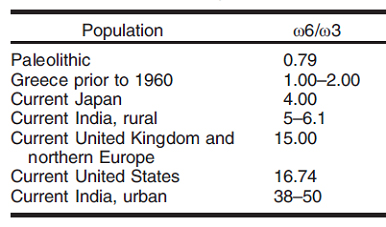
Table 1. Omega-6:Omega-3 Ratios in Various
Populations
From the inception of the research program, an important focus was on the diet and its possible relationship to the etiology of coronary heart disease. The 5-y follow-up found favorable all-cause death rates in Greece, Japan and Italy compared with the other areas, as well as a lower incidence rate of coronary disease. The Seven Countries Study was designed to investigate relationships between diet and cardiovascular disease, primarily described in terms of the fatty acid composition of the diet.
The presentation will focus on the characteristics of the traditional diet of Greece before 1960 as exemplified by the diet of Crete. The diet of Crete or the traditional diet of Greece resembles the Paleolithic diet in terms of fiber, antioxidants, saturated fat, monounsaturated fat and the ratio of (n-6) to (n-3) fatty acids (Table 1). The Lyon Heart Study and subsequently the study of Singh et al. support the importance of having a diet consistent with human evolution. Western diets today deviate from the Paleolithic diet and are associated with high rates of cardiovascular disease, diabetes, obesity, cancer and mental health.

FIGURE 1 Hypothetical scheme of fat, fatty acid (n-6, n-3, trans and total) intake (as percentage of energy from fat) and intake of vitamins E and C (mg/d). Data were extrapolated from cross-sectional analyses of contemporary hunter-gatherer populations and from longitudinal observations and their putative changes during the preceding 100 y
Implementation of the diet of Crete
The Lyon Heart Study clearly showed that the diet of Crete can be adhered to over a period of 5 y. Figure 2 is the Greek Column Food Guide based on the diet of Crete. The visualization of this food guide in the form of a Greek column includes the concepts of genetic variation and nutrition and a balanced energy intake and energy expenditure; it is based on foods, not food groups. Although it excludes certain foods made with hydrogenated oils, it does not restrict the intake of naturally occurring foods. It also takes into consideration moderation, variety and proportionality.
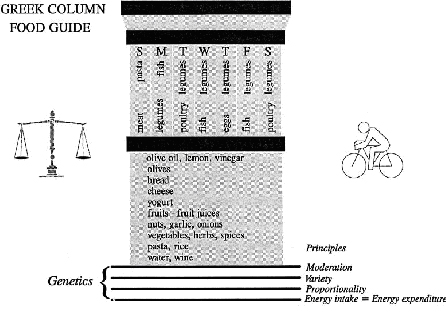
FIGURE 2 The Greek column food guide. The guide is based on genetic individuality; the principals of
moderation, variety, proportionality, and equality of energy intake with energy expenditure
Studies on the Paleolithic diet suggest that (n-3) fatty acids were present in practically all foods that humans ate and in equal amounts with (n-6) fatty acids. The depletion of the (n-3) fatty acids in Western diets is the result of agribusiness, modern agriculture and aquaculture. The high ratio of (n-6) to (n-3) fatty acids (16.74:1 instead of 1:1) is the result of excessive production of vegetable oils and the indiscriminate recommendation to substitute saturated fat and butter with oils high in (n-6) fatty acids to lower serum cholesterol levels without taking into consideration their adverse effect on overall human metabolism.
The results of the Seven Countries Studies and the Lyon Heart Study based on a modified diet of Crete indicate that a Paleolithic-type diet such as the traditional Greek diet balanced in (n-6) and (n-3) fatty acids and rich in vitamins C and E (fruits and vegetables) is associated with decreased rates of heart disease and cancer more so than any other diet or drug intervention. What appears to be so special about the Greek diet relative to the other Mediterranean diets is the content of bioprotective nutrients, specifically the following: 1) a more balanced intake of EFA from vegetable, animal and marine sources; a ratio of (n-6) to (n-3) fatty acids of ;2:1 instead of the 15:1 in Western and Northern Europe and 16.74:1 in the United States; and 2) a diet rich in antioxidants, i.e., high amounts of vitamin C, vitamin E, b-carotene, glutathione, resveratrol, selenium, phytoestrogens, folate, and other phytochemicals from green leafy vegetables; phenolic compounds from wine and olive oil; high intakes of tomatoes, onions, garlic and herbs, especially oregano, mint, rosemary, parsley and dill, which contain lycopene, allyl thiosulfinates, salicylates, carotenoids, indoles, monoterpenes, polyphenols, flavonoids and other phytochemicals used in cooking vegetables, meat and fish.
Such a dietary pattern has been shown to be beneficial to health because it is associated with a reduced risk of cardiovascular disease and cancer.
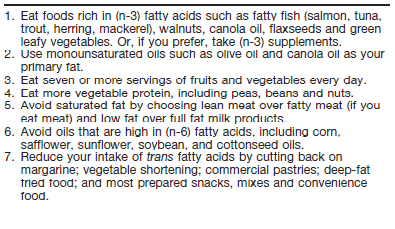
TABLE 2
The seven dietary guidelines of the Omega Diet
——————————————————-
1 Lecture delivered at the 10th
Dr. Demetrios Flessas Annual Commemorative Event
of the Hellenic Link, Ink. And the Hellenic Medical Society of New York, Archdiocesan Cathedral Cultural Center, April 15, 2010 at 7:00 p.m.
To view the PowerPoint presentation, entitled “Nutritive Basis of Positive Health,” employed by Dr. Simpopoulos at the above-referred lecture,