Bulletin No. 114
THE HELLENIC LINK, Inc.

Member Update- BULLETIN
|
Editorial Committee: Achilleas Adamantiades, Alex Economides, Christos Efthymiopoulos, Dean C. Lomis, Gerasimos Merianos, Panagiotis Siskos Contributing Editor: Evangelos Calamitsis Associate Editor: John Angelidis, Acting Editor: Costas Efthymiou No. 114, February, 2014 |
Representative Grace Meng Responds to Concerns of the Greek Community
We have received the following letter from the U.S. Representative of the 6th Congressional District, Ms. Grace Meng; we are pleased to bring it to the attention of our readers:
“Thank you for contacting me in regarding some issues of concern to the Hellenic community. I would like you to know that, as a Member of the House Foreign Affairs Committee and the Congressional Hellenic Caucus, I am a fervent supporter of the Greek-American community.
I support negotiations towards reunification of Cyprus. Any solution must protect the sovereignty of the Greek Cypriots, and must safeguard their human rights, and their ability to develop and transport energy resources in territory that belongs to them. I am also a sponsor of House Resolution 187, which asserts that the financial troubles in Cyprus must not be allowed to affect negotiations for reunification of the island.
As a Christian and a friend of the Hellenic community, I support religious freedom in Turkey, and I am worried about the growing threats to religious liberty. I have cosponsored H. Res.136, which urges Turkey to respect the rights and religious freedoms of the Ecumenical Patriarchate. I am also deeply concerned about the Greek Orthodox bishops who in April were kidnapped in Syria and are still missing. I have signed a letter to the State Department urging it make the bishops’ release a priority, and to work to protect Christians in Syria.
I will continue to focus on these important issues in Congress. Thank you for taking the time to share your views with me, and I hope you will continue to do so in the future.
Sincerely,

Congresswoman, Grace Meng
Grace Meng
Member of Congress “
An “Energy Revolution”
By Dr. Achilles G. Adamantiades
Introduction. In the last few years, the picture of the energy sector has been changing drastically, bringing about a reconsideration of all related issues: cost, security, environmental impacts, climate change, and even international relations. Because energy is a fundamental commodity affecting practically all aspects of life and our entire civilization, intense discussion has been generated on these issues and the debates are going on and will continue to occupy the press, think tanks, academic circles and discussions among common citizens.
Recent discoveries. Large amounts of fossil fuels, oil and natural gas, have been discovered in recent years in amounts unheard of in previous times. These discoveries are led by natural gas discovered and produced by new technologies in shale formations that are abundant in certain areas in the U.S. and overseas. The large Marcellus field (Figure 1), covering parts of New York State, Pennsylvania, West Virginia, Ohio, and Maryland has led this production while other deposits are being examined and prepared for production.
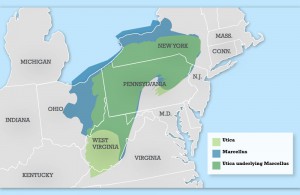
Source: http://marcelluscoalition.org
Figure 1. The Marcellus field – the highest- producing U.S. natural gas field with the new technologies (source: Noble Energy).
It has been reported that Texas, Colorado and other states possess large shale gas reserves. Total reserves in the U.S. have been estimated up to 1,500 tcf (trillion cubic feet) although only a fraction, perhaps one third, may be commercially exploitable. As a result of this feverish new development, shale gas has risen from a mere 2% of total gas production in 2000, to 44% in 2013; it is poised to go up to 70% of total in the next 25 years, according to some forecasts. The accelerating production has been stimulated by new technology, mainly by hydraulic fracturing, the so-called “fracking,” and horizontal drilling, along with several other technical developments in hardware and advanced software. Fracking is a technology that directs a high-pressure jet of sand, water and chemicals underground to crack open the formation and free oil and gas. Along with natural gas, U.S. domestic production of oil has also increased dramatically from “tight formations.” Total U.S oil production in 2013 was about 8 mill bbl a day, feeding a high percentage (42%) of consumption of about 19 mill bbl, lower than previous years, in great part due to strong conservation measures; it is on track to go to 10 mill bbl a day by 2016. It is reliably forecast that the U.S is poised, in the next few years, to overtake Saudi Arabia and Russia as the world’s leading crude oil producer. All this has changed the position of the U.S. in the world energy scene, positioning the country to become, in time, an energy exporter instead of being an importer of massive amounts of oil (up to 14 mill bbl a day), much of it from unsavory regimes, to the extent of two thirds of its consumption, only a few years ago. Facilities that were planned for importation of gas are now being converted for export!
Economic Effects. The large new discoveries of gas and rapid acceleration of domestic production have led to a steep drop in gas prices. After reaching a high of $14 per mill British thermal units (MMBtu) in the early 1990s (bringing about a political upheaval in the state of California), they fell to the range of $2-3/MMBtu in 2012 and were still in the range of $3-4/MMBTU in 2013, thus affording a large advantage to domestic residential and industrial gas consumers. It should be noted that prices of the same amount of gas in Europe, which relies to a great extent on Russian gas (on average 30-35%), have been much higher, in early 2013 in the range of $11-12/MMBtu and of liquefied natural gas (LNG), on which relies Japan almost entirely, has hovered around $16-17/MMBtu. Given the energy cost component in many products, it should not be surprising that several foreign firms, mostly European but also, surprisingly, Chinese, have been reported to be planning to move their production facilities to the U.S. in order to take advantage of low energy prices and maintain competitiveness.
Geopolitics. There are also enormous geopolitical implications in this “energy revolution” but the subject is too large and outside the scope of this short article. Suffice it to say that it should not escape anyone’s attention that there is a strong linkage between the oil and gas security that the U.S. and other countries constantly worry about and the manifold war activities (and cost in human life and funds) in the world, especially in the Persian Gulf and other places that are seen as mandatory in order to maintain a secure flow of oil from producers to consumers.
Effects on coal. Another effect of increased gas production and low prices has been a gradual shift of electricity production away from coal and toward gas. The reasons are several: many coal generating plants are becoming obsolete, unreliable, and expensive to maintain; many states have introduced the so-called Renewable Energy Standard requiring utilities to place in operation a certain percentage of their production in renewable energy forms; tightening environmental standards that make it expensive to install pollution control equipment, especially on old plants, and sheer economics that mitigate for retiring coal plants and substituting them with natural gas units. As a result of this large-scale shift, electricity production from coal dropped in the U.S. from almost 50% a few years back to about 38%, a substantial decrease, indeed.
Renewable energy (RE). A strong increase has been observed in the last decade in renewable energy for electricity generation, mainly wind and solar, with a current contribution of a few percent to the total electricity generation. The revolutionary aspect in this field has been a dramatic drop in the price of solar panel prices, owing to aggressive competition policies by China even to the extent of almost bankrupting its own solar panel industry. Prices of solar panels decreased dramatically from the range of $3.40 per kilowatt five years ago to an astonishing $0.80/kW, with the cost of completed installation about double this figure. Another important development has been the crisis in European countries with the high feed-in tariffs in Germany, and also in other countries of the EU, leading, currently, to a serious reevaluation of these high-subsidy policies that are not considered affordable (in Greece the Public Power Corporation has stopped honoring even signed contracts with private customers that produce power with photo-voltaic cells, claiming it simply cannot afford to pay private generators four times(!) the price it receives from selling its own power). In the U.S, Incentives in the form of production tax credit (PTC) for wind projects expired at the end of 2013 with no prospects of an extension – most economists consider such incentives a thing of the past and a loss of revenue that the government budget can ill afford. Coupling these developments to the low price of natural gas, renewable energy’s forward march appears as stunted, at least for a number of years, although development will continue in some form and in favorable locations, for example in utility operations in the south-west of the country.
Shale gas potential in other countries. The potential of shale gas has also arisen in many other countries although development has lagged that in the U.S. Deposits have been identified in Poland, Romania, France, Germany, the United Kingdom and Ukraine (Figure 2), as well as in Africa and South America.

Figure 2. States of fracking in Europe [Some of the nations (in boldface) where hydraulic fracturing is banned or a moratorium is in place].
It appears that, in Europe, only the UK is moving decisively toward exploration and production. Ukraine has large deposits and so does Russia but the latter has taken a rather lukewarm approach to the issue, probably because it does not wish to encourage a glutted international gas market that would reduce the price on which Russia depends heavily for its national budget. Nevertheless, Russia may embark on development of its enormous Bazhenov shale deposit in West Siberia and market it either as gas or liquefied natural gas (LNG). China has also large deposits of shale and is intent on exploring its potential and starting production to feed its rapidly developing and energy-hungry economy, not least to reduce its massive dependence on coal with large-scale deleterious effects on the environment, human health, and the economy itself. However, the rapid and effective development of the shale gas and oil industries in the U.S. is not likely to be replicated easily elsewhere because the U.S. possesses several unmatched advantages, namely: (i) availability of high technology and methodology; (ii) the existence of a strong industrial infrastructure; (iii) a vibrant private economy and a large number of small firms, ready to take risks for potential gain; (iv) a legal framework by which mineral rights belong to the land owner rather than to the state; (v) a strong regulatory regime with rigorous institutional provisions and advanced technical means to propose, introduce, monitor, and enforce compliance with regulations; and (vi) US had a fully developed pipeline infrastructure covering the whole country allowing new gas to reach the markets easily. For all these reasons, U.S. developments in this field are unlikely to be observed elsewhere in the world, at least not with the same speed, vigor, results, and efficiency.
Another major development in the field of hydrocarbons is the discovery of large deposits in the Eastern Mediterranean, namely in offshore fields of Israel and Cyprus (Figure 3) and, not far behind, in the Greek off-shore areas of the Ionian Sea and south of Crete.
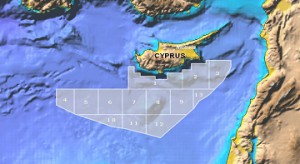
Figure 3. Exploration Lots within Cypriot EEZ
The exploration area is part of the Exclusive Economic Zone (EEZ) of the Republic of Cyprus and covers approximately 51,000 km2. It has been divided into 13 exploration blocks. The Aphrodite well is located in Lot 12. Exploration in additional lots has been contracted.
Vigorous exploration by Norwegian and French firms, followed by appraisals and production by U.S. firms, have led to confidence that the gas and oil deposits in this area are substantial and sufficient to fill not only these countries’ needs but also a good percentage of European demand. Proven gas reserves in Aphrodite (lot 12), the first off-shore field in Cyprus, are in the range of 5-9 tcf (trillion cubic feet) although additional reserves are speculated to total 60 tcf (or even 80 tcf according to unofficial estimates) in the southern lots, and higher if the entire off-shore area of the Republic of Cyprus is considered. Cyprus is pursuing further exploration in its southern off-shore Exclusive Economic Zone (EEZ) with French and Italian/Korean companies. Israel has made discoveries in several fields of its EEZ with a total proven resource amount of 28-30 tcf, especially in the very large Leviathan and Tamar deposits which have been estimated to contain 1.7 bill bbl of oil and 25 tcf of gas. The above amounts are certain to make both Cyprus and Israel net exporters of hydrocarbons. Furthermore, joint activities such as pipelines and liquefaction plants are being planned for the transportation of the produced hydrocarbons to European markets either as gas, through pipelines, or as LNG via tanker; this would apply downward pressure on the international gas price and reduce the cost for European consumers. Greece, although somewhat behind than the two countries above, is also pursuing exploration vigorously and is establishing cooperation with Israel and Cyprus for the same purpose. An LNG liquefaction and exporting facility is already being planned at a site near Vassilikos on its southern shore of Cyprus.
Environmental issues. As coal is the most polluting fuel, emitting a variety of noxious pollutants -any reduction in coal use is obviously beneficial environmentally. On sulfur and nitrogen oxides, a great deal of progress has been made over past decades in the U.S. owing to vigorous regulation, known as cap-an-trade, resulting in substantial improvement in air quality (dropping by 50% between 1980 and 2005 and by another 50% to 2012). Contrasted to that are environmental conditions in China, on which several reports have been published recently. Rapid economic development without due environmental controls has resulted in dire, almost “unlivable,” local conditions. China’s horrendous pollution has been detected to affect even air conditions in the West coast of the U.S., as reported recently. In order to improve the very poor quality of air, the Chinese government’s strategy includes increasing the number of nuclear plants, accelerating local and imported natural gas, and speeding the development of renewable energy. Similar measures are being taken to improve conditions in water and the soil. Many large cities in the world (Karachi, Mumbai, New Delhi, Kolkata, Jakarta, Mexico City and many others) suffer from similarly dire air-quality problems, which can be alleviated by an increasing introduction of natural gas in industry and transportation.
Fracking has become a hot environmental issue, provoking opposition not only by environmental organizations but also governments themselves (strong resistance is encountered in France, Germany and other European countries). It must be acknowledged that this technology contains the possibility of serious environmental impact, most importantly, contamination of water resources. In the U.S., the Environmental Protection Agency (EPA) has taken the problem seriously and is working on developing strong regulations regarding disclosure of the chemicals used, the methods of disposing contaminated water and minimizing methane (the most powerful greenhouse gas) leaks resulting from hydraulic fracturing operations. Strong methods and provisions for preventing such occurrences must be put in place if wide public acceptance is to be obtained. Although this work is still in progress, there is reasonable expectation that promulgating appropriate regulations as well as monitoring and strict enforcement will be instituted to guarantee the safety of drinking water and, more broadly, the integrity of the environment. Given the enormous advantages of new large quantities of natural gas produced domestically, the U.S. government cannot afford to ignore the potential of the new technology and environmental groups need to confine their activities to reasonable albeit vigorous intervention.
The other major environmental concern is the effect on climate change. Many objections center on the fact that natural gas (mostly CH4) contains carbon and, hence, its combustion causes the emission of carbon dioxide which is the major contributor to global warming. Since gas used in power generation emits about one half (0.45 kg) the amount of CO2 emitted by coal (about 1 kg ) per kilowatt-hour generated (plus, causes a substantial reduction in many other air pollutants), it is clear that substitution of gas for coal marks a large improvement to the environment and to the issue of global warming. Owing to a combination of factors, including the economic downturn, improved energy efficiency, and the expansion of clean energy sources, including natural gas and renewables, greenhouse gas emissions (GHG) in the U.S. were reduced by 6.5% in the period 2005 to 2011 (although in 2013 they increased by 2%). The present U.S. administration has set a goal of 17% reduction in GHG emissions by 2020 compared to 2005 levels. This will require additional regulation, for example, by regulating existing power plants.
The increased requirement for automobile efficiency (introduced in August 2012 for passenger cars and light trucks) from about 29 mi/gal in 2012 to 54.5 mi/gal in 2025, when the new rules will become fully effective, will go a long way in fulfilling this goal. The rules are expected to reduce auto fuel consumption by 40 to 50 % with a commensurate reduction in greenhouse gas emissions. In general, they are expected to yield multiple benefits: reduced dependence on foreign oil, fewer greenhouse gas emissions, consumer savings at the pump, and a more competitive auto industry. More efficient cars have already started to make a substantial difference in oil demand and price.
Meeting the 17% emissions reduction goal will be only a first step in the process. But leadership shown actually in the field, rather than in words uttered in conferences, will be a strong argument vis-a vis other large countries like China and India in convincing them that it will be to their advantage to go along with measures to reduce emissions and stabilize temperature rise to 2o Celcius, which is considered a “must” goal if large, disruptive, and unmanageable climate effects are to be avoided. Eventually, of course, carbon into the atmosphere will need to be reduced to zero net emissions if the increase of CO2 content in the atmosphere is to stabilize. Therefore, gas can be seen as a good transition fuel that will contribute a great deal to emissions reduction and allow time for new technologies to emerge or for existing technologies and their cost to be drastically improved.
The role of nuclear power. A few years ago, nuclear power was poised for a strong renaissance, spurred by increasing power demand, evolutionary, passive designs that afford greater safety, and the capacity to provide power without greenhouse emissions. However, this foreseen renaissance has foundered, basically, for three reasons: the Fukushima accident, decreasing prices of natural gas, and continued high costs and delays in nuclear unit construction. Out of about 24 new units expected to apply for construction and operation licenses in the U.S., only four materialized and are proceeding with construction. Nuclear is, however, having strong prospects in China, India, Russia, and several other countries (Belarus, Romania, Turkey, United Arab Emirates, Saudi Arabia, Korea, Brazil, Pakistan) where planning and construction activity has picked up dramatically. In Europe, whereas Germany has decided to retire all nuclear power by the year 2022, the UK is moving ahead with the planning of new units to replace old ones that are for retirement. In the U.S., work has shifted to the development of new designs of small, modular reactors (SMR). These have, on paper at least, several advantages: inherent safety, underground installation, manufacturing at the factory followed by transportation and installation on-site, modularity and, hence, suitability for incremental addition as demand increases, long operation without refueling, and proliferation resistance. These advantages, plus their small size, will make them suitable for installation in many countries whose electric systems are small and cannot accommodate the large units that have been predominant up to now. Although these designs have yet to be subjected to regulatory scrutiny, they hold considerable promise, and can play a significant role in combating climate change as this issue becomes more pressing in future years. Here again, the U.S. may play a major role in the development of the next generation of nuclear power technology. Financial support for such development has already been awarded by the U.S. Department or Energy.
Conclusion. There can be no doubt that the energy scene around the world and especially in the U.S. has changed dramatically and continues to change – it is not an exaggeration to call it an “energy revolution” which is working much to the advantage of the U.S. Economic effects have already started to become evident and will, in all probability, affect the world economy and international relations. Some of these developments are taking place in the Eastern Mediterranean, which is a region of great interest to many readers. Eventual effects will depend not only on actions but also on omissions such as failing to take measures against corruption and environmental degradation. Heraclitus stated, almost two and one half millennia ago, that “everything is in flux” («τα πάντα ρεί»). Although it is impossible to forecast with any accuracy future developments, one should expect drastic and, possibly unexpected, changes to occur. Those countries and societies that are prepared to face them with the correct attitudes of foresight, scientific knowledge and objectivity, the rule of law, social equity, fairness, and transparency will do well whereas those without these principles will fare poorly. Equipped with the right attitudes, such changes can be handled successfully and to great advantage.
———————————————-
Dr. Achilles G. Adamantiades is a retired academic and researcher and former Principal Engineer at the World Bank. He is a member of the Editorial Committee of the Hellenic Link’s Bulletin. ———————————————- Φαίνεται τώρα ότι είναι ζήτημα χρόνου η Ελλάδα να βρεθεί στη δίνη της “Ενεργειακής Επανάστασης”, την οποίαν ο συνεργάτης μας Δρ. Αχιλλέας Αδαμαντιάδης ανάγλυφα παρουσιάζει στο τεύχος αυτό. Από το άρθρο του Θοδωρή Γεωργακοπούλου στις “Απόψεις” της Εφημερίδας ΚΑΘΗΜΕΡΙΝΗ που ακολουθεί, με ανησυχία υποστηρίζεται ότι η προσδοκία του πετρελαϊκού πλούτου σαν “από μηχανής θεού” να φέρει τη κάθαρση στην τραγωδία της κοινωνικο-οικονομικής κρίσης στην Ελλάδα δεν είναι άμοιρη σοβαρού προβληματισμού. Ο φόβος επικράτησης καθεστώτος γενικευμένης ηθικής διαφθοράς λόγω νεοπλουτισμού, πολύ μεγαλύτερης διάστασης από αυτήν που καθημερινά αποκαλύπτουν οικονομικοί και δικαστικοί έλεγχοι, δημιουργεί αρνητική προδιάθεση για την πολυπόθητη εξέλιξη που όλοι περιμένουν να φέρει ριζική ανάκαμψη στην οικονομία και το φρόνημα των Ελλήνων. Ο αρθρογράφος θέλησε ίσως να αγνοήσει ιστορικά παραδείγματα χρηστής διοίκησης και ισορροπημένης διακυβέρνησης, που η Ελλάδα εγνώρισε στο παρελθόν: στην επίλυση οξέων κοινωνικο-οικονομικών συγκρούσεων, π.χ., από τον Αρχοντα της Αθήνας Σόλωνα στην αρχαία εποχή, και στην συνετή διακυβέρνηση και διαχείριση κρατικού πλούτου του Βυζαντίου, που εξασφάλισε χιλιετή επιβίωση της Αυτοκρατορίας, σε πιο πρόσφατους χρόνους. Η αρνητική άποψη που εκφράζεται στο άρθρο, καθ’ όλα ρεαλιστική βέβαια με τα σημερινά δεδομένα, κρούει κώδωνα κινδύνου και πρέπει να συνεγείρει τούς Ελληνες να μη χάσουν ανεπιστρεπτεί την ευκαιρία που μπορεί να δώσει η ενεργειακή επανάσταση στην Ελλάδα, να ευημερήσει με την ατομική , κοινωνική, και πολιτειακή εξυγίανση που προσφέρουν οι ακατάλυτες αξίες του πολιτισμού μας, αρκεί με στοχευμένη φροντίδα να επιζητήσουμε να τις ζήσουμε και εφαρμόσουμε. Με την προϋπόθεση αυτή, οι ενδοιασμοί του άρθρου θα αποδειχθούν αβάσιμοι και η αναγκαία ανακάλυψη και εκμετάλλευση υδρογονανθράκων στην Ελλάδα θα αποβεί πράγματι θεϊκή ευλογία για τη χώρα. CJE
Γιατί δεν πρέπει να βρούμε πετρέλαιο στην Ελλάδα
ΠΟΛΙΤΙΚΗ 17.01.2014
Καθώς η ελληνική κυβέρνηση, τώρα, στις αλκυονίδες του 4ου Μ.Π. χρόνου (Μετά Πτώχευσης) προσπαθεί να σφυρηλατήσει μιαν αφήγηση ελπίδας και αναζωογόνησης, έχει ενδιαφέρον να ρίξουμε μια ματιά σε έναν από τους κινδύνους που ελλοχεύουν στα αμέσως επόμενα χρόνια, οι οποίοι είναι πολλοί και περιλαμβάνουν και το ενδεχόμενο οι πολίτες όντως να πιστέψουν την αφήγηση που τώρα, στις αλκυονίδες του 4ου Μ.Π. χρόνου, προσπαθεί να σφυρηλατήσει η κυβέρνηση.
Ο κίνδυνος για τον οποίο θέλω να γράψω είναι ο εξής:
Το ενδεχόμενο να εντοπιστούν στην Ελλάδα μεγάλα και εκμεταλλεύσιμα κοιτάσματα πετρελαίου ή φυσικού αερίου.
Πολλοί προσβλέπουν στο ενδεχόμενο αυτό με λαχτάρα, σαν να κάθεται η χώρα πάνω σε μια θάλασσα από χρήμα που, αν την εκμεταλλευτεί, θα εξασφαλίσει εύκολη ευμάρεια στον λαό για παντοτινά, πράγμα που είναι ο πυρήνας του Greek Dream άλλωστε.
Η παγκόσμια πραγματικότητα, δυστυχώς, λέει άλλα.
Υπάρχουν αυτή τη στιγμή 24 χώρες στον κόσμο που στηρίζουν την οικονομία τους στην ενέργεια (άνω του 60% των εξαγωγών τους είναι πετρέλαιο ή φυσικό αέριο). Από αυτές, οι 23 δεν είναι Δημοκρατίες. Είναι καλά τεκμηριωμένο το φαινόμενο πια, έχει και όνομα: «Resource curse». «Η κατάρα των πόρων». Οι χώρες που έχουν φυσικό πλούτο τείνουν να κυβερνώνται από αυταρχικά καθεστώτα και οι λαοί τους στερούνται βασικών ελευθεριών.
Υπάρχουν διάφοροι λόγοι γι’ αυτό, παραδόξως καθόλου πολιτισμικοί, αλλά αμιγώς οικονομικοί: μια εξωγενής πηγή πλούτου που ελέγχεται εξ ολοκλήρου από το κράτος είναι αυτονόητη γεννήτρια διαφθοράς. Ο πυρήνας της οικονομικής δραστηριότητας στρεβλώνεται, στρέφεται από την παραγωγή αγαθών και υπηρεσιών στη νομή των εσόδων από τις εξαγωγές του φυσικού πλούτου. Η κρατική εξουσία γιγαντώνεται, η ισχύς της πολλαπλασιάζεται και, καθώς ο προϋπολογισμός του κράτους παύει να εξαρτάται από τη φορολογία του λαού, οι πολίτες απομακρύνονται από την κυβέρνησή τους και η λογοδοσία αποδυναμώνεται. Χώρες που ήταν ανελεύθερες όταν ανακάλυψαν πετρέλαιο στο υπέδαφός τους δεν έχουν πάψει να είναι ανελεύθερες, και κατά κανόνα έγιναν πιο διεφθαρμένες.
Οπότε τι σημαίνει αυτό για μια χώρα όπως η Ελλάδα;
Για να μελετήσουμε το σενάριο και να αξιολογήσουμε τις πιθανότητες, μπορούμε να κοιτάξουμε το παράδειγμα της μιας χώρας που στηρίζει τις εξαγωγές της στο πετρέλαιο και το φυσικό αέριο και δεν είναι χούντα: Της Νορβηγίας.
Η Νορβηγία είναι ανάμεσα στις πλουσιότερες χώρες του κόσμου, και ταυτόχρονα μια από τις περισσότερο δημοκρατικές. Η κρίσιμη διαφορά της με τις υπόλοιπες 23 αμιγώς πετρελαιοπαραγωγούς χώρες είναι πως, όταν ανακαλύφθηκε πετρέλαιο στο υπέδαφός της, ήταν ήδη πλούσια, και είχε ήδη μια βαθιά δημοκρατική παράδοση 70 χρόνων.
Η Ελλάδα, θα μπορούσε να πει κανείς, έχει μια δημοκρατική παράδοση 40 χρόνων. Και ανήκει και στην Ευρωπαϊκή Ενωση, έναν από τους σημαντικότερους θεματοφύλακες της Δημοκρατίας στον κόσμο. Και είναι -ακόμα και σήμερα, σε σχέση με τον υπόλοιπο πλανήτη- σχετικά πλούσια. Ενα ξαφνικό δωράκι στο ΑΕΠ από τα έγκατα της γης θα μπορούσε να της λύσει πολλά προβλήματα.
Η Ελλάδα, όμως, δεν είναι Νορβηγία. Η Δημοκρατία της, όπως έγραψα την προηγούμενη εβδομάδα, είναι μεν καθιερωμένη, αλλά ακόμα ευάλωτη. Είναι η πιο διεφθαρμένη χώρα της Ευρωπαϊκής Ενωσης. Σύμφωνα με την ετήσια έκθεση του Fund For Peace, που δημοσιεύτηκε την προηγούμενη Τρίτη, η Ελλάδα είναι το 138ο «πιο αποτυχημένο» κράτος σε μια λίστα 178 κρατών που κατατάσσονται ανάλογα με το πόσο «failed states» είναι, και άρα τοποθετείται πιο ψηλά (και άρα είναι πιο «αποτυχημένη») από χώρες λιγότερο δημοκρατικές όπως η Ουγγαρία, το Κατάρ και η Σιγκαπούρη (η Νορβηγία σ’ αυτή τη λίστα είναι 3η από το τέλος). Αν στην Ελλάδα βρισκόταν πετρέλαιο, κι αν το ήδη γιγάντιο και διεφθαρμένο κράτος αποκτούσε έναν αναπάντεχο μποναμά προς διανομή, ποιος θα καλούνταν να το διαχειριστεί;
Το -δημοκρατικά εκλεγμένο- ελληνικό πολιτικό προσωπικό, οι Λιάπηδες κι οι Τσοχατζόπουλοι και οι υπόλοιποι, οι σημερινοί και οι παλαιότεροι, έχοντας να διαχειριστούν μια οικονομία μεγέθους ταπεινού, κατάφεραν να την κάνουν την πιο διεφθαρμένη ανάμεσα στις άλλες δυτικές Δημοκρατίες, και τελικά να την πτωχεύσουν. Αν το πολιτικό προσωπικό που διαμορφώνεται σήμερα -τους βλέπετε, τους ψηφίζετε- αποκτήσει στη διάθεσή του μια οικονομία μεγέθους μεγαλύτερου, τι πιστεύετε ότι θα την κάνουν;
Δεν ξέρω αν η ίδια η Ελληνική Δημοκρατία θα κινδύνευε αν βρισκόταν πετρέλαιο στην Ελλάδα. Ωστόσο, το σενάριο ενός ακόμα πιο γιγάντιου κράτους-πατερούλη που θα χάριζε άκοπο πλούτο στην ελίτ και στους εξαρτημένους ψηφοφόρους/πελάτες θα ήταν το πιθανότερο. Αυτό το δωράκι της φύσης θα γινόταν δεκανίκι για τη διαιώνιση της διαφθοράς και της πελατειακής δημοκρατίας ετούτης της χώρας και σε ένα μέλλον χωρίς μνημόνια – κάτι που, απ’ ό,τι φαίνεται, είναι και για πάρα πολλούς ψηφοφόρους το ζητούμενο.
—————————————————-
On-Line Course in Modern Greek Offered Free
In cooperation with the Institute for Language and Speech Processing (ILSP)/“Athena” Research Center, the Hellenic Link, Inc. is offering as a service to the community a series of Greek language lessons on its Web site: http://www.helleniclink.org ( on a 24/7 schedule)
On the home page of the site, upper left corner, click on “Learning Greek,” to be introduced to a series of fifteen lessons of the philoglossia+ courseware.
Please inform anyone who would be interested in learning Greek of this service.
THE HELLENIC LINK, Inc.
A NON PROFIT CULTURAL AND SCIENTIFIC ASSOCIATION
OF HELLENES AND PHILHELLENES
INCORPORATED IN DELAWARE
Suite No. 278, 38-11 Ditmars Blvd, Astoria, New York 11105
Web Site: http://www.helleniclink.org Email: info@helleniclink.org
Contact Telephone: (718) 217- 0430
Forthcoming Lecture of Literary and Cultural Interest Sponsored by “Prometheus”
Below, we bring to the attention of members and friends of the Hellenic Link in the new York area an invitation to an important Lecture having strong environmental connotations; the Lecture is organized by the Greek Teachers Association “Prometheus” and is to be given by Dr. Thanasis Maskaleris, Professor Emeritus of Comparative Literature and Creative Writing at San Francisco State University. We remind our readers the recent contribution by Professor Maskaleris of a related article to the HL Bulletin(No. 112, December 2013). We warmly recommend attendance of this culturally uplifting literary event.
Greek Teachers Association << Prometheus >>
P.O. Box5852, Woosley Station, L.I.C., N.Y. 11105
Website: www.greekteachersprometheus.org
Tel.: 201-768-0161—E-mail: Dtrianta@aol.com
Special Invitation
February 4, 2014
Serial No. 1941
Dear Mr. President:
The Greek Teachers Association << Prometheus>>, founded in 1975, cordially invites you and all the Board members of your society, to attend an inspiring and provocative lecture on the best internationally known Greek writer, Nikos Kazantzakis, on Sunday, March 2, at 4:00 p.m. at the Hellenic Cultural Center of the Archdiocese at 27-09 , Crescent Street, Astoria.
Lecture: << The humanistic spirit in the works of Nikos Kazantzakis >>
Speaker: Dr. Thanasis Maskaleris, Professor of Comparative and Modern Greek Literature , Founding Director of the Greek Studies Center/Kazantzakis Seat, at the San Francisco University in California
At the end of the lecture, we will present his book
<< The Terrestrial Gospel of Kazantzakis: Will the Humans Be Saviors of the Earth?>>
The program will also include an exhibit of Greek Books, for young and adults, sponsored by the Hellenic Books Club of the Livanis Company, as well as a musical and dance component. The program will close with a reception at the Library of the Center.
Your presence will be appreciated. If you decide to honor us, please call the president, Prof. Demosthenes Triantafillou, who will reserve your seats. We like to reserve seats for Presidents of different societies and for special guests.
Respectfully,
Prof. Demosthenes Triantafillou
President, 201-768-0161
Eleftheria Oikouta, Vice President, in charge of Cultural Programs