Bulletin No. 113
THE HELLENIC LINK, Inc.

Member Update- BULLETIN
|
Editorial Committee: Achilleas Adamantiades, Alex Economides, Christos Efthymiopoulos, Dean C. Lomis, Gerasimos Merianos, Panagiotis Siskos Contributing Editor: Evangelos Calamitsis Associate Editor: John Angelidis, Acting Editor: Costas Efthymiou No. 113, January, 2014 |
The Editorial Committee of the Bulletin is wishing to its readers a Healthy and Blessed in every way
New Year!
This Bulletin issue is dedicated to GREEK LETTERS and to the Service of their needs in North America
GREEK LANGUAGE SUMMER STUDY IN GREECE
Dean C. Lomis, Ph.D. *
The Hellenic Link, Inc. initiative of several years for teaching of the Modern Greek language in American high schools is a noble, though herculean task to achieve. Even as the effort is gaining ground, the end result is still in the distance.
The need for teachers of Modern Greek language, and Hellenic studies, is of major importance, but dependence upon Greece to provide them is not something that can or should be relied upon exclusively, though not for any negative reasons.
Preparation of teachers for Modern Greek language and Hellenic studies is viable through the established system of the Richard Stockton College of New Jersey Greek Studies Program. Perhaps the major defect is that with approval of Modern Greek to be taught in American high schools, the possibility might be that only very few secondary schools might accept it, primarily of course due to financial reasons.
At the present time, Greek language learning in our communities is almost exclusively at the afternoon schools of the local Greek Orthodox churches. However, these offerings serve few pupils, the limited number due to several reasons, including distance. The Greek American households are no longer based in Greek American communities near the churches.
The major centers for Greek language teaching, and learning, are now the “charter schools” which, unfortunately, are very few. This leaves the bulk of Greek studies opportunities to some 85 colleges and universities that have some Greek offerings from just basic language to several courses. However, not every Greek American attends these limited higher education institutions out of about 3,500.
We are now proceeding beyond the third generation of Americans of Hellenic descent, and the connection of heritage begins to fade. A recent survey revealed that 60% of Greek American college graduates do not return to the Greek American communities. It is obvious, therefore, that while we are preparing for Greek language programs to be instituted in our American high schools — albeit with several apparent difficulties on the path notwithstanding, we must look elsewhere also for yet an additional path before the third and fourth generations distance themselves beyond salvation.
Under current higher education requirements, college students must complete two years of a foreign language course. For many, if not for most high school graduates – including Greek Americans, this is not usually a favorite subject. Disinterest in struggling to complete the course while concentrating on their major field of study is considered a heavy burden, which they undertake reluctantly, and in far too many cases with limited results other than fulfilling the dreaded requirement.
There may be a better way of fulfilling the college foreign language requirement, and with positive attitude and vigor.
The Hellenic Link has ‘links’ with higher education institutions in Greece. With appropriate contacts, a summer program of Greek as a foreign language may be instituted for “Elementary Modern Greek” and for “Intermediate Modern Greek” courses to be offered, each for six college credits. This can be accomplished with daily 2-hour classes each for 6 week, receiving 3 college credits, or with daily 4-hour classes in two three-week sessions, receiving 6 college credits. Attendance in two summer sessions will complete the U.S. college requirement.
However, let us examine the EXTRA advantages students will obtain. They will learn Greek from a native source; they will not be forced into a difficult situation of ‘competing’ with their other college courses; they will be gaining a study-abroad experience; they will be learning about Greece; they will be immersed into the Greek society and culture; they will enjoy a summer in beautiful Greece; they will make new friends, both among their Greek American fellow students and fellow Greek compatriots with whom they will associate and befriend; they will ‘sense’ their Greek heritage and identity; and so very many more that one may imagine. And, ultimately, they will be able to transfer their accumulated credits to the U.S. tertiary institution of their attendance, immediately satisfying the foreign language requirement. An additional positive element is the fact that their academic grade point average will not be affected, since credits transferred from another tertiary institution are accepted directly, whereas grades are not incorporated into academic records.
Selection of a Greek university to establish a Greek language summer program must be considered carefully in a manner that will provide to the students the greatest possible exposure to the entire country. Despite its outstanding record of long-standing in Greek as a foreign language, the Aristotelian University of Thessaloniki, along with the University of Ioannina, the University of Crete, and whatever others are available away from a centralized location for easy access to the students, should not be readily considered. Certainly Athens is the most centralized location, but due to the hugeness of the city, its several problems of concern to many, especially parents, should not be a priority, although most certainly students will visit the famous capital perhaps several times over their six-weeks stay.
The University of Patra may be an institution that perhaps should be considered and examined. The campus itself is not inside the city of Patra, but some 9 kilometers – 10 minutes — away, in the small college-town of Rio, near the new bridge connecting Peloponnese with Central Greece. The campus is very nice, the buildings very good, the town friendly, and a long and beautiful beach nearby. Its location makes it ideal for easy access to Southern Greece — including Crete, to Athens, Northern Greece, the Ionian Islands, and even the Aegean.
Patra itself is a large city – the nation’s third, and easily accessible. There is a small but modern train that commutes between Rio and Patra every half hour for 1 Euro each way, although students ride free with their student identity card.
Of course, it is possible to establish a summer Greek language program at a U.S. college or university, and certainly the Richard Stockton College of New Jersey would be a sound one. However, the experience of being immersed in Greece for two summers – one at a time, cannot compare with being in the U.S. Also – and with due respect to the Richard Stockton College, or any other U.S. institution — study through their program, even if traveling to Greece, will be much costlier than attending a Greek university. In addition, U.S. colleges and universities sending students abroad prepare most everything for them, even planning their travels, taking away their initiative for individual responsibility and creativity.
Direct contact with the University of Patra through colleagues associated with the Hellenic Link should provide details and possibilities. But whatever the situation and whatever plans are to be made, the first “Elementary Modern Greek” course should be offered this coming summer of 2014. No matter how small the first class might be, it shall be beneficial for the planners and the educators who will have the opportunity to evaluate it while feasible, and make the appropriate adjustments for the larger classes of the future. In conclusion, a wait for yet another year will mean that yet another crop of young Greek Americans will lose out.
WE CAN NO LONGER AFFORD LOSSES!
——————————————–
*Dr. Dean Lomis is Professor of International Education, Emeritus, University of Delaware and a Member of the Advisory Council on Hellenic Education of the Hellenic Link, Inc.
A Letter to the Editor and Reply
To: info@helleniclink.org Dec 23, 2013
Dear Dr. Efthymiou:
What a great revelation reading your Bulletin No.112 which was sent to me by a friend associated with the Hellenic Link! It revived my memory when I went to the chairman of the Philosophy Department of New York University, many years ago, and I submitted my Ph.D. dissertation topic<< The concept of freedom in the writings of Nick Kazantzakis>>. The chairman’s disappointing answer was that << With this dissertation you are not going to be able to get a teaching position in any University>>. That of course turned me off, but the flame and passion for Kazantzakis are indelibly kept in my heart and mind.
My name is Demosthenes Triantafillou, President of the Greek Teachers Association << Prometheus>> in New York City. I was elected its President last November. We would like to invite the author of the article on Kazantzakis, Dr. Thanasis Maskaleris, to give a presentation on the same topic in New York. The event will be sponsored by the Greek Teachers Association << Prometheus>>, the oldest Greek Teachers Organization founded in 1975, for the celebration of the Greek Letters Day and Three Hierarchs possibly the second Sunday of February.. If you could help us contact Dr. Maskaleris, we would appreciate it.
I am a Ph.D. candidate in Philosophy at this time. I received both my B.A. and M.A. in Philisophy from New York University. My M.A. Thesis was << The concept of truth in Greek thinking from Homer to Aristotle>>. If you think we can be of any help to you and the Hellenic Link, feel free to contact us.
On behalf of the Board of << Prometheus>>, I wish you and all the members of the Hellenic Link << Kala Xristougenna kai to Neo Etos 2014 plires ygeia, xara kai proodo!>>.
Demosthenes Triantafillou
To this letter the President of The Hellenic Link, Inc. and Acting Editor of the Bulletin replied as follows:
Dear Mr. Triantafillou:
I am very pleased to learn from your message that the last issue of our Bulletin, focused on Nikos Kazantzakis’ deep concern for the survival of the environment, struck an inner chord attuned to the legacy of the great Hellene writer.
I wish to congratulate you on your recent election as President of “Prometheus” and at the same time express the wish and hope that with your leadership Prometheus will attain new high feat-levels in the realm of Hellenic Education.
Indeed, it is a great idea to invite Professor Thanasis Maskaleris to New York as Theme Speaker for the Annual Celebration of Greek Letters and of Three Hierarchs Day. (We have sent the e-mail address of Dr.
Maskaleris).
I and my colleagues in the “Hellenic Link” appreciate greatly your suggestion of collaborating in the scope and context of our educational activities. In this respect, for your information, I attach the Mission Statement of the Advisory Council on Hellenic Education of our Association. Soon, I will follow with suggestions aimed at an effective collaboration.
With best wishes for the New Year,
Costas Efthymiou, Ph.D.
From the Creative Work of Our Colleagues: Two Books Steeped in the Quintessence of
Greek Culture:
Sing In Me, Muse, and Through Me Tell the Story:
Greek Culture Performed
By Maria Hnaraki
Sing In Me, Muse, and Through Me Tell the Story: Greek Culture Performed is a collection of ethnographic essays that meditate on Greece through the looking glass method. The book investigates how ancient mythologies shape modern identities at the crossroads of East and West, while it also provides an ample description, both broad and deep, of various aspects and incarnations of Greek folklore performance, such as song, literature, music and dance.
In an era of globalization, Greeks insist upon going local by proudly celebrating their multifaceted past as they carry it into a turbulent present. From the time of Homer to contemporary forms of resistance, the poetics of Greekness provide an excellent ground for investigating the ecology of expressive behaviors that may inhabit any mountain or plain. When Greeks, for instance, sing the olive tree and speak without words through music and dance, performance becomes a means of dialogue and communication that raises ecological awareness of one’s place by also creating a strong sense of belonging. In a part of the world where life revolves around the centripetal idea of freedom in opposition to any form of tyranny, a community is willing to be sacrificed for a slice of bread. As the Greek future is predicated upon a stubbornly unfinished past, ultimately, one is at the same time exalted and despondent, grounded and soaring, rationale and passionate — elements in counterbalance that define the very essence of being Greek.
All in all, being Greek in the 21st century offers fertile territory for re-discovering the fundamental nature of life by actually experiencing Greece’s truly rich, “baked” realities that have been so much stigmatized as being in “crisis.” By building bridges and understanding the wealth and uniqueness of Greek culture, the clues to our own identities may unfold, albeit via labyrinthian pathways, capable of leading us to a catharsis, by realizing that, after all, nothing in our cosmos is … Greek.
Maria Hnaraki, the Author of the Book is
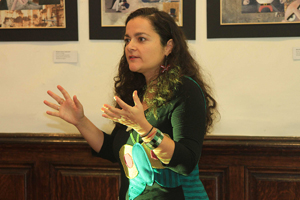
Photo by Eleftherios Kostans--Cosmos Philly
a professor of anthropology, folklore and ethnomusicology, and an accomplished scholar in the field. She has extensively researched cultural identity expressions, traditions and customs, such as music and dance events in the Mediterranean, as well as investigated topics in nissology (study of unique cultural, etc., characteristics of islands), experiential learning and hybrid educational environments. She favors investigating who people are and how they behave through the arts they create and the customs they observe, coming to the conclusion that “we are all amalgams of many influences and that the same things happen all over the world in different ways.”
Hnaraki holds a Diploma of Arts in Music Studies from the National and Kapodistrian University of Athens-Greece (1996), an M.A. in Folklore and Ethnomusicology (1999) and a Ph. D. in Folklore and Ethnomusicology from Indiana University in Bloomington (2002). Additionally, she has a Piano Soloist Diploma from the Hellenic Conservatory of Athens (1997) and degrees in Theory, Pedagogy and Music Education from the National Conservatory of Athens, while she has also received numerous awards, honors and fellowships.
Photo by Yiannis Bromirakis
Hnaraki is currently the Director of Greek Studies and an Associate Teaching Professor at Drexel University, Philadelphia. Her wide-ranging circle of activities include, among others, presentations in international conferences on several topics such as contemporary Greek society and its diasporas, cultural identities in the Mediterranean, learning pedagogy, cultural aspects of the Greek language, literature and the other arts, music and dance, publications of book reviews and articles in journals and periodicals, translations, instruction of folk songs and dances, co-organization and performance in music and dance ensembles, as well as coordination of various events such as lectures, concerts, theatrical performances, movie showings, and Mediterranean Diet symposia. Due to her almost inherited abilities in researching and using archives, she keeps enriching a patrilineal collection of audio-visual as well as written sources. Last, but not least, she constantly pursues collaborations with multiple organizations and significantly outreaches to innovative Greek businesses.
(data from: http://zorbapress.com/?page_id=1052
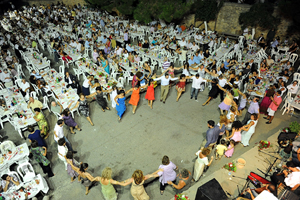
Photo by Yiannis Bromirakis
While at Cornell University, Hnaraki founded a study abroad program in Crete-Greece which she has been expanding and enriching since then. At Drexel University, she has created more than 30 university courses, several of which are unique in the USA, with the educational purpose of implementing an integral, holistic, interdisciplinary, academic approach to the Greek and Mediterranean reality.
Her 2007 book Cretan Music: Unraveling Ariadne’s Thread has received the “Young Academic Writer and Researcher” prize from the Pancretan Association. (data from: http://zorbapress.com/?page_id=1052
Published by Zorba Press
Paperback, 7x10inches, 308 pages
Nonfiction, Published October 2013
ISBN 978-0927379-16-8
Price $20
The Hellenic Link congratulates Dr. Maria Hnaraki for her scholarly achievement. At the same time, HL acknowledges with appreciation her positive response to its invitation to serve in the Task Force
for the development of National Standards for Teaching/Learning Modern Greek in U.S. schools; her cheerfully offered expertise was very valuable in advancing the development of the Standards. We sincerely wish her success and productive continuation of her pioneering research.
———————————————————————-
The Greeks Who Made Us Who We Are
By Michael A. Soupios
“Hellenic contributions to Western Civilization are acknowledged by all, but the details of their endowment are under-appreciated. This volume seeks to disclose two distinctive features of Western culture uniquely attributable to the ancient Greeks: a human-centered worldview that elevated humans to the threshold of divinity and a philosophical temperament which for the first time in history proffered the unbridled operation of the human mind as a kind of cultural imperative.
Eighteen seminal thinkers who left lasting impressions in such fields as ethics, medicine, religion, politics, poetry and art are examined in detail. The efforts of these individuals helped establish a unique cultural pedigree unlike any other in world history. They invested the West with that restless, intrepid habit of mind that remains the hallmark of Western civilization to this day.”
Excerpted from the Publisher’s (Mc Farland & Company, Inc) presentation on the book’s cover
The list of the eighteen geniuses-the theme of this volume- who impinged indelibly their thinking on the Greek psyche and the future of Europe and the World includes:
1. Homer: Founder of Western Humanism 2. Solon: Poet, Lawgiver, Statesman 3. Thales: Father of Western Science 4. Sappfo: Poet on Fire 5. Pythagoras: Mystic Mathematician 6.Parmenides: Father of Metaphysics and Logic 7.Themistocles: Savior of the Western World 8. Phidias: Lord of Western Aesthetics 9. Gorgias: Master of the Word 10. Socrates: Iconoclast and Moral Revolutionary 11.Thucydides: True Father of History 12. Plato: Fountainhead of Western Philosophy 13. Aristotle: Polymathic Genius 14. Alexander the Great: Disseminator of Greek Culture 15. Epicurus :Physicist and Ethician 16. Zeno: Stoic Sage 17. Galen: Physician, Scientist, Philosopher 18. Plotinus: Mystic Philosopher
The author of the book, Dr. Michael A. Soupios, is Professor of Political Philosophy, Department of Political Science, at the C.W. Post Campus of Long Island University (LIU). Dr. Soupios was born in the U.S.A., where for his educational preparation he followed a diverse course of study; he obtained eight academic degrees from six different academic institutions: BA in History from St. Lawrence University (1971), an M.S. in History Education from LIU (1973) and an M.A. in History, also from LIU. From LIU, he obtained another M.A. in Political Science (1976). His doctoral studies led to an Ed. D. in Administration – Higher Education from Columbia University (1976), a Ph.D. in Philosophical Studies (Education) from the State University of New York at Buffalo, a Ph.D. in Political Science (Theory) from Fordham University (1992), followed by an M.A. in Theology from the Seminary of the Immaculate Conception in Huntington, NY (1997) and a Doctorate in Ministry from the same Seminary (2004).
Earlier in his career, he has had administrative responsibilities: University Dean for Liberal Arts and Sciences (three years), Dean for Academic Planning and Evaluation (one year), Assistant Vice President for Academic Affairs (four years), Liaison to NY State Department of Education (eight years).
Dr. Soupios has presented papers in conferences and published articles in professional journals.
He has published 3 other books: “The Ten Golden Rules” (2009) (with P.Mourdoukoutas), printed in six languages – English, Spanish, Italian, Danish, Slovenian and Greek; “The Song of Hellas” (2004) and “European Political Theory” (1985) (Edited with Introduction); he has completed a manuscript for a forthcoming book “Greeks Bearing Gifts,” while currently he is working on a new project “Profiles of Power .”
Dr. Soupios has received numerous distinctions, which, inter alia, include: Nominee US Teacher of the Year Award (2008); Chancellor’s Award for Outstanding Service (2007); Nominee: Robert F. Cherry National Teaching Award (2007); Diaz Memorial Lecture Series in Classical Civilization – Designated Presenter in Perpetuity; Recipient of a Lecture Room Named in his honor (secured by student donations totaling $150,000); Newton Award for Teaching Excellence (LIU).
Dr. Soupios’ superior contributions as an academic teacher have been duly acknowledged as a matter of course and this fact is reaching now the community far beyond the University Campus.
The Hellenic Link congratulates him for his new contribution to the education of the country and the world with this book, which can be justifiably considered an excellent testimony for the implementation of the Objectives as well as for his productive membership in the Advisory Council on Hellenic Education of our Association. We express to him our deep appreciation.
The Greeks Who Made Us Who We Are
Eighteen Ancient Philosophers, Scientists, Poets and Others
By Michael A. Soupios
McFarland & Company, Inc., Publishers
Jefferson, North Carolina, and London
Soft cover, 6×9 inches, pages 239
Published in 2013
ISBN 978-0-7864-7273-4
Invitation to a Feast of Letters and Learning
Come Celebrate (invite others too!)
“Letters & Learning”
At Morris County Library
30 East Hanover Avenue, Whippany, NJ 07981
Saturday, January 18, 2014
1 pm-4:30 pm
1pm Children’s Program ~Alphabets around the World
1:45pm Community Café ~ ALL invited
2:30pm-4:30pm Café of Ideas featuring 3 topics:
1. Value of public libraries by Reference Librarian Amy Saloway
2. “Unwrapping Your Language Ability” by Professor James Hart, Asst. Chair, Languages and ESL, County College of Morris
3. “Service Language Learning at its Best” by Stella Economou (Norwalk Community College, CT), Maria Stamoolis (Metropolis of Pittsburgh, Greek Education Director), and Vasiliki Tsigas-Fotinis (Caldwell College/Kean University, NJ) a presentation recently offered during the American Council on the Teaching of Foreign Languages (ACTFL) Convention Orlando, FL~11/23/13
All in the Public Meeting Room of MCL
For more information & to RSVP: Vasiliki Tsigas-Fotinis, Ph.D. HEANJvasiliki@verizon.net
THE HELLENIC LINK, Inc.
A NON PROFIT CULTURAL AND SCIENTIFIC ASSOCIATION
OF HELLENES AND PHILHELLENES
INCORPORATED IN DELAWARE
Suite No. 278, 38-11 Ditmars Blvd, Astoria, New York 11105
Web Site: http://www.helleniclink.org Email: info@helleniclink.org
Contact Telephone: (718) 217- 0430